




RM80 million lost over abandoned buses
The government purchased 1294 public buses for RM93 million in 2003, only to turn them into scrap two years later.
The government had purchased 1294 public buses for RM93 million in 2003, only to turn them into scrap two years later.
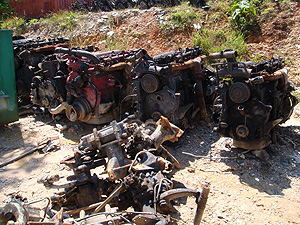 In the process Finance Ministry-owned Syarikat Prasarana Negara Berhad (SPNB) may have lost more than RM80 million by phasing out the buses in batches in 2005 and 2006 respectively.
The Public Accounts Committee (PAC) today visited a bus depot in Sungai Buaya where 774 of the 1139 decommissioned buses are stored to examine whether SPNB’s decision to get rid of the buses was valid.
The remaining 365 buses stored in a depot in Serendah have been already been scrapped.
The probe was undertaken after the National Audit Report (NAR) revealed that 459 (40.3 percent) of the 1,139 buses stored in Sungai Buaya and Serendah could be refurbished by either repairing engines or replacing accessories.
Too costly
However, according to SPNB, the buses that were about 10 and 15 years old during the period of acquisition were too costly to be repaired and refurbished. They were then replaced and disposed in stages beginning 2005.
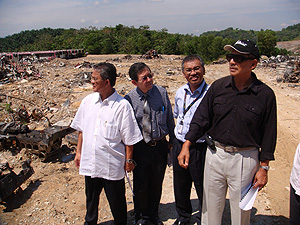 Speaking to reporters after examining the site, PAC chairperson Azmi Khalid
(wearing cap
) said that only 180 buses remain as most of them have been reduced to scrap metal and parts that were salvaged were sold.
Speaking to reporters after examining the site, PAC chairperson Azmi Khalid
(wearing cap
) said that only 180 buses remain as most of them have been reduced to scrap metal and parts that were salvaged were sold.
According to Azmi, SPNB had bought the buses from DRB-Hicom and Park May. The latter two companies continued operating the bus services until RapidKL took over.
Also with him on the site tour were other PAC members Tan Seng Giaw (DAP-Kepong), Tony Pua (DAP-Petaling Jaya Utara) and Hamim Samuri (BN-Ledang) as well as Kamaruddin Jaafar (PAS-Tumpat).
Only 10 buses in good condition
Azmi also said that the parts were currently being disposed off by TAF Resources, which won the tender for RM4.4 million and has currently submitted RM6.5 million to SPNB from the sale of the scraps.
“The buses were officially to be decommissioned in July 2008 but after professional evaluation the buses were categorised in three categories,” he said, when asked the reason for the early disposal.
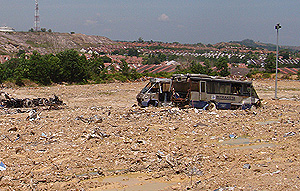 There were only 10 buses under Category A, or best condition, while the rest were categorised under Category B and C, he said.
The bulk of the buses (40.6 percent) were 12 years old. Another 27.65 percent were 14 years old and 20.56 percent 13 years old, as stated in the Raine & Horne evaluation in 2007.
Azmi explained that the average estimated value for each bus was RM60,000 but the cost for repairs and refurbishing was an average RM200,000.
“So it was a decision between RM60,000 and RM200,000,” he said.
Asked whether any evaluation was conducted prior to the purchase in 2003, Azmi said: “There must have been some evaluation... we don't know the rationale on how they concluded (on the disposal) but PAC will be deliberating it.”
According to a PAC member, the worn buses must either have been bought at inflated prices in 2003 or RapidKL did not want to manage old buses and therefore, decommissioned them.
Mockingly, he said the buses were likely deemed roadworthy if they could be driven 5km without breaking down.
The PAC is to meet tomorrow to discuss the matter in detail before coming to a decision.


Are you sure you want to delete this comment?
This action cannot be undone.