




City Hall flats 'not up to standard'
Deputy Federal Territories Minister M Saravanan has conceded that City Hall's low-cost flats do not provide tenants with conducive living because basic facilities are still lacking.
Deputy Federal Territories Minister M Saravanan has conceded that City Hall's low-cost flats do not provide tenants with conducive living because basic facilities are still lacking.
"The units need to be upgraded... (and) we are working on it with additional funding (from the ministry)," he told Malaysiakini .
"Without the basics, you can't have conducive living. With the additional allocation I think we will be able to tackle the issue. At this moment it is totally insufficient."
Most of the flats were constructed in the 1970s to accommodate urban squatters, who paid low rentals. However, the catch is that the majority of these units have just one bedroom.
In 2004, then Federal Territories Minister Mohd Isa Abdul Samad said City Hall would start converting these to two-bedroom units, but this was not done. New flats, however, have three bedrooms.
Among the ideas for upgrading the facilities is the inclusion of a community hall.
"Y
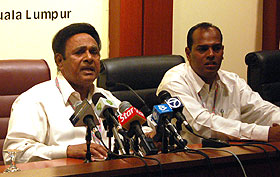 ou must have a proper place for last rites if somebody passes away. Muslims carry out their last rites within 24 hours... Indians might do so in two days and the Chinese might go beyond that," explained Saravanan (
right in photo
).
ou must have a proper place for last rites if somebody passes away. Muslims carry out their last rites within 24 hours... Indians might do so in two days and the Chinese might go beyond that," explained Saravanan (
right in photo
).
"You can't set up a tent in the public area for this. You need a special area."
Saravanan also pointed to the absence of places of worship for non-Muslims at low-cost flats.
"We have 23 (public) flats and none of these are equipped with places of worship for Hindus and the Chinese. Are we saying that they don't have to pray when they live in flats?
"I have submitted a proposal to the minister for a Hindu and Chinese temple to be built at 23 of the flats."
He explained that Indians and Chinese comprise more than 10 percent of the residents in most public housing areas. In some, they exceed 25 percent.
"The minister has agreed in principle that not only City Hall flats, but any housing development, should have places of worship for non-Muslims. We will start with City Hall flats."
Saravanan said the proposal has yet to be approved, but pledged to push for this to be realised and for similar facilities to be provided in upcoming public housing projects.
In its 2010 budget, City Hall was allocated RM2.12 billion to upgrade infrastructure and public facilities. Construction of the community halls in low-cost flats is expected to be financed through this allocation.
Units for sale
City Hall has offered 44,146 more low-cost units for sale since last year.
These should be able to accommodate all the squatters in KL if the numbers remain constant, City Hall Mayor Ahmad Fuad Ismail had said previously.
H
 e had also said that, to date, more than 80 percent of all squatters have been relocated except for those occupying private land.
"The core objective of all public housing in Kuala Lumpur is two-pronged. The policy was conceived first out of compassion and second out of aesthetics," he told the New Straits Times last December.
Several local authorities are working towards eradicating urban slums under a ‘zero squatter' policy.


Are you sure you want to delete this comment?
This action cannot be undone.