




Stop private wing in gov't hospitals
PKR vice-president Dr Lee Boon Chye has appealed to the government and the Health Ministry to review its policy of having private wings for specialists in government hospitals in its Full Paying Patient (FPP) scheme.
PKR vice-president Dr Lee Boon Chye has appealed to the government and the Health Ministry to review its policy of having private wings for specialists in government hospitals in its Full Paying Patient (FPP) scheme.
Lee, who is also chairman of the health and sciences bureau of PKR,said government hospitals and the country, are already facing a brain drain of specialists of up to 50 percent.
He contended that allowing specialists to set up private practice in government hospitals to serve the rich would deprive the poor of much-needed specialist care.
This would ultimately lead to differing standards of care for the wealthy and the poor. The Gopeng MP likened it to having ‘1Malaysia but two standards of healthcare’.
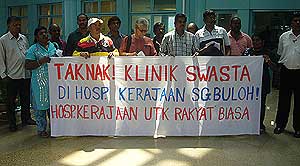 Yesterday, nationwide
protests
were organised by Coalition Against Health Service Privatisation at the Sungai Buloh
(left
), Serdang, Sultan Ismail and Sultanah Bahiyah hospitals.
Yesterday, nationwide
protests
were organised by Coalition Against Health Service Privatisation at the Sungai Buloh
(left
), Serdang, Sultan Ismail and Sultanah Bahiyah hospitals.
Kota Damansara assemblyperson Dr Mohd Nasir Hasim who led protests at the Sungai Buloh hospital had denounced the FPP scheme, which the government initiated in 2007.
According to Nasir, the FPP scheme pilot project in Hospital Selayang has proven detrimental to both doctors and patients.
"The specialists are keen on spending (time) and energy on treating private patients and neglect their responsibility to other patients who pay less. Some specialists are paid more through their involvement in FPP scheme," he alleged.
Prelude to further privatisation
Lee said the introduction of the private wing in government hospitals could be a prelude to further privatisation of health services.
 “The experience with the privatisation of drug supplies showed an escalation in cost when the 15-year drug supply concession was given to Renong then and now Pharmaniaga. During the concession period, the ministry's expenditure on drugs increased from RM149 million in 1995 to RM1.543 billion in 2008,” he said.
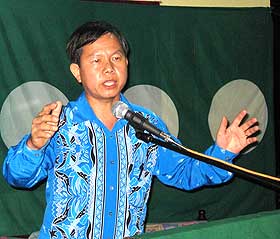
The Gopeng MP ( above ) said the expenditure on drugs represented an increase of more than ten-fold or an annual increment of 20 percent.
Lee said PKR recognises the need to retain specialists in the Health Ministry and he proposed the setting-up of a special service commission to help cater to the needs of government doctors.
He had made the proposal during the 2009 parliamentary debate on the 2010 budget.
“This will help arrest the brain drain from the private sector,” he said.
“To solve the immediate shortage, the Health Ministry should work hand-in-hand with private specialists to allow them to perform ‘national service’ by providing one session per week in government hospitals.”
This, he said, will go a long way in alleviating the shortage of specialists in government hospitals.


Are you sure you want to delete this comment?
This action cannot be undone.