




Sabah mulls water rationing if no rain by April
The Sabah state government has drawn up a water rationing contingency plan to be put into operation if the regular April showers don't appear next month.
The Sabah state government has drawn up a water rationing contingency plan to be put into operation if the regular April showers don't appear next month.
There has been no let up so far in the current dry spell which has persisted since late January.
Kota Kinabalu, for example, only recorded 0.4 mm of rain in February compared with 210 mm in Jan, according to the Malaysian Meteorological Department (MMD). Kudat recorded 4.0 mm (190 mm in January), Labuan 2.2 mm (284 mm) and Sandakan 7.0mm (308 mm).
Tawau bucked the trend with 37 mm (130 mm). However, one heavy downpour, highly unlikely in the current dry season, swears the MMD could change the reading for the entire month.
 Deputy Chief Minister Joseph Pairin Kitingan (
left
), however, rules out any need for immediate water rationing. Still, he plans to discuss the matter further with the Sabah Water Department (SWD).
Deputy Chief Minister Joseph Pairin Kitingan (
left
), however, rules out any need for immediate water rationing. Still, he plans to discuss the matter further with the Sabah Water Department (SWD).
"The Meteorological Department's says the current dry spell will last another two months, until the end of April," said Pairin who is also the State Infrastructure Development Minister. "We are hoping that it will be shorter."
He explained that there are different levels of dry spells and if the one being experienced contains intermittent rainfall, it would not be as bad as people could still store water.
"However a full month without intermittent rainfall would be difficult. The outbreaks of forest fires, sporadic or otherwise, would further strain water resources."
Cloudless skies
Maximum temperatures at all weather stations in the state are hovering just below 34 Celsius (C) which is unusually warm.
This is accentuated by cloudless skies, unusually weak winds, and little or no rain.
SWD Director Awang Mohd Tahir Mohd Talib sees the current situation, based on storage, as being on the safe side except for districts like Tawau with small rivers.
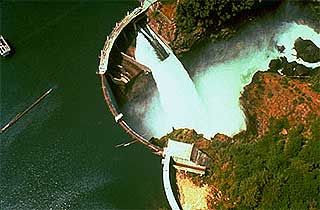 "In Kota Kinabalu, the Babagon and Talibong dams can last between two to three months," said Mohd Tahir. "We should have no problem in Sandakan in the short run."
To add insult to injury in Tawau, according to SWD sources in the east coast town, some of the pumps used to obtain supply from the Sungei Tawau were too old, poorly maintained or broken.
This has exacerbated the water shortage situation with the Sungei Tawau having almost dried up in the current dry spell.
SWD divisional engineer Teo Chee Kong gave the assurance that any water interruption would be kept to a minimum.
Contingency plan
He added that the water rationing contingency plan also includes the transportation of water to ease bottlenecks and sporadic shortages, manage the increasingly shrinking water storage and channel water resources to completely dry districts.
The SWD's benchmark is the 1998 El-Nino phenomenon when there was no rain for six months, according to Teo.
Sungei Moyog, for example, in the outskirts of Kota Kinabalu, had completely evaporated. But the completion of the Babagon Dam a year earlier saved the state capital from running completely dry.
Taking the state capital as an example, Teo sees no problem in ensuring enough water but only until mid-April and not the whole month which is expected to be dry. This means a critical two-week gap assuming it rains as usual in May.
Beyond mid-April, measures would kick into place to reduce production at the Babagon and Telibong reservoirs and water resources would need to be conserved.
The SWD sets the water demand for Kota Kinabalu including Penampang and Putatan, and the nearby Tuaran and Paper at approximately 380 million litres per day (mld).
The SWD's installed production capacity is a maximum 420 mld with its reservoirs in Babagon, Telibong and Kokopon.
Telibong-2 - maximum water storage 10,000 million litres of water covering 350 to 370 acres - can account for 100 days of production without refilling.
Telibong can compensate Babagon, according to SWD estimates, when the water at the latter reaches 86m. The marker has been falling 0.15m per day since Jan 21 when it was 130.51m.
The SWD, according to Teo, has carried out a simulation exercise to predict the various outcomes to prevent the water reserves in the Moyog and Kasigui rivers - total capacity 210 mld - from being completely drained.
"At the moment, we can still produce the amount of water needed especially in the state capital and there's no problem," reiterated Teo. "Our concern is beyond mid-April."


Are you sure you want to delete this comment?
This action cannot be undone.