




Pakatan leader slams gov't over economic woes
Opposition Leader Anwar Ibrahim today attacked the government over its handling of the economy, citing an over dependency on oil profits, pump priming measures and failing to curb a widening public-private investment gap.
Opposition Leader Anwar Ibrahim today attacked the government over its handling of the economy, citing an over dependency on oil profits, pump priming measures and failing to curb a widening public-private investment gap.
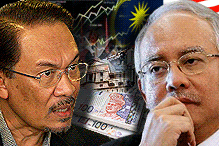 Anwar, initiating his speech on the royal address on a negative note, said the Prime Minister Najib Abdul Razak pronouncement that the “the worst is over” was misleading.
“While the economy began to grow again in the fourth quarter of 2009, relatively speaking Malaysia continues to fall behind in comparison to other countries in the region.
“This poses a serious question on the direction of the economy in the future vis-a-vis the efforts to bring the economy to a higher value chain,” said Anwar, during his three-hour speech.
He also pointed out that the government’s preoccupation turn Malaysian into a high-end economy might lead to the neglect other key economic issues such as poverty eradication.
Growing income gap
“Our efforts in eradicating poverty have had mixed results. According to United Nation's Human Development Report 2009, Malaysia ranks 66 in terms of economic inequality, measured by Gini coefficient.
“We are behind Singapore (ranked 23), Hong Kong (ranked 24), South Korea (ranked 26), Brunei (ranked 30) and Cuba (ranked 51), among others,” said Anwar.
Moreover, the Permatang Pauh MP said that between 2004 and 2007, Malaysia managed a meagre 37 percent reduction in poverty rate, which is stark difference to the 60 percent success rate in the early 90s.
“At the rate we are going, one wonders whether we will be able at all to eradicate poverty in the near future.
“If anything, it is a reminder of the gigantic reform and monumental shift in the management of the economy that is required, if Malaysia were to upgrade itself into a high-value economy and ensuring the prosperity is distributed equally to all groups and levels.
Public spending is not sustainable
Attacking the increase in government spending to restore the economy, Anwar said it is only a short-term measure, adding that the over-reliance on income from petroleum and gas can no longer support this.
“If we were to take into account income (in the form of taxes and duties) from other oil and gas companies in Malaysia, the country conservatively relies more than 50 percent of its income on non-renewable source.
“In the year of 2007 and 2008, Petronas contributed to 36.8 percent and 44.9 percent to the total government income for the year.
“And despite the bumper income from Petronas in 2007 and 2008, the government continued to spend lavishly and registered deficit budgets,” he said.
He also said that the “massive drop” in private investments could also halt efforts to move into an high-end economy.
“Furthermore, the pattern of public spending is not sustainable at the rate it is growing. Any attempt to re-model the economy must address the skewed nature of public-private investments,” he said.
FDI outflow
He cited the alarming outflow of capital investment which had reached 44 percent of the gross domestic production (GDP) at one point.
“Despite the alarm raised, the government rubbished concern on the pretext that this was reflective of... government-linked companies’ (GLCs) more daring ventures overseas. At the height of it, an estimated RM355 billion left our country,” he said.
The GLCs move to reinvest overseas rather then in local ventures also reflected their confidence in the economy.
“Only with honesty, transparency, fair-mindedness and commitment to reforms that Malaysia can begin to restore confidence in its economy.
"Pakatan Rakyat is consistent that without a holistic reform involving a total fight against corruption, the tightening of the government procurement process, the dismantling of the state-politician business relationship.
"Injecting integrity back into the judiciary and important institutions; and an overhaul of our education system – the efforts to move to high-value economy will remain as rhetoric,” said Anwar


Are you sure you want to delete this comment?
This action cannot be undone.