




'Gov't not doing enough for us'
Despite glowing reports of an economy on the rebound the local Chinese community has yet to fully benefit from the stimulus packages introduced by the government, according to an Associated Chinese Chambers of Commerce and Industry of Malaysia's (ACCCIM) survey.
Despite glowing reports of an economy on the rebound the local Chinese community has yet to fully benefit from the stimulus packages introduced by the government, according to an Associated Chinese Chambers of Commerce and Industry of Malaysia's (ACCCIM) survey.
"The majority of respondents replied that the effects of the government's two economic stimulus packages had yet to trickle down to their businesses," said the report.
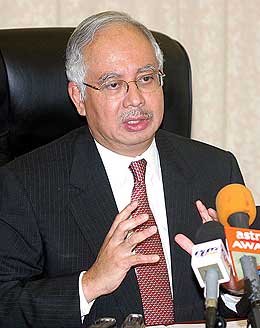 Last year, Prime Minister Najib Abdul Razak (
left
) announced a new RM5 billion Working Capital Guarantee Fund (WCGF) and another RM5 billion Industry Restructuring Loan Guarantee Fund to assist small medium enterprises.
Last year, Prime Minister Najib Abdul Razak (
left
) announced a new RM5 billion Working Capital Guarantee Fund (WCGF) and another RM5 billion Industry Restructuring Loan Guarantee Fund to assist small medium enterprises.
The government then topped that up by another RM2 billion for the WCGF to boost the fund to RM7 billion in September.
Only 28 percent of respondents replied that their business had somewhat benefitted from these funds launched by Najib in the second stimulus package touted as the ‘mini budget'.
ACCCIM president William Cheng pointed out that these funds were "fully taken up within months and had benefitted only the lucky few".
A litany of woes
These were their responses when asked about the major factors adversely affecting business performances in the second half of 2009.
Lopsided government policies, rises in operating costs and the price of raw materials, manpower shortage and domestic competition were some of the main gripes noted by ACCCIM which represents some 28,000 prominent Chinese businesspersons .
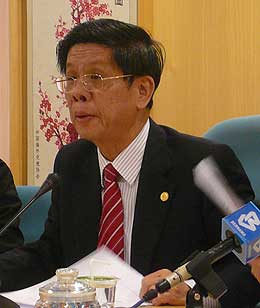 The press were briefed today on the survey findings by ACCCIM Commerce Committee chairperson Dr Leong Kai Hin (
right
), who maintained that the government is not doing enough to channel funds to SMEs.
The press were briefed today on the survey findings by ACCCIM Commerce Committee chairperson Dr Leong Kai Hin (
right
), who maintained that the government is not doing enough to channel funds to SMEs.
He urged the government to "step up efforts" to improve its delivery system and make its policies more transparent and liberal.
Over 90 percent of the 310 respondents polled also expressed concern over the public safety in the country and this, ACCCIM reasoned, could affect business performance and security.
Respondents consisted mainly of entrepreneurs of the wholesale and retail, manufacturing, professional and business services and construction sectors.
More than half of the respondents also opined that the Goods and Services Tax (GST) will bring negative impact on their businesses.
Social impact
Recently, the government has decided to shelve plans to implement the GST by mid 2011, citing the need to complete an in-depth study on its social impact first.
 Second Finance Minister Ahmad Husni Hanadzlah (
left
) reportedly commented that GST is expected to reduce the fiscal deficit and not burden consumers.
Second Finance Minister Ahmad Husni Hanadzlah (
left
) reportedly commented that GST is expected to reduce the fiscal deficit and not burden consumers.
However, that sentiment is not shared by the business community as they find it difficult to grasp the workings and implications arising from the introduction of GST, explained the survey report.
"In particular, all businesses, be it big or small would have to ensure that there exist proper documentation and recording systems to ensure that customers are properly invoiced and taxed (with respect to GST). This is known as output tax.
"Also, there is a need to ensure that input tax credits are similarly properly recorded so that such businesses can deduct them against the output tax.
"The need to introduce a proper system to handle GST in a firm can cause costs in the businesses to rise.
"As such, the rules behind GST are seen as complicated. Businesses may tend to take the easy way out and pass the costs increases to the consumers.
"Whether this is possible becomes the next issue. It is this difficulty to grasp the workings and implications that has given rise to confusion and concern among the business community participants," stated the report.


Are you sure you want to delete this comment?
This action cannot be undone.