




Academics put sweaty masses' issues under microscope
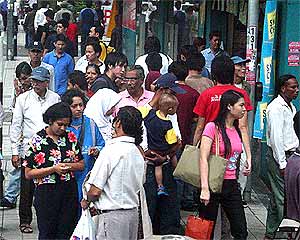
All of a sudden the powers that be are interested in knowing in detail the average Ahmad, Ah Chong and Muthu's thoughts and feelings on various and sundry issues.
All of a sudden the powers that be are interested in knowing in detail the average Ahmad, Ah Chong and Muthu's thoughts and feelings on various and sundry issues.
So the result is a mushrooming of polling or research centres seeking to provide information on various issues from the popularity rating of a political leader, to the social variety, the mood prevailing in society and political and economic confidence.
 Some of the established research centres like Merdeka Centre have been around for years, but newer organisations like Ilham Centre and Zentrum Future Studies Malaysia are making their presence felt.
A new centre which is coming up later this month is the Universiti Malaya Centre of Democracy and Elections (UMCEDEL), where researcher Dr Noor Sulastry Yurni Ahmad, said the centre is tasked with providing accurate political information, and analysis, on democracy and elections in Malaysia.
"It has been directed to combine various disciplines like electoral geography, polling history, socio-political issues, media and voting patterns along with regional and international political impacts on the country.
"There is a need for such a centre as the population's interest in politics is rising. They are now more aware and informed of their rights and responsibilities.
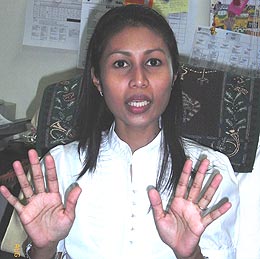 "What is important is for society to have the political awareness for them to evaluate the political situation prevailing in the country," Noor Sulastry (
right
) said.
"What is important is for society to have the political awareness for them to evaluate the political situation prevailing in the country," Noor Sulastry (
right
) said.
Hence, she said the formation of such centres like UMCEDEL, help society and the government keep a finger on the pulse of political developments within the country.
The public, Noor Sulastry said is thirsting for accurate and independent information as they do not want to be deluged by idealistic ideological rhethorics which may not be achievable.
"Through surveys people will know the mood and it would also create awareness of their participation in the democratic process and help them check and balance the government," she said.
Need to look into micro-aspect
Zentrum Future Studies founding chairman associate professor Abu Hassan Hasbullah said the rise in the number of such centres reveals the need to look into the micro aspect of the issues or problems, and not viewed only at a macro level.
He admits this is a problem in tertiary institutions as they focus on the macro level or the long run and not micro-research, especially in social studies.
"There is a problem in looking at a research or sample after a long period as they only look at what had already happened in the past as in history, psychology or anthropology. Hence, such studies may seem insignificant when we enter into the 21 st century."
"The age of the new media is flourishing. This has also led to rapid development as any rewind in thinking or looking at the past would not develop a civilisation."
At Zentrum, he said they look at the way forward in predicting what is in store for the future.
 Abu Hassan (
left
) added that past government efforts like in public transportation, mammoth buildings, the education system had not been either fully successful or did not achieve their objectives.
Abu Hassan (
left
) added that past government efforts like in public transportation, mammoth buildings, the education system had not been either fully successful or did not achieve their objectives.
"The reason for failure is we do not give emphasis to looking at the micro-impact. When a project starts, the negative feeback arrives too late," he said.
Zentrum, Abu Hassan said is involved in research on current data, with focus on the future enabling it to say with some confidence "it can be predicted".
He pointed out the future depends on the present where "we have the opportunity to shape the future.
"Hence, for us it is important to have current data to predict the future and public opinion survey is the way to do it," he said.


Are you sure you want to delete this comment?
This action cannot be undone.