




Ku Li tells Sabahans secret of Pakatan's success
Kelantan strongman Tengku Razaleigh Hamzah, or Ku Li, does not see the opposition Pakatan Rakyat (PR) alliance as having captured the middle ground, or any ground for that matter in Malaysia, in the battle for the hearts, minds and votes of the people.
Kelantan strongman Tengku Razaleigh Hamzah, or Ku Li, does not see the opposition Pakatan Rakyat (PR) alliance as having captured the middle ground, or any ground for that matter in Malaysia, in the battle for the hearts, minds and votes of the people.
Instead, the former finance minister and Petronas founder-chairman sees the opposition alliance merely capitalising on the fact that Malaysians have come to dislike the Barisan Nasional (BN).
He was giving his views in a interview carried yesterday by Sabah's Sunday Express in Kota Kinabalu.
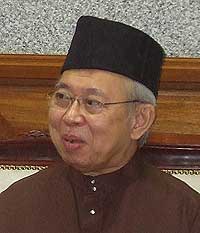 The interview, was conducted two Fridays ago when Ku Li
(right)
was then in the Sabah capital for a
talk
,
Minyak Sabah Untuk Siapa?
The interview, was conducted two Fridays ago when Ku Li
(right)
was then in the Sabah capital for a
talk
,
Minyak Sabah Untuk Siapa?
"If people don't like your face, they just don't like your face," explained Ku Li on the dilemma faced by the BN as the only party to have ruled Malaysia since independence in 1957.
He implied that it was extremely difficult for the BN to be liked by the people again, no matter what they do, because of its longevity in public office and a combination of various acts of commission and omission done overtly and covertly.
Ominously, the dislike of BN, continued the Kelantan prince, included young Malays, the most developed states in Malaysia, the least developed, and across all communities.
Touching on young Malays, Ku Li opined that "their political perspective was in terms of whether something was fair or unfair".
They realised when the Malays were being used as an excuse or tool by the ruling elite, resulting in the benefits not flowing to them or flowing to a small group, he noted.
He cited Selangor, the richest and most developed state under the BN, as an extreme example of BN not being wanted by the people despite what the ruling coalition had done there for over 50 years.
"That doesn't mean that they want PR in Selangor," reiterated Ku Li. "It just means that they would vote for anyone standing against the BN."
He denied that he was being a one-man opposition think tank within Umno or harbouring hopes of replacing Anwar Ibrahim as the opposition leader in the event the latter is carted off to jail again after his ongoing Sodomy II trial.
He said he was not leaving Umno, squashing widespread speculation that he was just waiting to be sacked from Umno to make moves that he had long planned.
Oil issue
Ku Li sees the oil issue as an example of how the country was being managed unwisely and run unfairly, and among the reasons why BN was unpopular with the people.
The issue arose, according to Ku Li, when Terengganu wanted an upwards revision in the five percent oil royalty.
The federal government quickly abolished Terengganu's oil royalty, claiming that it was not entitled to such payments, and replaced it with wang ehsan (goodwill payments), he added.
"Wang ehsan is just a deliberate attempt by the Federal Government to prevent the oil states from asking for an upwards review of the oil royalty."
"Such a thing should never happen because that is not what is in the law," said Ku Li. "I can speak with authority on this subject because I drafted the oil law myself."
Also, the question of him breaching the Official Secrets Act does not arise since "the law is in the books for everyone to see".
"I am just explaining when people ask me," said Ku Li, who heads the opposition-initiated Parliamentary Caucus on Oil. "The issue is bigger than oil because our reserves may not last very long since Petronas has denied reports of the ‘find of the century. ' "
Ku Li confirmed that he wanted to use the caucus to review the existing federal-state relationship "which is bigger than the oil issue". He hoped to take his cue from Canada, Australia and the United States, among others.
Not vested with Petronas
On Sabah in particular, he clarified briefly that he only came to Labuan on June 6, 1976 when newly-appointed Sabah Chief Minister Donald Mohd Fuad Stephens agreed to sign the oil agreement. He conceded however that Stephens predecessor, Mustapha Harun, refused to vest Sabah's oil rights with Petronas.
On whether the Federal Government could get away with wang ehsan on the oil royalty issue, Ku Li implied that it may, since Malaysia has moved away from the concept of being a federation and towards a unitary state with a very powerful centre.
This is where Ku Li wants the Parliamentary Caucus on Oil to come in and help set matters right "since we don't want this re-emergence of the Malay Union which we (Umno) rejected in 1946".
The emergence of Malaysia as a unitary state, reiterated Ku Li, is synonymous with the growing unpopularity of the BN as a coalition unfit to govern the country. "The states have lost their powers which they had under the three-tier power-sharing concept of the federation. This is something that has come back to haunt the ruling coalition."
The Sunday Express interview, conducted by chief editor James Sarda and senior writer Mary Chin, was also a walk down memory lane for Ku Li.
He also took questions on his defeat by a narrow margin for the Umno presidency at the 1987 polls and the failure of his 1990 Gagasan Rakyat Malaysia to take off in the wake of the Sigah controversy where the Malay media circulated a picture of Ku Li wearing the Dusun headgear in Kota Kinabalu with a cross superimposed.
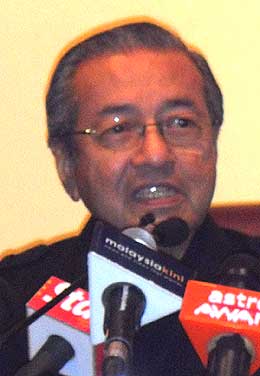 The Gagasan Rakyat also circulated a picture of the then Prime Minister Mahathir Mohamad
(left)
in a
Sigah
"but to no avail".
The Gagasan Rakyat also circulated a picture of the then Prime Minister Mahathir Mohamad
(left)
in a
Sigah
"but to no avail".
Ku li also touched on Petronas monies being poured into unrelated activities like the "unnecessary" development of Putra Jaya, that Prime Minister Mahathir "did not understand economic values", public sympathy for Anwar Ibrahim in the wake of Sodomy II, especially among young Malays, and 1Malaysia being "a nice slogan".
He also took credit for initiating the Petronas scholarship programme which awards 3,000 scholarships every year to all Malaysians, irrespective of race, "and they don't have to come back to serve the national oil corporation, but the world".


