




Anwar hails 'fourth wave' of Asian democracy
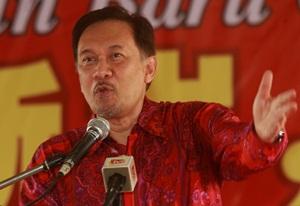
Anwar Ibrahim blended themes he has consistently been propounding in international forums in recent years by describing parts of Asia as in the throes of a “fourth wave of democratisation” in a speech in Jakarta yesterday.
Addressing the sixth assembly of the World Movement for Democracy in the Indonesian capital, Anwar traced the beginnings of the stirring for democracy in Asian countries to the poem ‘The Epic of Sheik Bedreddin’ by Turkish poet Nazim Hikmet in 1938, which is said to have fired the Turkish people’s quest for freedom from Kemalist (after Mustapha Kemal, founder of the modern Turkish state) autocracy.
The Malaysian opposition leader admitted that this was a rather arbitrary choice for the start of the democratic movement in Asia. But he claimed that the poem fired Muslim, Christian and Jewish Turks to rise in support of democracy in their country...
Anwar Ibrahim blended themes he has consistently been propounding in international forums in recent years by describing parts of Asia as in the throes of a “fourth wave of democratisation” in a speech in Jakarta yesterday.
Addressing the sixth assembly of the World Movement for Democracy in the Indonesian capital, Anwar traced the beginnings of the stirring for democracy in Asian countries to the poem ‘The Epic of Sheik Bedreddin’ by Turkish poet Nazim Hikmet in 1938, which is said to have fired the Turkish people’s quest for freedom from Kemalist (after Mustapha Kemal, founder of the modern Turkish state) autocracy.
 The Malaysian opposition leader admitted that this was a rather arbitrary choice for the start of the democratic movement in Asia. But he claimed that the poem fired Muslim, Christian and Jewish Turks to rise in support of democracy in their country.
Clearly, Anwar was on to a wellspring of democratic inspiration that had multicultural potency.
Hence he was not trying to slight the impetus provided for democracy and freedom in Asian countries by the struggles of the slain Jose Rizal in the Philippines in the late 19th century, by Sun Yat Sen in China in the early 20th century and Mohandas Gandhi in India in the third decade of the last century.
But those three progenitors of freedom for their countries were essentially in a fight against colonial rule.
The neo-colonialism that was imposed by local replacements after the colonial powers had departed was the bitter experience of some Asian countries after independence was gained.
Thus an eclectic Anwar was on to a slightly different stream of inspiration where the spark for the democratic struggle is provided by someone with the capacity to forge solidarity across racial and religious lines.
The second, third and fourth wave
But he did not restrict his arc of inspirational reference to someone with only multi-cultural ballast.
Although he did not mention South Korea’s Kim Dae Jung by name, he cited that country’s struggle, led by Kim, to free itself from military dictatorship.
He said Korea’s successful struggle represented an eschewal of the argument that its Confucian mores placed communitarian ideals and prosperity above the individual liberty that a democracy valued.
Anwar was targeting the old ‘Asian values’ mantra, employed by autocratic leaders who clothed their authoritarianism in a mantle that scorned democracy as a western construct and held the continent’s filial piety as somehow in conflict with libertarianism.
Anwar said he saw no conflict between values dear to Asian hearts and the features prized in a democracy - rule of law, free and fair elections, latitude for dissent, and an impartial judiciary.
Obviously, this was the second wave of democracy in Asia. The third wave was the movements that got rid of Marcos regime in the Philippines and the Suharto dictatorship in Indonesia.
The fourth wave of Anwar’s coinage was the democracy he said he saw in Indonesia under its present leader, President Bambang Yudhoyono.
“I was in Surabaya in late January when I saw the news on television about the thousands of people protesting in the streets of Jakarta against President Yudhoyono.
“But he did not order troops to fire water cannon on the protesters or to use tear gas to break them up because in his words, ‘democracy means expressing opinions, thoughts, and criticism.’
“And he advised the people to uphold the law and obey the constitution. So the Fourth Wave might well find its epicenter here in Indonesia,” claimed Anwar.
Democracy and Islam not incompatible
Anwar reiterated an argument he has often espoused – that democracy and Islam are not, as skeptics suggest, incompatible.
Once again he held aloft the ‘maqasid shariah’, the higher objectives of the divine law, a 12th century promulgation by an Islamic thinker that Anwar said was a precursor of the European Enlightenment.
“In fact, not just freedom, but the same crucial elements in a constitutional democracy become moral imperatives in Islam - the freedom of conscience, freedom to speak out against tyranny, sanctity of life and right to property, gender equality and a call to reform,” propounded Anwar.
After expatiating on the protection of minorities as a crucial plank of democratic governance, Anwar brought his initial salutation to Nazim Hikmet to a final summation of his overall themes:
“We can make diversity in culture and religion a source of strength and richness, and the shared history of oppression and political enslavement, a further impetus to solidarity. The flame that fires the passion for freedom and democracy must not be left to flicker, let alone die out.
“To keep it burning, we must remain resolute in our conviction to fight for freedom and democracy and defend it courage, honour and dignity.”


