




Another stand-off against logging giant
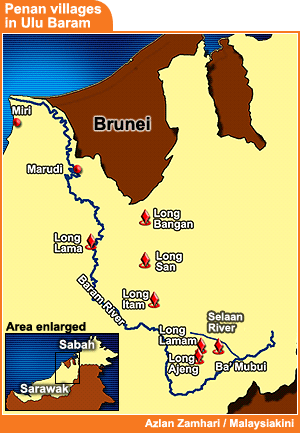
Besieged Penan communities in Baram, Sarawak, have set up two new blockades against multinational logging firm Samling.
The Bruno Manser Fund (BMF), a Swiss NGO advocating Penan rights, reported that local communities had asked Samling surveyors to stop working on their lands, but their pleas were ignored.
Besieged Penan communities in Baram, Sarawak, have set up two new blockades against multinational logging firm Samling.
The Bruno Manser Fund (BMF), a Swiss NGO advocating Penan rights, reported that local communities had asked Samling surveyors to stop working on their lands, but their pleas were ignored.
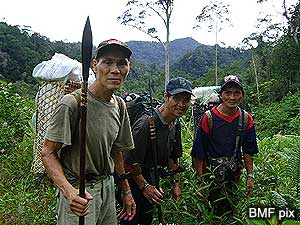
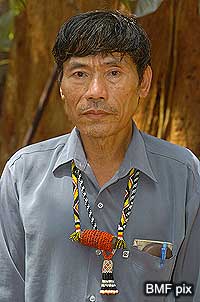 "We know that we are weaker than the Samling bulldozers. But we are determined to fight for our next generation because we cannot survive without the forest.
"If we let the company in (to) do some logging, they will want to take all of our forest," said Long Sabai spokesperson Aya Luding (left).
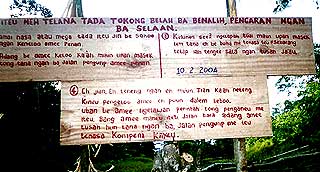
The two new blockades have been mounted across logging access tracks near Long Sabai and Ba Keramau, on the Akah River, for over a fortnight.
The blockades protect part of a "Peace Park", a nature reserve proclaimed by 17 Penan communities in Baram last November.
The "Peace Park" was declared a common human heritage, comprising 163,000 hectares of forested areas. The pronouncement was a direct challenge to Samling, which holds timber concessions to the area.
"The conservation of our forest is our highest priority. Without the forest, we cannot survive. We call this park "Peace Park" because lawi (peace) is a very important concept in our culture. We wish to live peacefully together with our neighbouring tribes and as fully recognised Malaysian citizens," said Jawa Nyipa, chief of Long Ajeng during the announcement of the Peace Park.
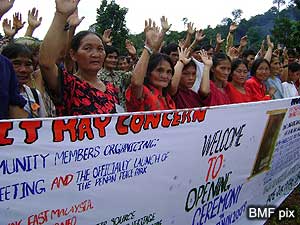 According to James Lalo Keso, previous penghulu for Baram and a highly respected Penan leader, the forest is essential for the survival of settled Penan, as well as the few remaining nomadic groups.
"As nomadic hunter-gatherers, we Penan people have been roaming the rainforests of the Upper Baram region for centuries.
"Even though we have settled down and started a life as farmers since the late 1950s, we still depend on the forests for our food supply, for raw materials such as rattan for handicrafts, for medicinal plants and for other jungle products. Our entire cultural heritage is in the forest and needs to be preserved for future generations," he said.
Violent responses to peaceful blockades
The Long Sabai and Ba Keramau blockades are face in being removed by force. This has been the pattern with previous timber blockades in Baram, and elsewhere in Sarawak.
The powerful Samling timber conglomerate has enjoyed the support of the police in its land disputes. One recent example was the police destruction of blockades in Long Bangan, Long Belok and Long Nen in Baram last year.
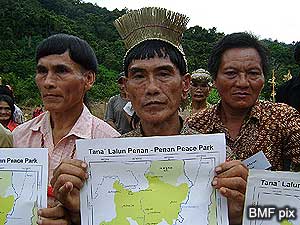 Penans (
right
) are universally regarded as peaceful, gentle people. Although the Penan respect their leaders and elders, there is no strict hierarchy in their settlements or nomadic groups.
Penans (
right
) are universally regarded as peaceful, gentle people. Although the Penan respect their leaders and elders, there is no strict hierarchy in their settlements or nomadic groups.
Penan chiefs are chosen by consensus. Men and women share in decision-making and leadership roles.
The Penans have simple requirements, but they are not simpletons. They are engaging in a defiant, time-honoured resistance to invasion of their land, deprivation of their resources - and sexual abuse of their children and womenfolk, as documented by the federal ministry of women last year.
Local villagers say previous police actions in support of logging companies have often turned violent. Penan protestors have reported that the police have slapped and punched villagers of all ages standing peacefully at the blockades. Villagers say the police have used tear gas and have even fired rounds of live ammunition.
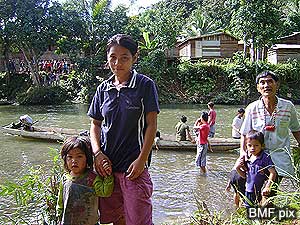 Despite reports of deaths and injuries at such police actions, there has never been an official police investigation, nor disciplinary action taken against police personnel, though Suhakam has noted these allegations.
Sarawak government representatives have played their part in trying to pressure the local communities to remove blockades.
During the standoff with Long Bangan, Long Belok and Long Nen last September, local State Assembly representative Lihan Jok told Penan leaders from blockading communities that "my hope is that you will remove this blockade, so that the companies (Samling, Shin Yang and KTS) can carry on their work, and see the money."
The Penans, from 16 communities, refused to comply, asking instead for the state government to recognise their land rights. The police moved in to destroy the three blockades the next day: ironically, on September 16, Malaysia Day. Lihan then told the press that the communities had removed the blockades voluntarily.
Massive obstacles to peace
Samling Global is a massive conglomerate, homegrown in Miri, Sarawak. It has diversified into property, hotels and other sectors, based on its enormous income from timber.
 Samling has a total of 3 million hectares of forest concessions: 1.4 million hectares in Malaysia and 1.6 million in Guyana, Latin America.
Every year, these concessions produce 2.3 million cubic metres of timber, enough to fill Wembley Stadium twice over. Samling also has 438,000 hectares of land for current or future tree plantations in Malaysia, and more land in New Zealand and China.
 Samling had a prized Forestry Stewardship Council (FSC) certificate in Guyana suspended in 2007 for its environmental record and dealings with local indigenous people.
The FSC auditor Hubert de Bonafos found that indigenous people had ceded control of their land to Samling "without free and informed consent".
One of the longest running land rights blockades against Samling has been at Long Benali, middle Baram. Henneson Bujang, a Long Benali elder, told Malaysiakini that he and other villagers have been savagely beaten and imprisoned by police, and their blockades have been torn down repeatedly. Local villagers rebuilt the blockades patiently.
The paramilitary police field force even built a camp on the timber access road for several months, in an attempt to stop the blockades. But eventually the police left, and the blockade remains in place.
In a 2007 media release, Samling rejected accusations of infringing the human rights of indigenous people in its logging concessions.
 According to James Ho, head of Samling's forest operations in Malaysia, "the blockade (in Long Benali) was there for three years and we have never done anything to it.
"We waited patiently to negotiate with the natives. The blockade was just a piece of log, but out of respect to the natives, we didn't enter to operate."
James Ho was also quoted as saying, in an interview with Swiss television in the same year, that "the Penan have no rights to the forest."
Samling enjoys virtually unlimited autonomy in the forests under its concession - a kind of omnipotent ‘mercantocracy'. The company operates its own security force, with guarded barriers across timber tracks carved into the heart of Baram, over hundreds of kilometres.
Local villagers say gangsters have been brought in to threaten the natives if there is any sign of resistance.
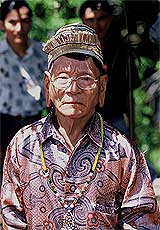 Penan chief Kelesau Naan (
left
), of Long Kerong, a village that sued Samling and the state government in 1998 to stop Samling's intrusion into its forests,
died
under mysterious circumstances in October 2007.
Penan chief Kelesau Naan (
left
), of Long Kerong, a village that sued Samling and the state government in 1998 to stop Samling's intrusion into its forests,
died
under mysterious circumstances in October 2007.
Long Kerong villagers say surveyors had been found working in their forests that year, and had threatened villagers with physical violence, three months before Kelesau was found dead.
It appears the Penans' yearning for peace requires continuing civil disobedience, directed against the corporate Leviathan driving bulldozers into their forests. The Penan have not given up on their courageous, flimsy logging blockades.
Despite the political tsunami in the peninsula in 2008, there remains little hope of electoral reform in Sarawak politics. They have a long journey ahead of them.


