




Speak, Umno Youth is listening
Growing up, I always found the lack of actual ‘youth' in Umno Youth's leadership an irony. You could perhaps only call them ‘youths' if you compared them to the rest of Umno - men on the far side of middle age.
Growing up, I always found the lack of actual ‘youth' in Umno Youth's leadership an irony. You could perhaps only call them ‘youths' if you compared them to the rest of Umno - men on the far side of middle age.
The whole idea of Umno Youth alienated people who fit the actual youth demographic. How, they reasoned, could people their parents' age, claim to understand their needs when even their own parents struggled?
 But Umno Youth is evolving, a necessary thing lest they continue to remain irrelevant to the younger generation who are making themselves heard in both the public sphere and at the polls.
Besides a markedly younger leadership, helmed by Rembau MP Khairy Jamaluddin ( right ), Umno Youth is now engaging the youth on their own turf - the Internet. Umno's youth wing is taking to Twitter and Facebook, as well as via blogs.
Yet it's not just all about the Internet. This writer was invited to participate in the BN Youth Laboratory, an idea mooted by Prime Minister Najib Abdul Razak. Geared towards identifying issues and touch points for government policies and activities tailored towards the younger set, the ‘lab' is basically a think tank of sorts.
Meeting of the minds
Umno Youth selected 30 people of diverse, non-partisan backgrounds to participate in the lab. They were then divided into four sub-labs:
- Education
- Quality of living
- Jobs and business
- Democracy and unity
Why these topics in particular? According to a telephone survey conducted earlier, these were the areas of most concern to youth. The survey sample consisted of 1000 youths in Malaysia, who Umno Youth claim to represent a broad cross-section of Malaysian society.
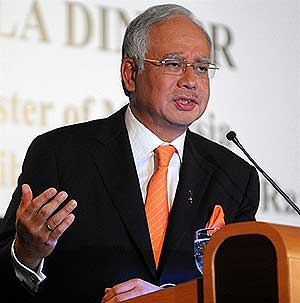 The 30 members are to meet for four Saturdays in a row, in their specific groups. At the end of those four weeks, the findings and recommendations of lab members will be compiled into a report to be submitted to Najib (
left
).
The 30 members are to meet for four Saturdays in a row, in their specific groups. At the end of those four weeks, the findings and recommendations of lab members will be compiled into a report to be submitted to Najib (
left
).
Whatever findings derived from the lab will be subjected to stress tests such as town hall meetings, focus groups and feedback from social media channels.
My group, the democracy and unity sub-lab, was a mixed bag comprising entrepreneurs, independent artists, civil servants as well as media. The session was mostly informal, proving pretty conducive for relaxed discussions.
One thing to note, though, is that the lab's participants could not be said to be truly representative of Malaysian youth as a whole. For the most part, they were middle-class, English-speaking, urban-dwelling, white collar workers. When queried, a lab facilitator conceded that it was the case. Yet, she was quick to point out that the lab served as a platform where they could then make efforts to get feedback from those not represented in the lab's makeup.
Finding consensus
To be honest, I found the whole experience enjoyable and stimulating. It was pleasant to be able to speak about potentially explosive issues without censure, in a safe environment without said issues being deemed sensitive.
What was rather surprising was the lack of cynicism in the room, particularly in my group. The lab members were generally of the opinion that despite the challenges faced by the country, as a whole Malaysia and Malaysians had a lot going for them.
"We're not killing each other on the streets," said one participant. "I think that's something (to acknowledge). "
Another one noted the relative calm shown by Malaysians in the face of such incidents as the recent cow head protests and church arsons.
"Look at Indonesia, for all its so-called Bangsa Indonesia-ness...every five to six years (it) will surface. Some Chinese business or community will be razed."
Not that there was a sense of complacency in the room either. Participants were very vocal in giving feedback during the presentation of the education lab's findings, highlighting a general dissatisfaction in the room with the country's education system.
But when it came to the democracy and unity lab's presentation, as one participant said: "You could cut the tension in the air with a knife."
The presentation touched on socio-political issues for the most part and suddenly, even the more reserved members were trying to chime in. People who seemed to be wilting after a heavy lunch were sitting up straight and playing close attention to what almost evolved into a prolonged debate.
It was a revelation of sorts; a sign of how impassioned young Malaysians can be about topics such as race policies, unity and free speech because these things are, to most Malaysians, deeply personal and potentially explosive.
Yet these are the things we can least afford to ignore, for the longer you let them simmer, the hotter they become.
 The BN Youth Lab is perhaps a step towards taking the lid off the controversial hot issues pot before it comes to boil. At the end of the day, however, discourse is only a means to an end. Will this discourse lead to ideas and useful recommendations for action? Will the measures recommended actually be implemented?
As long as politics can be kept out of the entire process, BN Youth Lab could be considered a positive sign that the ruling coalition is making an attempt to really listen to feedback and act on it.
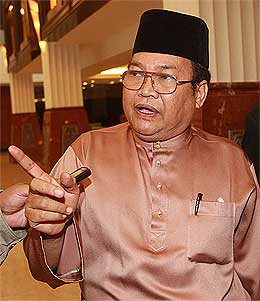
Until the last session is over, this jaded journalist is giving Umno Youth the benefit of the doubt, unless, of course, they invite Ibrahim Ali ( above ) to the next session to ‘help facilitate'. Then all bets, and this writer, will be off.


