




Rocky road for interfaith relations working committee
I have just read about the establishment of the Interfaith Relations Working Committee (IRWC) in The Sunday Star (April 18). Datuk Azman Amin Hassan, the director general of the National Unity and Integration Department, reportedly stated therein that there is no better time for Malaysia to have an inter-faith relations body, and that we cannot sweep things under the carpet any longer.
commen t I have just read about the establishment of the Interfaith Relations Working Committee (IRWC) in The Sunday Star (April 18). Datuk Azman Amin Hassan, the director general of the National Unity and Integration Department, reportedly stated therein that there is no better time for Malaysia to have an inter-faith relations body, and that we cannot sweep things under the carpet any longer.
 I can't agree more. Despite the claim of tourism brochures that we are a model country for racial unity in diversity, our history of race relations has not been too good. In the recent past we have had a long list of race-related problems, most of which arguably emanate from the government's different standards and treatment on matters relating to religion.
There seems little justice and fair play, and rules by far favour the Malays and Islam.
While Malay value system appears to be quite accommodating and even generous for matters relating to Islam against other religions, it appears quite guarded and authoritative with regards to individual religious preferences and can (and does) run contrary to the universal principles of human rights.
So yes, the IRWC can play a useful role in injecting justice and fairplay in matters that pertain to race and religion. But to be sure it has a huge responsibility to undertake and there can be very many areas where its work and efforts can be frustrated.
Based on this belief and presumption, it would be an idea to have a closer look into the basic fundamentals of the Malay mind to have a better understanding of its features and characteristics, and thus be more appreciative of how it works to make it easier to deal with it
.
Why only the Malay mind and not of the rest? This is because the Malays are the most ‘mature' ethnic group in the political arena; they are the majority incumbents in the political elite, in government service and in most government agencies.
 They are the civil servants, the officials of government agencies. By accident or design they have elevated the ulamas into the government decision-making mainstream. As a collective entity they term themselves as the
Ketuanan Melayu
.
They are the civil servants, the officials of government agencies. By accident or design they have elevated the ulamas into the government decision-making mainstream. As a collective entity they term themselves as the
Ketuanan Melayu
.
Their collective mind frame is the apparatus that moulds the country's public policies and their eventual implementation. The Malay mind dictates the goings-on in this country.
With that background filled in, I begin by first quoting the adage of human psychology saying that thinking influences behavior; I believe in this article of wisdom.
Many of the items of race relations cited above relate to the ‘behaviour' part of Malay and Ketuanan Melayu thinking/behaviour coin.
Perception of superiority
So what are the features and characteristics of the Ketuanan Melayu mindset?
 In one word, it is ethnocentric.
So what is ethnocentrism?
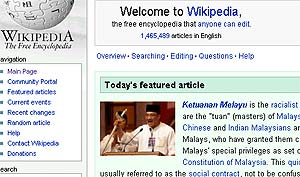
The Wikipedia states that ethnocentrism ‘is the perception in the superiority of one's own ethnic group' and supported by ‘the tendency to look at the world primarily from the perspective of one's own culture.'
It is the tendency to believe that one's ethnic or cultural group is centrally important, and that all other groups are measured in relation to one's own.
In the case of this writing, it is the aggrandisement of the Malay culture made by the Malay.
Indeed, the Malay norm is a virtual example of this thinking trait. I for one grew up within a culture that calls itself as the best in the world, one world renowned for its sopan santun and budi bahasa . It is a culture I love and cherish, and will defend its beauty and strength to the best of my ability.
While ethnocentrism relates to the current world, there is another form of self-aggrandisement that ropes in elements of the Hereafter, and it is called theocentrism. I am not sure whether this relatively new word is in the dictionary, in the event it is not, then it should.
This time it relates to the aggrandisement of the uniqueness and singularity of Islam and therefore the tendency to look at the world and the Hereafter primarily from the perspective of Islamic teachings and philosophies. I believe to this mind Islam carries the only one truth in this world while all other teachings are fairy tales.
When ethnocentrism and theocentrism are fused together we have the following mental state of affairs:
i. Of all the ‘races' in the world the Malay race is the best; other races are poor seconds.
ii. Without exception, the Malay culture and value system is the best there is.
iii. Malays must love their culture and protect it against the perceived corruption and erosion from the west.
iv. They must despise all other cultures and values, especially those coming from the west.
v. Islam is the only religion authorised (‘direstui') by God.
vi. There is only one truth in the world and it is that Allah is the one Supreme God and Mohammad is His prophet.
vii. All other religions are at best fairy tales.
viii. Without exception, Islam is always right and other religions are always wrong.
I believe these are the standard features and characteristics of the collective Malay thinking, unless of course I am grossly wrong, to which I'd like to hear from my critics.
Absolutist and exclusive stances
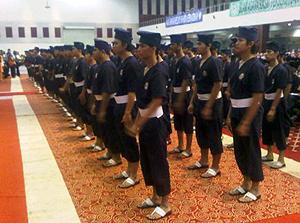 From this quick analysis we can see two fatal flaws of the ethnocentric/theocentric coin. On the one side we have the Malay absolutist and exclusive attitude and stance towards race and religion. To them there is only one truth and they are holding the monopoly to truth. Everybody else is wrong. They demonise everybody else but themselves.
On the flipside of this coin we can see that the act of self-aggrandisement indicates that the Malay is cutting himself away from mainstream human civilisation. As it keeps to itself, it does not have the benefit of cross-cultural exchange of ideas and experiences.
Most if not all of its wisdom would emanate from its own heritage, handed down from the elder generation to the younger. The contents of the wisdom would then be accepted without much doubt, criticism, or scepticism.
Because of this unilateral experience the Malay would have neither the knowledge, the vision nor the awareness to see that there can be similarities or differences between his problems and those of others like him elsewhere in the world (Wikipedia paraphrased). It is thus a case of ignorance is bliss. Or what you do not know you do not miss. Or, you do not know that you do not know. Or, in this world where no man is an island, the Malay would somehow prefer to go it alone.
Culture of poverty
So much for the thinking part of the Malay polity. Now for the behaviour part.
For this I am reminded of a concept first raised by Oscar Lewis called 'the culture of poverty'.
A person's wellbeing can suffer income poverty, where his level of income is below a certain minimum level.
Similarly, we have a cultural version of poverty where the individual's thinking and behavioural patterns are somewhat under-par to the normal.
The Wikipedia describes the people in the culture of poverty as ‘having a strong feeling of marginality, of helplessness, of dependency, of not belonging. They are like aliens in their own country, convinced that the existing institutions do not serve their interests and needs. Along with this feeling of powerlessness is a widespread feeling of inferiority, of personal unworthiness'.
 If we ponder a bit about this definition we can see that the Malay psychology comes close. The Malays feels the economic helplessness, of dependency to government largesse, of not really belonging to the economic mainstream of the country. So they feel they are ‘alien' in the country of their birth where as fate would have it they are in the majority.
‘People with a culture of poverty have very little sense of history', says the Wikipedia further. They are a (mentally) marginal people who know only their own troubles, their own local conditions, and their own neighborhood.
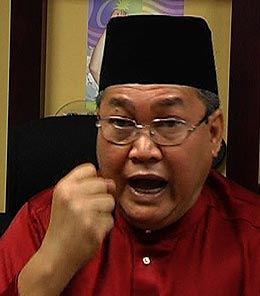
Again this description more or less fits well with the Malay behaviour pattern. Just ask Ibrahim Ali ( above ) of Perkasa for confirmation.
Disturbed mind
The point I wish to make is that
i. when a culture claims unilateral and unsubstantiated superiority over all others;
ii. when this same culture claim superiority of religious faith and belief over all others;
iii. when this same culture refuses to see that there can and may be the existence of other alternative cultures and religions that might equal if not better than one's own; then it is understandable for this culture to demonise everybody else but their own kind.
There is a label for this thinking, and it is called a disturbed mind. I am no psychologist but a disturbed mind to me would have ample amounts of the following debilitating mental conditions:
Firstly the person is unreasonably fearful of many things, from ghosts to the Unknown. As there are many unknowns in this world, the Malay is always in a state of fear.
Secondly he harbours an inferiority complex, i.e. the conflict between the desire to be noticed and the fear of being humiliated. The person thus has a very low confidence level.
Such people would tend to go for denial whenever caught in a less than favourable position or situation. He is quick to lie.
To conclude, the creation of IRWC is bound to meet with a of obstacles and hindrances most of which would come from the ethnocentric and disturbed mind of the Malay. He harbours a culture of poverty. Committee members should be on the lookout for them. These principles might create havoc to the committee.
 Some hindrances have already been expressed, like Muhyiddin Yassin (
right
) saying that this committee is of no consequence as it's position in the government bureaucracy and hierarchy is at a low level. It's a small fry (my word) committee in the
Ketuanan Melayu
scheme of things.
Some hindrances have already been expressed, like Muhyiddin Yassin (
right
) saying that this committee is of no consequence as it's position in the government bureaucracy and hierarchy is at a low level. It's a small fry (my word) committee in the
Ketuanan Melayu
scheme of things.
Also, the ulamas like Harussani Zakaria have made request for the committee not to deal with religion, or something to that effect, for fear that the non-Muslims might be encouraged to demand for more concessions pertaining to their religion!
Its definitely not going to be easy. But I am putting a lot of hope on this matter.
My high hopes lays with the fact that there is the awareness of the prevalence of some race relation problems and difficulties in the country. Yes, the awareness is there and to me for any problem to be solved the awareness of the existence of the problem first of all is most important.
So, if Datuk Azman Amin Hassan is serious enough, he should do well if he nurture this awareness, popularise and propagate it and make it more acceptable to the Ketuanan Melayu polity. Who knows, even the most ethnocentric Malay minds might eventually see reason.
AB SULAIMAN is an observer of human traits and foibles, especially within the context of religion and culture. As a liberal, he marvels at the way orthodoxy fights to maintain its credibility in a devilishly fast-changing world. He hopes to provide some understanding to the issues at hand and wherever possible, suggest some solutions. He holds a Bachelor in Social Sciences (Leicester, UK) and a Diploma in Public Administration, Universiti Malaya.


Are you sure you want to delete this comment?
This action cannot be undone.