




Zaid to win by 1,000-1,500 votes
PREDICTION Countless speeches have been heard, numerous accusations and counter-accusations have been hurled, much mutton curry has been consumed, many promises have been given and many goodies have been dispensed.
After eight days of campaigning in Hulu Selangor, all that is left is for the votes to be cast and counted.
Many reports indicate that this will be a close race with the balance seeming to tilt in favour of BN in the run-up to polling day.
I, however, stand by my earlier conclusion that this by-election is Pakatan Rakyat’s to lose.
I still think that PKR’s Zaid Ibrahim will win this important by-election and that he will win it with a majority of between 1,000 to 1,500 votes...
PREDICTION Countless speeches have been heard, numerous accusations and counter-accusations have been hurled, much mutton curry has been consumed, many promises have been given and many goodies have been dispensed.
After eight days of campaigning in Hulu Selangor, all that is left is for the votes to be cast and counted.
Many reports indicate that this will be a close race with the balance seeming to tilt in favour of BN in the run-up to polling day.
I, however, stand by my earlier conclusion that this by-election is Pakatan Rakyat’s to lose.
 I still think that PKR’s Zaid Ibrahim will win this important by-election and that he will win it with a majority of between 1,000 to 1,500 votes.
I may yet be proven wrong.
Hindsight is always 20/20 and I am sure that there will be many ‘Monday morning quarterbacks’ who will confidently step forward - coincidentally on Monday morning after the results of this by-election are known - to tell us exactly why Pakatan or the BN won (or lost).
I can provide a laundry list of arguments explaining the eventual result, whether it is a Pakatan or BN victory:
 The BN won because of PAS’ lukewarm campaign for a PKR candidate who had clashed with the PAS leadership over issues to do with Islam.
The BN won because of the likeability factor associated with its candidate, compared to the ‘dour’, ‘stiff’ and ‘distant’ demeanor of the Pakatan candidate, who was once the lead partner of the largest legal practice in the country.
The BN won because of its superior machinery and grassroot organisation compared to the poorly coordinated efforts of the opposition.
The BN won because of the inability of the Selangor state government to deliver on its post-election promises. And so on and so forth.
Alternatively, Pakatan emerged victorious because of BN’s over reliance on its strategy of making personal attacks against Zaid.
Pakatan won because of the botched candidate selection process conducted by the BN.
Pakatan won because the BN overestimated the strength and popularity of the Selangor government.
Pakatan won because of too many Malay voters preferred to vote for a Malay opposition candidate than an Indian BN candidate. And so on and so forth.
 The truth of the matter is that no one can confidently assess the independent effects of the factors I have outlined above.
All of them might be important in influencing the final results, perhaps in a mutually reinforcing manner. Or none of them might be.
Some of them may cancel each other out.
A well-designed research survey would be able to tease out the relative importance of some of these factors but even then, the results are usually not impervious to methodological and empirical criticisms.
Given the closeness of this race and the competing factors above, no one can say, with absolute certainty, who the eventual winner and his winning majority will be.
Everyone is entitled to make their own predictions as to who will win and by what margin.
An educated guess
The only advantage I can lay any sort of claim to is that my prediction is probably more or less an ‘educated guess’ than the prediction of the man on the street given the number of election results I have analysed at the polling station and saluran levels over the past three election cycles as well as during the last nine by-elections since the 2008 general elections.
What then gives me some confidence of making the prediction that Zaid will win by this relatively small majority of between 1,000 to 1,500 votes?
 My reading of the various news reports tells me that there were ‘game changers’ which were introduced during the course of the campaign.
The widespread consensus has been that the personal attacks against Zaid have not worked, nor have the much less publicised attacks against the educational qualifications of P Kamalanathan.
The usual goodies offered by the BN in a regular by-election have been met with the machinery of the opposition-controlled Selangor state government, a luxury which was not available to the opposition in a by-election before March 2008 (with the exception of Kelantan and at one point in time, Sabah).
A friend reminded me that the opposition has yet to lose a by-election in a state in which it is in control of since March 2008.
The cut and thrust of both campaigns seemed to have neutralised each other, in my humble opinion, observing from afar.
 Which means to say that the assumptions I made shortly before nomination day should still hold true on polling day.
A significant number of Malay voters will still vote for the Pakatan candidate based on the fact that a Malay Umno candidate was not fielded.
The Chinese support for the Pakatan candidate is much more likely to reach the levels of support experienced by the DAP in the Kuala Kubu Bahru state seat in the 2008 general elections.
And one still cannot discount the possibility of subtle sabotage by disgruntled G Palanivel supporters and voters, and the fact that S Samy Vellu still casts a negative shadow over the BN’s efforts to win among the majority of Indian support.
Malay support for BN to drop
I estimate that the Malay support for the BN will be around 58%, a far cry from the 70% enjoyed at the state level in the 2008 general election.
True, this probably indicates that Pakatan still has some way to go before it can break even with the BN in terms of its Malay support.
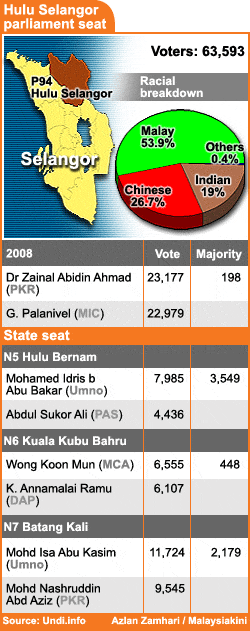 But this shortfall is more than made up for the 70% Chinese support it will achieve.
Pakatan’s majority among the Chinese voters will provide it with about a 1,000-vote nett majority after taking into account its deficiency among the Malay voters.
I estimate that the BN support among the Indian candidates will be approximately 45%.
The Pakatan majority among the Indian voters will be sufficient to cancel out the BN’s majority among the Orang Asli and the postal voters.
Hence, I end up a low-end majority of approximately 1,000 votes which may rise to 1,500 if the BN’s Malay support dips by a percentage or two.
Frankly, I would not be surprised if the majority for Zaid increases to more than the upper end of the 1,500 I predict.
My sense is that many observers have underestimated some of the underlying currents and trends which make the circumstances surrounding this by-election such a unique one, including the possibility that an MIC loss will mean that this seat will almost certainly be given to Umno in the next general election.
If the opposite occurs, and the BN wins by a relatively large margin, perhaps by the 3,000 or so majority predicted by Ibrahim Ali, then I will have egg on my face and will be forced to eat humble pie.
That, I am more than willing to do. After all, the risk associated with making any prediction is that you may be proven wrong.
I prefer the satisfaction (and perhaps the excitement) of putting my money where my mouth is, instead of sitting on the fence.
ONG KIAN MING holds a PhD in Political Science from Duke University. He can be reached at im.ok.man@gmail.com.


Are you sure you want to delete this comment?
This action cannot be undone.