




Malayan deaths in infamous railway unsung till today
Last Sunday was Anzac Day celebrations when Australians and New Zealanders remember their dead in the first and second world wars.
Ordinarily, the occasion would not mean anything to Malaysians save those who possess a memory of soldiers from the two countries who died in the course of Imperial Japan’s drive for dominion over Southeast Asia in the first half of the 1940s.
A Malaysian resident happened to be holidaying in Kanchanaburi in the west of Thailand last Sunday and observed the commemoration of Anzac Day there, held to...
Last Sunday was Anzac Day celebrations when Australians and New Zealanders remember their dead in the first and second world wars.
Ordinarily, the occasion would not mean anything to Malaysians save those who possess a memory of soldiers from the two countries who died in the course of Imperial Japan’s drive for dominion over Southeast Asia in the first half of the 1940s.
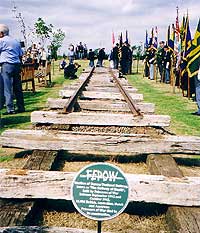 A Malaysian resident happened to be holidaying in Kanchanaburi in the west of Thailand last Sunday and observed the commemoration of Anzac Day there, held to remember Australians and New Zealanders who died while building the Death Railway in 1942-43 that linked Bangkok with Rangoon in Burma.
He requested anonymity but what he said merited publicity in these times when atrocities committed in the past rear up in the public consciousness in ways to trouble our sleep.
What seemed inexplicable to this ‘accidental’ witness of the Anzac commemoration at Kanchanburi were the statistics at the war museum in the Thai town and what these told of the relative dignity or lack of accorded to those who died in building the infamous Death Railway.
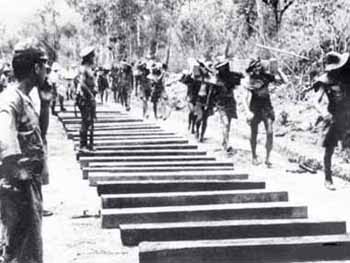 He said the Australian government had built and maintained the museum and the cemetery in Kanchanburi, though at some 3,000 dead out of 13,000-odd Australians forced to work on the railway, their casualties were relatively small compared to the Malayans who perished.
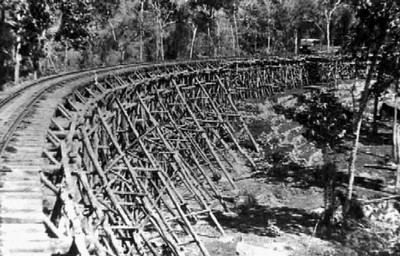
The figures for the latter are only estimates but at 42,000, it constituted the highest mortality rate among the British, Australian, Canadian, American, Burmese, Thai and Malayans who died from maltreatment, disease and accidents while building the 415km railway.
“I was surprised that there was not a single Malaysian dignitary at the ceremonies held to honour the dead whereas most of the rest of the nationalities had some representatives at the ceremonies,” observed the long-time Malaysian resident.
Asian war dead less worthy?
He said estimates of Burmese deaths were the second highest at 40,000. Together with the Malayan deaths, they constituted the bulk of the 90,000-odd who perished in what he said must have been a concentration camp not very different from the ones in Europe in which millions of Jews had met their deaths during the Second World War.
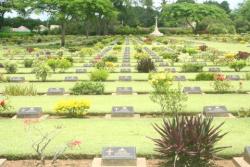 Among the Malayan deaths were Malays, Chinese and ‘Tamils’, as the museum murals reported, said our resident-reporter.
‘Given the scale of the Malayan deaths and the conditions in which these were met I could not fathom why there does not seem to be a shred of recognition for them,” he opined.
“Are the war dead of Southeast Asia less worthy than the others?” he asked.
Generally speaking, modern Malaysian history is regarded as something that began in 1946 when Umno was formed to fight the Malayan Union proposals of the British colonial authority.
 Most incidents prior are regarded as tangential rather than germane to the historical narratives that Umno has caused to be constructed in order to bolster their hegemony over the Malaysian polity.
A rewrite of history more in keeping with the relative importance of the whole panorama of events that constitute 20th century Malayan-cum-Malaysian history await a Malaysian Thucydides not likely to come forth until a new political order is inaugurated.


Are you sure you want to delete this comment?
This action cannot be undone.