




Electronics workers' union will 'enhance gov't image'
The government's decision to allow the formation of the Electronic Industry Employees Union has helped enhance Malaysia's image among workers' organisations both locally and around the globe, a trade unionist said.
The Malaysian Trades Union Congress (MTUC) was reported to have said that the cabinet had given the nod for the formation of non in-house trade unions for the sector.
The government's decision to allow the formation of the Electronic Industry Employees Union has helped enhance Malaysia's image among workers' organisations both locally and around the globe, a trade unionist said.
The Malaysian Trades Union Congress (MTUC) was reported to have said that the cabinet had given the nod for the formation of non in-house trade unions for the sector.
This issue has been a thorn in the flesh for the government since the early 1970s when electronic multinationals first began making Malaysia their base to produce electronic chips and products.
The workers, represented by MTUC, had demonstrated, protested and complained to the International Labour Organisation (ILO) over the last 40 years on the country's refusal to allow workers in this sector to unionise.
 "Internationally, at almost at every ILO conference, the Malaysian labour minister was criticised and queried about this issue, and locally at every workers meeting, this issue was hotly debated," veteran trade unionist and past MTUC president Zainal Rampak (
right
) told
Bernama
.
"Internationally, at almost at every ILO conference, the Malaysian labour minister was criticised and queried about this issue, and locally at every workers meeting, this issue was hotly debated," veteran trade unionist and past MTUC president Zainal Rampak (
right
) told
Bernama
.
As a result, the Malaysian government had a hard time convincing the international and local workers movement of its efforts to protect workers.
As a compromise, the government allowed these workers to form in-house unions but this was not accepted because the workers were still being exploited, he said.
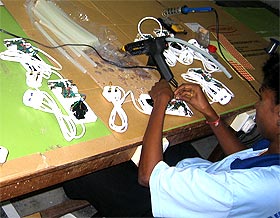 Moreover, only 12,000 to 15,000 workers were members of these in-house unions which translated to a mere five per cent of the total workforce in the industry.
He added the classic case was a company called Harris Advanced Technology Sdn Bhd which changed its name six times, thus disallowing the workers even to form an in-house union.
'Let bygones be bygones'
In 1988, a young trade unionist, Bruno Pereira who was then employed by Harris Advanced Technology, with the assistance from the MTUC, began a long struggle to organise workers in this sector.
Pereira's efforts borne fruits finally when the cabinet allowed the formation of a industrial union for this sector, albeit only for the Peninsular Malaysia region.
"Although we are only allowed to form industrial union on a regional basis, nevertheless it is far better than in-house unions," Pereira told Bernama .
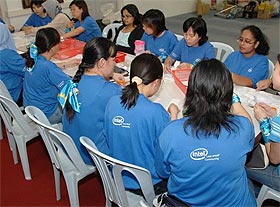 He said efforts were underway to organise the 286,226 workers in the industry into three regional unions - the western region comprising Federal Territory, Selangor and Perak; southern region covering Johor, Melaka and Negeri Sembilan, and northern region encompassing Penang, Kedah and Perlis.
Pereira, who is the general secretary for the western region said that "a generation of electronic workers have been denied benefits in spite of the huge profits these companies have been making year after year for the 40 years or so."
"However, let bygones be bygones and we hope to start a fresh and give some hope to the thousands of poor workers in the sector who are now earning around RM350 to RM700 per month which is below the poverty line," he said.
- Bernama


