




Kelantan sultan's habeas corpus hearing adjourned
The Special Court hearing over the habeas corpus application at Putrajaya today to “free” the Sultan of Kelantan Sultan Ismail Petra Sultan Yahya Petra, has been adjourned.
The Special Court hearing over the habeas corpus application at Putrajaya today to 'free' the Sultan of Kelantan Sultan Ismail Petra Sultan Yahya Petra ( below ), has been adjourned.
A later date to hear the application will be fixed.
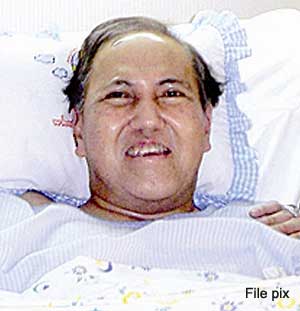 The adjournment was due to a lack of quorum of judges as the Federal Constitution states that the Special Court must consist of five judges to hear the matter.
The current panel today, however, had only four judges.
The habeas corpus application was brought by the lawyers for the Kelantan Sultan.
The proceedings were held in camera, with only the delivery of the judgement by the judges, led by Chief Justice Zaki Azmi, scheduled to be in open court.
Sitting with Zaki were Chief Judge of Malaya Arifin Zakaria Federal Court Judge Zulkefli Ahmad Makinudin and acting Chief Justice of Borneo Linton Albert.
"Unfortunately they could not get the other judge... Under the constitution, the Special Court is constituted by five judges - the chief justice, the two judges of Malaya and Borneo and two appointed by the Conference of Rulers," said senior counsel Param Cumaraswamy.
The matter was also postponed to allow time for Attorney-General (AG) Abdul Gani Patail to file affidavits in response and other consequential orders.
Abdul Gani is representing the government and other three respondents, namely - Inspector General of Police (IGP) Musa Hasan, Kelantan Police Chief Abdul Rahim Hanafi and Director General of Health Ismail Merican.
A writ of habeas corpus orders the authorities to produce a "detainee" before a judge to determine whether the person is being held lawfully, and if not, be freed from custody.
 Though Tuanku Ismail was
released
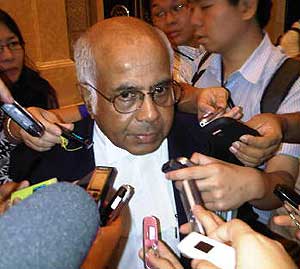
yesterday afternoon from the Hospital Universiti Sains Malaysia (HUSM) in Kelantan, the counsels for the sultan - led by renowned senior lawyers Raja Aziz Addruze and Param Cumaraswamy (
left
) - have said they have reason to believe that Tuanku Ismail had been held
under restraint
in HUSM.
Though Tuanku Ismail was
released
yesterday afternoon from the Hospital Universiti Sains Malaysia (HUSM) in Kelantan, the counsels for the sultan - led by renowned senior lawyers Raja Aziz Addruze and Param Cumaraswamy (
left
) - have said they have reason to believe that Tuanku Ismail had been held
under restraint
in HUSM.
Other than Abdul Gani, the Attorney-General’s Chambers was represented today by senior federal counsel Amarjeet Singh.
The Special Court was established to hear any civil or criminal action instituted by or against the Yang di-Pertuan Agong or any of the nine Malay Rulers.
Param told reporters outside the courtroom that the AG has also given assurance that the Sultan is permitted to seek treatment wherever he sees fit.
"Right now, the Sultan is free to go to Singapore for treatment," he said.
Matter of national and international concern
Counsel Gobind Singh, meanwhile, stressed that despite the Sultan's release from his alleged captivity, the case has to go on.
"The issue before this court is not just of public concern, but a matter of national and international concern," said Gobind.
"The manner in which the events surrounding the Royal Highness occurred is very serious in nature. There must be a response, and some definition as to whether or not what happened was lawful and proper," said Gobind.
He added that it was "sad and disappointing" that the royal court is insufficient in terms of judges.
THE SPECIAL COURT
Constitution
The Special Court was established pursuant to Article 182 of the Federal Constitution to hear any action civil or criminal instituted by or against the Yang di-Pertuan Agong or any of the nine Malay Rulers.
However, by Article 183 of Federal Constitution no action, civil or criminal, shall be instituted against the Yang di-Pertuan Agong or any of the Rulers of States in respect of anything done or omitted to be done by him in his personal capacity except with the consent of the Attorney General personally.
Members
Article 182(1) of the Federal Constitution provides that the Special Court shall consist of the Chief Justice of the Federal Court, who shall be the Chairman, the Chief Judges of the two High Courts and two other persons who hold or have held office as judges of the Federal Court or the High Court appointed by the Conference of Rulers.
Jurisdiction
Article 182(3) of the Federal Constitution stipulates that the Special Court has an exclusive jurisdiction to try all offences committed in the Federation by the Yang di-Pertuan Agong or any of the Rulers of the States and all civil cases by or against the Yang di-Pertuan Agong or any of the Rulers of the States notwithstanding where the cause of action arose.
In addition to its exclusive jurisdiction, the Special Court also has the same jurisdiction and powers as are vested in the subordinate courts, the High Court and the Federal Court by the Federal Constitution.
Proceedings
The procedure (including the hearing of proceedings in camera) in civil or criminal cases and the law regulating evidence and proof in civil and criminal proceedings, the practice and procedure applicable in any proceedings in any subordinate court, the High Court and the Federal Court shall apply in any proceedings before the Special Court. The proceedings of the Special Court is decided by the opinion of the majority of the members.
Finality of decision
The decision of the Special Court is final and conclusive and
cannot be challenged or called into question in any court on any ground.
Sittings
The Special Court may sit at the premises of the Federal Court located at the Palace of Justice, Putrajaya Wilayah Persekutuan on such dates and at such times as the Chief Justice may from time to time appoint.


Are you sure you want to delete this comment?
This action cannot be undone.