




Penangites demand Right to Information Bill
About 200 Penangites have endorsed a resolution to demand the state government to introduce a Right to Information Bill in the legislative assembly without delay.
About 200 Penangites have endorsed a resolution to demand the state government to introduce a Right to Information Bill in the legislative assembly without delay.
The Coalition for Good Governance Penang proposed this during a forum which they held on the topic last night. The four-point resolution affirmed the rights of individuals to obtain full access to information held by public offices.
 The forum noted with regret that right to information was not recognised at many levels of the state administration, including the executive committee, municipal councils and state-controlled entities like the Penang Development Corporation and Penang Water Authority.
“Disclosure of such information should not be denied on the grounds that it will compromise public security and individual privacy,” said Coalition representatives when proposing the resolutions at the forum.
“Such denial of information has hindered the communities’ participation in the democratic decision making processes that directly affect these communities,” the Coalition added.
Held in conjunction with World Press Freedom month, the event saw Penangites strongly demanding the government to emulate Selangor in presenting a draft of the Right to Information Bill for public consultation.
The bill aims to institutionalise and facilitate the public’s access to information from the state authorities.
Enforcing transparency
A four-speaker panel comprising The Sun Penang desk editor Himanshu Bhatt, municipal councilors Lim Kah Cheng (MPPP) and Latheefa Koya (MBPJ) and Tanjong Bungah Residents Association president George Aeria, discussed at length why the Bill was necessary to all sectors of society.
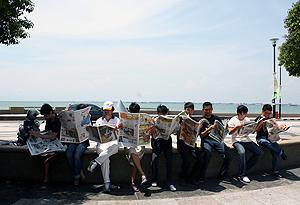 Explaining how important the Bill was to the media, Bhatt said there were numerous occasions where journalists could not obtain information from official channels, and had to rely on external sources instead.
“We would also like to get confirmation from people who are within the government departments or agencies, but there is no legal framework to make them obligated to give you this information. So we have to rely completely on goodwill, which I think in the general sense should not be the way,” he said.
“For the public and the media, there should be a legal contingency or framework to enable continuous flow of information,” he added.
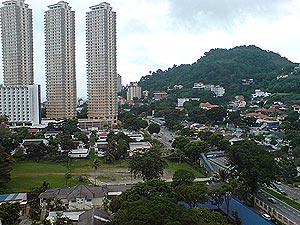 Aeria, who expressed regret over the previous state government’s unruly hillside development around the Tanjung Bungah area (
right
) where he lived, said legislating the right to information can force officials, civil servants and politicians to be efficient in their work.
Aeria, who expressed regret over the previous state government’s unruly hillside development around the Tanjung Bungah area (
right
) where he lived, said legislating the right to information can force officials, civil servants and politicians to be efficient in their work.
However, he noted that this group tends to invoke the Official Secrets Act or the Internal Security Act, which allows for detention without trial, as an excuse not to give information.
“When people hide behind the OSA and ISA, they do it as an excuse to hide their weaknesses and failures,” he said.
“The civil service often use this excuse so that others cannot see how badly they performed; politicians do it to remain in power,” he added.
Aeria was also upset with Chief Minister Lim Guan Eng’s administration for not being responsive to the association’s various complaints.
Bring back local elections
Lim Kah Cheng, a lawyer and NGO representative, lamented the abolishment of local elections in Penang since 1964, which resulted in councillors currently being appointed by political parties instead of the rakyat.
She also proposed an increase in NGO representation at the local council from the current 2 out of 24 state councillors. This she said would ensure better flow of information to the public.
She called on voters in future elections to insist that candidates support local elections and freedom of information before casting ballots in their favour.
 “Freedom of information must be supported to promote accountability and awareness among the people, and if people are informed, they can act accordingly,” she added.
Latheefa Koya ( left ) spoke about the challenges the Selangor state government has faced in trying to honour access of information to the public.
She said civil servants loyal to Barisan Nasional could sabotage the state government’s efforts by failing to provide, restricting or falsifying, information that is requested by the public.
“There may be some who will not even implement the decisions made by the state government. (And) this could happen (when, for example) the staff fear they might be implicated when the information is made public,” she added.


Are you sure you want to delete this comment?
This action cannot be undone.