




Raise penalty for unauthorised polygamy
Kinabatangan MP Bung Moktar Radin's one month jail sentence for unauthorised polygamy yesterday sparked calls for a heavier penalty for the offence, led by the judge himself.
Kinabatangan MP Bung Moktar Radin's one month jail sentence for unauthorised polygamy yesterday sparked calls for a heavier penalty for the offence, led by the judge himself.
In his strongly-worded judgement delivered yesterday, Syariah judge Wan Mayahuddin Wan Muhammad said that the current maximum penalty of RM1000 fine or a six-month jail term or both, is too low to act as a deterrent.
"A fine of RM1000 today is insufficient to bring about repentance (instead) it can cause society to disrespect Syariah law," he said.
Wan Mayahuddin also said that the fine adds to the suffering of wives and children, when a man enters into a polygamous marriage without the court's consent.
According to the Selangor Islamic Family Law Enactment 2003, those desirous of taking an extra wife must convince the court that he has the means to do so.
To obtain that consent the man's existing spouse (or wives) must also state her/their views on the move.
The judge's recommendation, said Malaysian Syarie Lawyers' Association vice president Musa Awang, was long overdue.
This is because Selangor Syariah laws had not been revised since 1995. The norm is most are revised after ten to 15 years, he said.
However, any revision to the penalty must be within the bounds of the Syariah Court which is only permitted to mete out a maximum sentence of RM5000, three years jail and six strokes of the rotan for any offence, he said.
Fines hurt but jail is scarier
Musa added that while Syariah laws are not punitive in nature, as it is meant to act as a deterrent, and the low penalties for family law offences do not meet this objective.
"People can still pay RM1000 and most commit the offence thinking they will just pay the fine later.
"I believe most people in the Klang Valley would still be able to pay a maximum fine of RM5000 which is high enough to hurt and make people think twice," he said.
Slapping a high penalty on a high profile and affluent person may not necessarily teach him a lesson, he said, but it can attract enough media attention and help educate society to avoid committing the offence.
 He added that Bung Moktar (
at right in
photo
) is not the first person to receive a jail term for such an offence, but to Musa's knowledge most have had the sentence converted to a fine by the Appeals Court.
He added that Bung Moktar (
at right in
photo
) is not the first person to receive a jail term for such an offence, but to Musa's knowledge most have had the sentence converted to a fine by the Appeals Court.
This is the gripe of Islamic Family Law expert Nora Abdul Hak, who said that most people do not take a really serious view of family offences.
Other offences like failure to provide nafkah (maintenance) also carry the same maximum penalty, hardly a deterrent, especially when the jail sentence is rarely meted out.
"If we are serious about trying to deter people from committing this offence then we should use what is already in the law - a jail sentence.
"Even one month in jail is greater deterrent to potential offenders than a fine," she said, adding that the appeal courts should also take such matrimonial offences seriously.
The International Islamic University lecturer added that the academic community has long argued for a heavier penalty for such offences, if only to prevent disrespectful treatment of the law.
"This is not about punishing polygamy, the law allows it but there are rules, so abide by them," she said.
Polygamous husbands not necessarily unfair
On the other side of the spectrum, former Perlis Mufti Mohd Asri Zainul Abidin in a statement issued yesterday expressed his sympathies for Bung Moktar for falling victim to "haphazard laws enforced in the name of religion".
"The question of fairness (in polygamy) cannot be weighed just by looking at certain factors before the marriage.
"Who is to say how many men were deemed qualified to enter a polygamous marriage but later act unfairly?" he said.
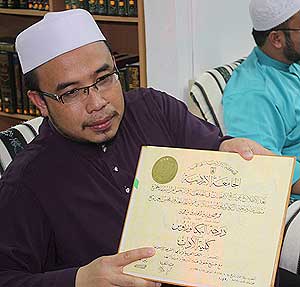 Mohd Asri (
left
) added that if the religious department wants to curtail abuse of polygamy it should formulate laws to act against the culprits.
Mohd Asri (
left
) added that if the religious department wants to curtail abuse of polygamy it should formulate laws to act against the culprits.
"(Instead) action is taken against a man who has solemnised his marriage in a halal manner simply because he is practicing polygamy," he said, noting also that many high-profile people have had illicit affairs without retribution.


