




Reflections on rape, sodomy and white lies
COMMENT There was once this philosopher (do forgive my rusty memory for not remembering his name) or plain joker who said that there can be no such thing as rape for the simple reason that a woman with her skirt up can run faster than a man with his pants down.
I tend not to agree with this however witty contention, for in the case of heterosexual rape the anatomical body structure of man and woman are such that the rapist has...
COMMENT There was once this philosopher (do forgive my rusty memory for not remembering his name) or plain joker who said that there can be no such thing as rape for the simple reason that a woman with her skirt up can run faster than a man with his pants down.
I tend not to agree with this however witty contention, for in the case of heterosexual rape the anatomical body structure of man and woman are such that the rapist has - in most circumstances - to be in a face-to-face position with his victim. She can even be pinned under him. Either way it makes it difficult for a would-be victim of rape to run away.
It is more realistic to contend that there can be no such thing as forced homosexual sodomy. This is because both the rapist and victim would be facing the same direction, thereby providing the victim with all the avenues to escape should he wish. In any case, both men would have their pants down, so neither would be able to dash off anyway.
I am reflecting on this rather unsavoury topic for it relates to the present legal case involving Anwar Ibrahim and Mohd Saiful Bukhari Azlan that is so much in the current domestic public and international domains. It certainly has consumed my mind and led me to reflect upon it in the last few days.
I have two points to raise on this current case.
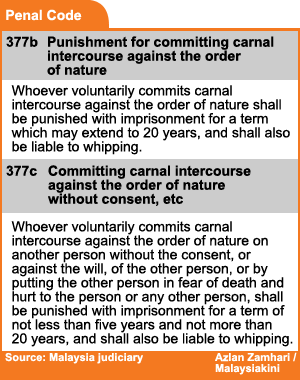 Firstly, Saiful is claiming that he had been forcefully sodomised, but the prosecutors are charging that Anwar (in effect) had sodomised Saiful but on consensual basis.
From what I know a person should be put on trial on the basis of the precise charges slapped on him. Any slight difference like this present case would not do. Indeed Raja Petra Kamarudin has written in some detail about this matter in his Malaysia Today blog with the heading ‘Technicalities are everything’ , and I shall not replicate or repeat his arguments; apart from saying yes, he is right on target.
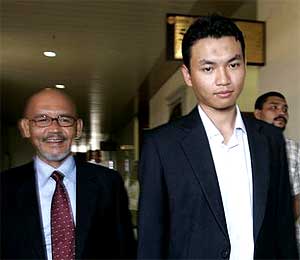
Secondly when defence counsel pointed out the differences, the prosecution (and judge) cited that the attorney-general has the right to charge Anwar either for consensual or non-consensual sodomy.
This brings me to one Islamic philosophy known as ‘taqiyyah’ (Arabic for ‘fear, guard against’). In its pure and ideal form, ‘taqiyyah’ is hiding one’s true belief for some compelling reasons.
For example, we take the situation when a Muslim is in minority among hostile non-Muslims. By revealing that he is Muslim might jeopardise his safety. So he can externally say he is non-Muslim but internally remain a devout Muslim. ‘Taqiyyah’ teaches one to preserve oneself in the name of faith and the community.
 But it is also known as the ends that justify the means – you do anything just in order to get what you want in the first place; a white lie in English parlance. There are no high principles here, but a whole lot of valued judgments.
Could Saiful in this case be exercising ‘taqiyyah’? I suppose only the court can decide on this. Could the prosecution team also be resorting to ‘taqiyyah’? I suppose likewise only the court can decide on this.
Silence of our ulamas
Meanwhile I am wondering why our ulamas, like for example the mufti of Perak who has always been active in the application of religious virtues, have been very quiet on this contentious matter. I would expect their persistent call for making this country into an Islamic state (where all public matters should have ‘ ciri-ciri ’ or features and principles of Islam) should make them keen to promote and champion the ideals and virtues of Islam at every turn.
But they seem to have kept mum on this possible resort to ‘taqiyyah’. Silence has been the norm thus far.
I declare I do not like ‘taqiyyah’ at all, for to me it goes against the grain of and spirit of modern law. The spirit of the law to me is seeking truth in order to give fairness and justice to the citizens. This can happen only when the law is applied in a cold, reasoned, objective and transparent way, where the processes (or means) of getting judgment (or the ends) are equally transparent.
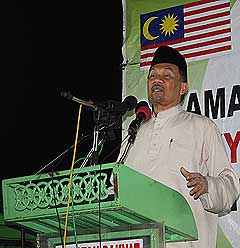 In the Saiful-Anwar case the public perception seems to suggest that the ‘ends’ have already been decided and now the court is juggling around with (i.e. justifying) the ‘means’. So perhaps the ulamas should come with some kind of conceptualisation and rebuttal on this issue - apparently in early Islamic history ‘taqiyyah’ is allowed; is this still be the case in modern times?
(I have to pose this question for oftentimes we have been told to leave all matters pertaining to religion to the ulamas, the experts on Islamic matters).
This is vitally important for we are going at some (not breakneck) speed to be an advanced country by 2020. Part of this target would involve the development of the intellectual infrastructures of the country in addition to its usual physical ones. ‘Intellectual infrastructure’ in this context refers to our legal system, procedures and regimes. A progressive modern country cannot survive on archaic laws.
We can never be an advanced country if our legal system is judgmental and subjective. We can never progress far with a the application of law that justifies playing around with the means in trying to get to subjective ends.
Should the ulamas still stay silent, then they are not progressing any further in promoting the higher ideals of Islam. They seem to be content with just attending to mundane and questionable acts like catching people for drinking beer, penalising couples for holding hands in public, snatching corpses from their bereaved relatives, and making sure every Muslim eats ‘halal’ food. Very medieval.
And surely that is not all that Islam amounts to.
AB SULAIMAN is an observer of human traits and foibles, especially within the context of religion and culture. As a liberal, he marvels at the way orthodoxy fights to maintain its credibility in a devilishly fast-changing world. He hopes to provide some understanding to the issues at hand and wherever possible, suggest some solutions. He holds a Bachelor in Social Sciences (Leicester, UK) and a Diploma in Public Administration, Universiti Malaya.


Are you sure you want to delete this comment?
This action cannot be undone.