




Najib: Pemandu's figures merely projections
Prime Minister Najib Abdul Razak today played down his own ministry’s estimates that Malaysia would be bankrupt by 2019, should the government fail to cut its burgeoning subsidy bills.
Prime Minister Najib Abdul Razak today played down his own ministry’s estimates that Malaysia would be bankrupt by 2019, should the government fail to cut its burgeoning subsidy bills.
Commenting on the Performance and Management and Delivery Unit (Pemandu) chief Idris Jala’s speech this morning, Najib said figures quoted were merely based on the agency’s studies and there is no firm decision by the government.
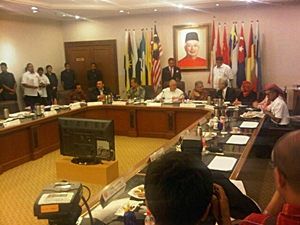 Speaking during a press conference after the Umno supreme council meeting in Kuala Lumpur, the premier added more studies were needed before subsidy cuts could be introduced.
"We are still waiting for information and feedbacks from the rakyat on this.
"Idris' remarks are just estimates... When it comes to matters which involve the well being of the people, we will consult the rakyat first," he said.
In his speech, Idris warned that Malaysia is in risk becoming the next Greece unless the public swallow subsidy cuts for petrol, food, electricity and other staples.
'One thing at a time'
Najib also dismissed former premier Dr Mahathir Mohamad’s claims that the government still has many issues which must be resolved with Singapore.
"We cannot solve everything at once. It is a step by step process and we need to handle one thing at a time. As for now, the more important thing is the Points of Agreement.
"More so, most of the issues are ‘legacy issues’," said Najib, in a veiled reference to bilateral problems left by his predecessors.
Najib recently held talks with his Singaporean counterpart Lee Hsien Loong and reach an agreement to relocate the Tanjung Pagar railway station to Woodlands, the northern-most part of the Island-state, thereby forgoing substantial tracts of land.
In exchange, Malaysia would be given several parcels of land, which would be developed by a newly set up company controlled by Malaysian investment arm Khazanah Nasional.
On the Sibu by-election, Najib said Umno has identified reasons for BN’s loss at the polls but would not reveal them, because it was an “internal matter”.


Are you sure you want to delete this comment?
This action cannot be undone.