




Barry Wain provides insights on Mahathir at UM
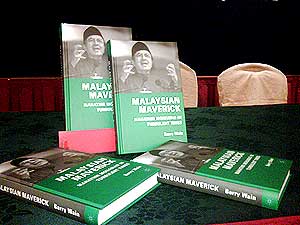
What was supposed to be a highbrow discussion of Barry Wain's Malaysian Maverick: Mahathir Mohamad in turbulent times led by the author himself at the nation's oldest university turned out to be a critical session on the fourth prime minister.
What was supposed to be a highbrow discussion of Barry Wain's Malaysian Maverick: Mahathir Mohamad in turbulent times led by the author himself at the nation's oldest university turned out to be a critical session on the fourth prime minister.
 Wain
(right)
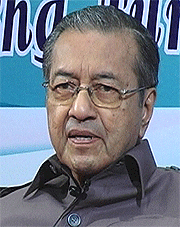
, started yesterday's evening session in Universiti Malaya with recounting his fascination in writing about Mahathir, owing to his interests in Southeast Asia and the rise of dominant political figures here like Ferdinand Marcos (Philippines), Suharto (Indonesia) and Lee Kuan Yew (Singapore).
Wain
(right)
, started yesterday's evening session in Universiti Malaya with recounting his fascination in writing about Mahathir, owing to his interests in Southeast Asia and the rise of dominant political figures here like Ferdinand Marcos (Philippines), Suharto (Indonesia) and Lee Kuan Yew (Singapore).
"As Malaysia was a rising Southeast Asian country, I thought it would be fruitful to write on Mahathir. I had interviewed the fourth prime minister three times before writing this book."
One of the lesser known things, Wain, 65, disclosed to the 100-plus audience that despite Mahathir being known to be anti-American, the former premier was agreeable to the country signing an agreement with the United States to allow the US army to conduct jungle warfare training in Johor.
Mahathir, the author said, had opposed the presence of the American 7th fleet in Singapore, but he did not make a public disclosure of 1984 document.
Wain, a former Asian Wall Street Journal editor said this showed the two contrasting characters of the Malaysia's fourth prime minister.
 "Despite Mahathir's passion for politics, such matters were never discussed at home," he said, adding he verified this fact with Siti Hasmah Mohd Ali, the former premier's wife.
"Hasmah said politics was never discussed at home. Even when Mahathir had written the infamous letter calling for the first premier Tunku Abdul Rahman's resignation following the 1969 racial riots, the matter was not made known to her or the family," he said.
It was as if Mahathir had compartmentalised his life, said Wain in providing an insight into Malaysia's long-serving prime minister.
Wain had mentioned this compartmentalised thinking in an exclusive interview with Malaysiakini.
Wain, also said while Mahathir was bent on the physical development of Malaysia, not much was centred on human capital development of the country.
Ong: Conduct research on brain drain
Political analyst Ong Kian Ming, one of the panelist who reviewed the book concurred with Wain, saying that studies should be conducted on this issue.
"For example, the Public Services Department spent a lot in awarding scholarships to Malaysians for overseas studies. However, when they return, do they work or contribute their best minds to the government and civil service?" he asked.
"I can say 99 percent of them are working outside the government. As a result, the civil service here is still incompetent."
 Ong, who had just completed reading his PhD in Political Science at Duke University in the US, asked why can't Malaysia emulate her southern neighbour, Singapore, in that the best minds are all in the government sector or in government-owned companies.
However, he stressed that while he was not arguing that the Singapore model was better, this contrast needed to be examined.
Prof Edmund Terence Gomez, another panelist agreed that despite all the attention in the New Economic Policy, Mahathir's (right) tenure as prime minister was not used properly to achieve its goals.
"Mahathir had noble goals. However, the outcomes of his policies did not conform with these goals. For example, Mahathir's aim was to industrialise Malaysia and create a new breed of Malay capitalists who would lead internationally renowned conglomerates," he said.
"But, by the end of his tenure, not even one Malay was listed among the top 10 publicly-listed companies. Seven of the top 10 companies in the Bursa Malaysia were GLCs. His heavy industry projects had also failed."
Gomez said that there was a need to understand what had gone wrong with the implementation of Mahathir's policies.
Wain: Investments not coming in
Wain noted that foreign investments to Malaysia had dropped compared with the 1990s.
"What is a source of concern is also that Malaysian businessmen themselves are not reinvesting in Malaysia but are doing so in some other countries. Money is not coming in but instead it is going out."
"The recent 10.1 percent GDP first quarter growth was as a result of government spending."
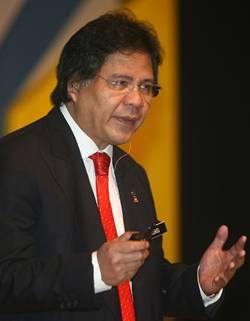 He agreed with the findings released by Minister in the Prime Minister's Department Idris Jala
(left)
yesterday that if
subsidies were not cut
, the country would go bankrupt.
He agreed with the findings released by Minister in the Prime Minister's Department Idris Jala
(left)
yesterday that if
subsidies were not cut
, the country would go bankrupt.
Wain, who was also the now defunct Far Eastern Economic Review editor, said besides subsidies, the Goods and Services Tax would have to be imposed to widen the base in taxes, through which the government could boost its revenue.
The author was also asked his opinion on why Mahathir supported Perkasa as it goes against his mooted idea of Vision 2020 of seeing the many races in Malaysia unify, and to which the reply was succinct: the former premier was a person who likes the limelight.
"He craves media attention and that is the reason why," he said.
Responding to another question whether he would write a second book on Mahathir since some topics like Sabah and Sarawak and aspects of his children were not covered extensively, the author said no, as his second would be on Southeast Asia.
Wain, said a sixth reprint of the book is in the works and that 4,000 copies of the books were sold out in Malaysia since the Home Ministry gave the green light for its distribution in the country on April 23, and another 5,000 copies had just been recently ordered.
He also said that he had given a copy of his book to Mahathir but had not either personally met him or knew his response to it.
Purchase 'Malaysian Maverick' online from Kinibooks .


Are you sure you want to delete this comment?
This action cannot be undone.