




Speaker cornered
Singapore's blogosphere was abuzz last week. And it's not about the KTMB Tanjong Pagar land swap deal or the fulfilment of the Points of Agreement of 1990 between Malaysia and Singapore.
Singapore's blogosphere was abuzz last week. And it's not about the KTMB Tanjong Pagar land swap deal or the fulfilment of the Points of Agreement of 1990 between Malaysia and Singapore.
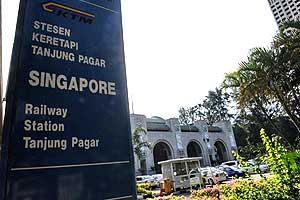 Singapore's online community is indignant for the most part with the barring of Vincent Cheng from speaking at a forum organised by university students, the NUS History Society for June 4, 2010 at the national library.
Cheng was detained without trial under the Singapore ISA for a year and his detention was extended for two years. In addition, he had restriction orders for a further five years.
Twenty-two people comprising of human rights defenders, lawyers and university student leaders were detained allegedly for a "Marxist conspiracy" in May, 1987. These allegations have not been proved.
Lee Kuan Yew first used preventive detention against his political opponents in Operation Cold Store and Operation Pechah (Break), both in 1963 before Malaysia Day in Sep 1963.
The 70s saw the forced closure of the Singapore Herald and the Eastern Sun and crackdown of Nanyang Siang Pau editors and journalists under ISA. According to Amnesty International, a slew of ISA arrests in the 1970s were targeted primarily at journalists and lawyers.
These arrests secured for the island republic, an uncritical press. For Lee, there cannot be any expression of editorial opinion other than his own.
Most of the 70s ISA detainees were released after forced confessions, something Malaysians are familiar with under its own ISA. Two journalists were deprived of their citizenship.
One was Shamsuddin Tung the former editor of Nanyang Siang Pau , the other was Arun Senkuttuvan. Arun was correspondent for the Economist and Financial Times.
Said Zahari, editor/journalist detained in Operation Cold Store was released in 1979 making his detention the longest of any journalist under the ISA.
'Abused and bullied'
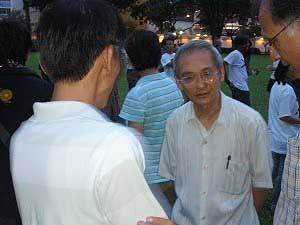 Vincent Cheng (
right
) shared the ordeal of his detention only in 2009, 22 years later. He was "abused and bullied" (read tortured) into writing self-incriminating lies and half truths.
Vincent Cheng (
right
) shared the ordeal of his detention only in 2009, 22 years later. He was "abused and bullied" (read tortured) into writing self-incriminating lies and half truths.
He suffers agony "shedding tears from my sense of utter powerlessness, loss of self-esteem and constant worry over how my ‘confession' would harm others."
The reasons for barring Cheng from speaking at the June 4th forum remain obscure to the public. The reasons were not made known to the student organisers. The public do not know why and how the invited speaker was barred.
This may appear absolutely nonsensical to Malaysians and more so to the community of human rights defenders who have campaigned for the abolishment of ISA since Operation Lalang (October, 1987) in Malaysia.
But this is the ‘other Singapore', not very much known across the Straits of Johor. There are speculations online that citizens as a whole are extremely jittery about rocking the boat of a first world Singapore.
It may well be that a board member of the national library who made the decision to bar Vincent had acted entirely on his/her own. There have however been past incidents where government agents have harassed venue owners.
Last year, independent film-maker, Martyn See had to postpone a public forum on the Operation Spectrum arrests because of harassment and intimidation.
A muzzled and compliant press and self censorship, based on a fear of the state has served Lee well. Lee's modus operandi is repression. It can be said that Lee actually put in place a scheme of repression that he voiced out against, as a member of Singapore's Legislature in 1956 (then a British colony).
"All you have to do is to dissolve organisations and societies and banish and detain the key political workers in these societies. Then miraculously everything is tranquil on the surface.
"Then an intimidated press and the government-controlled radio together can regularly sing your praises, and slowly and steadily the people are made to forget the evil things that have already been done, or if these things are referred to again they're conveniently distorted and distorted with impunity, because there will be no opposition to contradict."
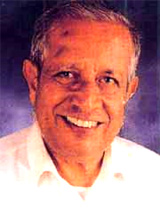 This is the same man who said of the late JB Jeyaretnam
(left)
, "If you are a troublemaker... it's our job to politically destroy you. Put it this way. As long as JB Jeyaretnam for what he stands for - a thoroughly destructive force - we will knock him.
This is the same man who said of the late JB Jeyaretnam
(left)
, "If you are a troublemaker... it's our job to politically destroy you. Put it this way. As long as JB Jeyaretnam for what he stands for - a thoroughly destructive force - we will knock him.
Everybody knows that in my bag I have a hatchet, and a very sharp one. You take me on, I take my hatchet, we meet in the cul-de-sac."
Dare Singaporeans, dream again?
SALBIAH AHMAD is a lawyer by training and works on human rights issues with a specialisation in Islam and gender


