




BN's shock therapy
MP SPEAKS The twisted reality of Umno leaders has not changed. And neither has the government's penchant waned for turning propaganda into political reality.
This is evident in the recent statement by Idris Jala, the minister in the Prime Minister's Department, who said Malaysia would be bankrupt in nine years if subsidies are not cut.
MP SPEAKS The twisted reality of Umno leaders has not changed. And neither has the government's penchant waned for turning propaganda into political reality.
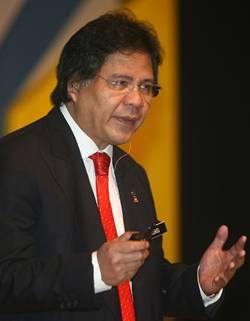 This is evident in the recent statement by Idris Jala
(left)
, the minister in the Prime Minister's Department, who said Malaysia would be bankrupt in nine years if subsidies are not cut.
This is evident in the recent statement by Idris Jala
(left)
, the minister in the Prime Minister's Department, who said Malaysia would be bankrupt in nine years if subsidies are not cut.
This clearly indicates that the BN-led federal government has lost all legitimacy to govern, as it has admitted that its economic model has failed.
And in a radical contrast to Prime Minister Najib Abdul Razak's rhetoric of putting ‘people first’, subsidy cuts are the preferred choice to avoid bankruptcy.
There has not been a whisper about institutional changes to improve efficiency in public-sector spending, or to reduce corruption, downscale wastage and promote a transparent and accountable government.
Discussions on reducing military spending without jeopardising security, the streamlining of unnecessary projects and right-sizing of the civil service are also yet to happen.
Instead a feckless decision on subsidy cuts on controlled items like fuel, sugar, flour and cooking oil has been proposed alongside allowing toll charges to rise,. This is despite concerns over the adverse impact on those who are poor or whose income is fixed.
 Idris provided political legitimacy for the subsidy cuts. In a SMS poll conducted by the government, 61 percent of the 191,592 respondents supported the subsidy reduction while another 66 percent suggested that the cuts should be phased out over three to five years.
The legitimacy of the SMS poll needs further scrutiny. This is because Malaysiakini recorded 222 comments within a couple of hours on this issue. And it is important to note that about 97 percent of the comments were highly critical of the government’s management of finances and economy.
A reader, who calls himself Bugis, said: ‘Idris your statement could finally be the straw that will break the back of this very very very corrupt government.’
Gen2 said: ‘Idris Jala. You are a smart guy but don't you realise you are the sacrificial lamb being put up to take the public's anger to deflect attention from all the past years of wastage?’
Yet another reader, Indhumathi, warned: ‘Idris you can be all wrong with your paper assumptions. Probably Umno had planted so called intellectual to portray a situation in order to frighten the people in subjecting or rather heeding to Umno's ways in order to gain billions in saved money so that the cronies can have a better life forever without having to sweat out. Don't fool the people.’
Fairplayer noted: ‘Idris, you should tell the Umno crooks to return what they have siphoned out from our treasury, for their excesses and corruptible indulgences, back to the nation's coffer! Umno is responsible for draining out our wealth in the last 53 years!’
These comments clearly show that a significant segment of the population is unhappy with the proposed subsidy cuts despite spin doctoring by the local media.
Feel-good reports
The mainstream media has argued that the country has no choice but to bite the bullet for the sake of future generations. The print media ran stories of individuals and representatives of business supporting the measures as necessary, while cautioning of political consequences.
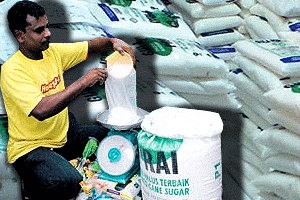 The business media reported that the proposed subsidy cuts for controlled items like sugar, flour and cooking oil would not burden the poor as these will be implemented in stages.
The business community and economists argued that the controlled goods are not major items in a household budget but cautioned about the knock-on effect on other items which could prompt prices to inflate.
However, they also said the impact of these cuts could be managed as it will not lead to a major adjustment.
The consumer and trade unions welcomed the move but expressed concern about the impact on the poor and workers with a fixed income.
In short, the media and corporations have cooperated with the government as a smart play for their career advancement.
But why aren’t the front-burner questions being asked?
The minister argued that high levels of debt (RM362 billion and growing) and unsustainable levels of subsidies (RM74 billion a year) have created a financial hole in economic management.
At present, the economy is faced with an estimated fiscal deficit of RM47 billion. This suggests that government expenditure exceeds revenue, suggesting a living-beyond-your-means scenario. This has been the case over the last 12 years.
And if government debt continues to pile up at the current rate of 12 percent per year, in another nine years (by 2019) national debt will equal GDP. Thus, the solution offered to mitigate financial collapse of the nation is to eliminate subsidies.
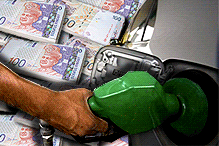 Specifically, subsidies for petrol, cooking oil, flour, sugar, gas and electricity are to be phased out. Also, toll rates are to be increased together with an increase in healthcare fees, combined with cuts in tuition subsidy and textbook loans for rich students.
In this schema, the government would save RM103 billion in the next five years which will be used to pay off the national debt. An important caveat to this effort is that subsidy cuts should be implemented immediately.
Where’s the accountability?
Put simply, these cuts would bail out the economy from a debt crisis, financial collapse and bankruptcy.
But let's go through a checklist:
- What no commentator has mentioned is that BN's 53 years of economic management have resulted in failure. From the 1960s to the 1980s, Malaysia was an envy of the developing world. At present, we are competing with the likes of Vietnam.
- If Malaysia is truly considered to be Malaysia Inc and if a company is confronted with debt and losses, together with the potential for bankruptcy in nine years, then stakeholders will demand that a new management team takes over.
- The Malaysian economic model that has been tinkering with a neo-liberal free market has been a failure. Large-scale transfer of public wealth to private hands has come to a naught.
- Malaysia is slated to attain developed nation status in 2020 but might face bankruptcy instead.
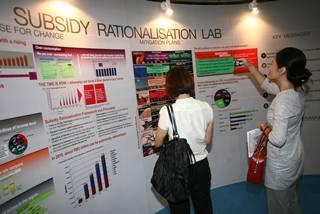
- The computer simulations predicting a marginal price increase is faulty. The government’s Subsidy Rationalisation Lab suggests that an increase of 15 percent in gas prices would result in a 1-4 sen increase in the prices of roti canai, nasi lemak, teh tarik and mee goreng .
The government’s simulation model has not factored in the nature and history of price increases in the country. Also, the simulators must have forgotten that prices of cooking oil, flour and sugar including fuel would be increasing at the same time.
It is important to note that the IMF and World Bank got it wrong in many countries. Failure stories in Indonesia, the Philippines, Africa and Russia call into question our continuing reliance on the Bretton Woods Institutions’ approach to structural adjustment.
- Are pro-market analysts in the driver’s seat?
- What are the implications on the quality of life of working women and men with increases in prices from GST and subsidy cuts.
I am verbalising the questions that linger in the minds of most Malaysians who have lost confidence in a government which has carelessly dismissed efforts at institutional changes to promote transparency and good governance.
The government's back-door deals and aversion to economic reform have sapped the nation's ability to address serious issues in a durable manner.
It is asking the people, especially the poor, to sacrifice but at the same time continues to dish out contracts to the rich in a non-transparent manner suggesting that the political-business link is alive and kicking.
The clumsy plans for subsidy slashes clearly reflect the government's lack of attempt at future reforms. Furthermore, shocking the population into submission with the view to accepting subsidy cuts will not be tolerated by a discerning population.
If the chief executive officer of Sime Darby could be told to step down after it was discovered that there was a cost overrun of RM1.6 billion, the same principle should apply to the BN government.
As such, I call on the government to dissolve Parliament and hold a snap election as it has failed the nation and its people.
CHARLES SANTIAGO is the DAP member of parliament for Klang.


Are you sure you want to delete this comment?
This action cannot be undone.