




Has Suhakam expired its shelf life?
COMMENT There appears to be public apathy about Suhakam. The several news reports on the national human rights commission in Malaysiakini from April to June had not encouraged much comment.
COMMENT There appears to be public apathy about Suhakam. The several news reports on the national human rights commission in Malaysiakini from April to June had not encouraged much comment.
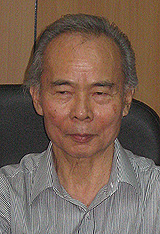 Even commissioner-in-office Simon Sipaun’s
derision
of the government’s disinterest in human rights last Sep went largely unnoticed. There was no public agitation at the Ministry of Foreign Affairs in response to this expose by Sipaun (
right
), who was also Vice-Chairman of Suhakam at the time. In fact, some 40 NGOs boycotted the September 2009 Suhakam Conference.
Even commissioner-in-office Simon Sipaun’s
derision
of the government’s disinterest in human rights last Sep went largely unnoticed. There was no public agitation at the Ministry of Foreign Affairs in response to this expose by Sipaun (
right
), who was also Vice-Chairman of Suhakam at the time. In fact, some 40 NGOs boycotted the September 2009 Suhakam Conference.
Does it not bring tears to your eyes that Suhakam is ignored by the government and isolated by the public? And thus these past commissioners retire without fanfare into a next life, for some in continued government service after a seemingly “ lost decade .”
We can only wonder if Suhakam has passed its shelf life?
No confidence
The establishment of a country-level human rights commission was part of an action plan agreed upon by governments pursuant to the 1993 UN Vienna Conference on Human Rights.
Malaysia’s human rights commission Suhakam came into being in 2000, a move observed to be motivated by public disaffection after Mahathir deposed Anwar Ibrahim in Sep 1998. This disaffection manifested in weekly street protests in the capital, practically a people’s vote of no confidence.
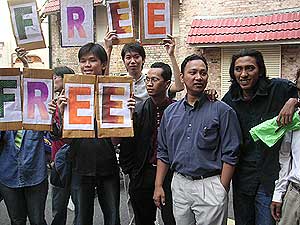 But complainants, like the student coalitions who campaigned for the students sacked under the University and University Colleges Act (UUCA) for holding an anti-ISA demonstration at the national mosque in 2001, gave up on Suhakam. They were disillusioned with a commission interested only in technicalities of human rights protection.
Despite misgivings about the efficacy of the commission to hold the government accountable and committed to human rights, the community of human rights defenders opted for constructive engagement.
NGOs are relentless on their demands that Suhakam be independent in its structure and processes according to the Paris Principles. The test of independence lies with the public and whether those who use its services believe it to be effective.
Hence Suaram’s agitation over the secrecy of the new commissioners is understandable.
A stand on human rights
Being independent does not mean being non-partisan. This point is hardly ever debated and there is common confusion about its meaning.
I remembered the point being raised at one of the early meetings in Kuala Lumpur, for the promotion of an ASEAN mechanism on human rights. At that time the only ASEAN country with a national human rights commission was the Philippines.
A government representative’s opinion that human rights commissioners should remain non-partisan was challenged by an NGO participant. The nature of accountability of governments to human rights can only mean that there must be a clear stand to be on the side of those discriminated and marginalised. And to make this possible, the commissioners have to be independent not non-partisan.
The second-term commissioners had played an advisory role to the government ad nauseum for several terms.
Same old Suhakam?
It was probably diplomacy with the UN that allowed Suhakam to retain its place in the ‘A’ list of the International Coordinating Committee of National Human Rights Institutions and a place in the Human Rights Council. The trade-off could be the appointment new Suhakam commissioners. That may explain the delay in making the new appointments.
 Will the new commissioners step up, or will Suhakam be used willy-nilly, or suka-suka as the Malay idiom goes, by the government as an escape-hatch to accountability?
The new commissioners will assume office in a Suhakam that, in terms of its structure and processes has not changed. Is it inevitable that they will merely continue the path of their predecessors?
I am reminded of Justice Muhammad Kamil ’s last act on the bench as an election judge. He complained of government interference, and he also did his job as a judge to safeguard human rights. In 2001 he declared that the Election Commission had failed its duty to ensure a clean electoral roll. This makes the roll illegal and the election, null and void. That reinstated the rights of voters in Likas to a fair and free election.
Suaram’s demands are clear and very doable. But what is of a greater concern is whether the new commissioners will be creative enough to begin processes of engagement which will set benchmarks for government accountability and commitment.
SALBIAH AHMAD is a lawyer by training and works on human rights with a specialisation on Islam and gender.


