




Gov't learns from mistakes, but no austerity drive
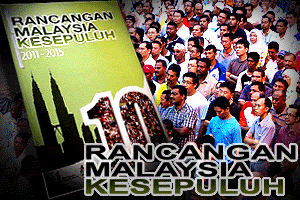
The government is allocating about RM90 billion for the next two years under the 10th Malaysia Plan.
The government is allocating about RM90 billion for the next two years under the 10th Malaysia Plan.
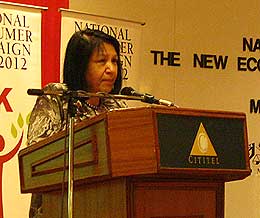 However, ministerial allocations have yet to be finalised as the Economic Planning Unit is still in the process of budgeting, said its director-general Noriyah Ahmad.
Speaking to reporters after a Fomca forum at a Kuala Lumpur hotel today, she said that this is unlike the 9th Malaysia Plan, which lacked flexibility in its responses to crises.
"During the food crisis we needed to spend money to solve it, but then we realised all the contracts had already been given out and there was no way to cut spending, so we had to enlarge the budget.
"We learn from our mistakes. Now we will be operating on a two-year rolling plan so only projects that are ready to go will be funded, and we then can respond to needs," she said.
Likewise, the government will also not go on an austerity drive, as previous ones had caused private industry to reel from lack of government-sourced demand.
"For example, the hotel industry will be hurt if we have all our meetings in the office, and this at a time of H1N1 and a drop in private spending," she said.
Spending prudently
 She said that instead, the government will look at prudent spending on projects, whereby those worth RM50 million and above will be required to go through a "value management stage" to contain the expenditure.
While specific allocations are still not known, Noriyah shared that the defence budget will not be increased, and will be a "continuation (of current budget) and mostly for equipment".
Ten percent of the RM230 billion allocated for the 10th Malaysia Plan is allocated for security purposes, which includes national defence.
On bumiputera affirmative action, Noriyah said that while the 30 percent equity target stands, it is no longer a compulsory requirement for businesses.
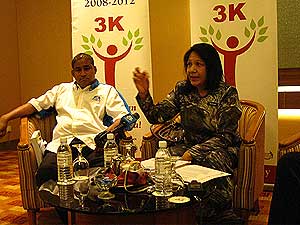 "This marriage of convenience does not work. You give 30 percent of shares to a bumiputera and he'll just be a sleeping partner.
"So now we say, you (non-bumiputera owned businesses) don't have to give 30 percent of shares to bumiputera, but (the government) will help bumiputera businesses so they can stand on their own," she said.


