




The robotic Malaysian in the 'Allah' row
COMMENT At the Bloggers Universe Malaysia (BUM) gathering on May 22, the ethnocentricity of the Malay-Muslim mind showed in the form of its steadfast impertinence to those who appear to criticise Islamic principles and features.
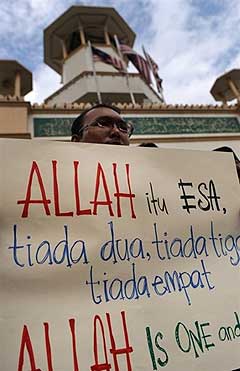
I refer specifically to the word ‘Allah’, a subject for discourse by those present. Blogger Akhramsyah Muammar Ubaidah Sanusi has been the strong flag bearer of this mantra. He stated that non-Muslims are not to use it, for by doing so would confuse the Malays.
The root or source of the possible confusion seems to be that in Islam there is only one God with the name of Allah. But in Christianity there are
COMMENT At the Bloggers Universe Malaysia (BUM) gathering on May 22, the ethnocentricity of the Malay-Muslim mind showed in the form of its steadfast impertinence to those who appear to criticise Islamic principles and features.
 I refer specifically to the word ‘Allah’, a subject for discourse by those present. Blogger Akhramsyah Muammar Ubaidah Sanusi (
left
) has been a strong flag bearer of this mantra. He stated that non-Muslims are not to use the word, for by doing so would confuse the Malays.
I refer specifically to the word ‘Allah’, a subject for discourse by those present. Blogger Akhramsyah Muammar Ubaidah Sanusi (
left
) has been a strong flag bearer of this mantra. He stated that non-Muslims are not to use the word, for by doing so would confuse the Malays.
The root or source of this alleged confusion seems to be that in Islam there is only one God with the name of Allah. But in Christianity there are three: first, God (as the supreme meta-physical super-human principle of transcendence) per se; second, Jesus as the son of God and third, the Holy Spirit or Ghost.
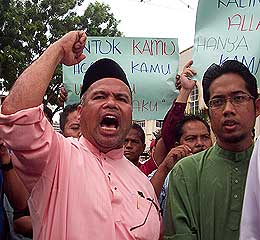
Akhramsyah further contended we are a democratic country where the majority rules. So as the majority rules that ‘Allah’ is not to be used by non-Muslim, then this ruling must be respected by the minority.
He suggested for non-Muslims to use ‘Alah’ rather than ‘Allah’ as a compromise, surely a superficial and cosmetic solution.
One meaning of ‘Allah’
This subject has been in the public domain for quite a while and would be a definite case of déjà vu by my repeating it in this article. But the issue is so compelling that I have to proceed commenting on it.
Consider the following:
Firstly, Al-Lah is Arabic for ‘the God’. This can be understood and even be seen by the phrase ‘La ilah ha il Allah Muhammad ur Rasul Allah’ a mantra uttered and repeated almost by the hour by any good Muslim. ‘La ilah’ means ‘there is no God’ and ‘Ha il Allah’ means ‘but God’.
The rest i.e. ‘Muhammad ur Rasul Allah’ means ‘and Mohammad is God’s Prophet’. So its direct translation would be ‘There is no god but God, and Muhammad is God’s prophet.’
(Note the same root word ‘Lah’ for God in the three occasions it has been used, in this short but vitally important religious mantra. This has been pointed out at the BUM forum by MP Khalid Samad who was also present).
Second, its usage in history. As far as I know, when the Prophet Ibrahim or Abraham founded the concept of monotheism in 20th-19th centuries BCE he was already bandying ‘Al-Lah’ when proselytising the principle of the One God to the unbelieving and polytheistic nomadic desert tribes.
 This label had since then been used by all subsequent prophets, which Islamic philosophers say amount to no fewer than 240,000 in their total number. It has been so for 4,000 years. It has been so until the present day.
Third, its usage at the present time. Arab Muslims and non-Muslims alike all use Allah to refer to God.
Similarly non-Arab Muslims or non-Muslims, like the peoples of Indonesia (250 million of them) also find no objection to this word. The same goes to the Christian (or Jewish) Egyptians, Iraqis, Iranians, Afghans and so on.
And don’t forget the Sikhs in this country and elsewhere in the globe. In their religious scripture ‘Guru Grant Sahib’ God is called by all the Hindu names and Allah as well.
Then we have the perennial Islamic teaching that Allah is God and He has 99 different names like Al-Rahman, Al-Rahim. The most peculiar thing is that when you go through the entire list, ‘Allah’ is tellingly not one of them.
Copernicus
Akhramsyah’s single-mindedness is reminiscent of Copernicus in the 15th century. During his time the belief had been that the sun and all the other planets moved around planet Earth. He was the only one single human soul who thought otherwise, that Earth and the other planets moved around the sun.
As human civilisation progressed and developed and the level of human knowledge increased by leaps and bounds, Copernicus was proven right.
In the case of Akhramsyah, however, (and here he represents the only one community in the whole world that says the word ‘Allah’ is strictly for Muslims) I do not think he will be proven right by time.
So for ‘Allah’ to mean ‘God’ to the generic human civilisation has gone through the test of time of over 4,000 years. Could Akhramsyah repeat a Copernicus? Based on the narrations above I am not inclined to think so.
Galileo
As it turns out Wan Azhar Wan Ahmad of Ikim in his article ‘Blasphemy can lead to apostasy’ has cautioned all Muslims not to be too brave with items of faith for there is a thin line between blasphemy and apostasy. And apostasy is a huge and most definite no-no in Islamic reckoning.
Wan Azhar has cautioned all and sundry not to play around with Islam, its tenets and principles, its teachings and philosophies. It is already a perfect religion when God revealed it first to Adam and later to Prophet Mohammad. He lamented that many Muslims are having the temerity and audacity to question or challenge Islamic principles.
In this article, I’ll address Akhramsyah’s contentions and Wan Azhar’s cautionary words together for I believe they have a strong cause and effect relationship: ‘I contend and believe that ‘Allah’ is exclusively the name of the Muslim God. If I do not believe it then I might be blasphemous and an apostate.’
This article is not about challenging the teaching of Islam. It is comparing the thinking platform Wan Azhar uses in his defence of the sanctity and piety of Islam with that of the more rational human mind. For this, I have to bring on Galileo, the ‘Father of Modern Science’, who broke the line of thinking similar to that used by Wan Azhar.
 Galileo says that no past wisdoms should be accepted in toto. Everything must be observed, experimented upon, followed by analysis, hypothesis, synthesis and conclusion, before any wisdom is to be accepted at all.
More than that - he taught all and sundry to record each observation and experimentation to allow other people to repeat them for themselves. Virtually all of the accumulation of scientific knowledge that we see around us today are the ‘results’ of this penetrating thinking method known as the ‘scientific method’.
In Islam, however, no such scientific method ever existed. It’s more that Islam is already in a state of perfection. What is perfect is to be emulated and approximated, not destroyed. So much so that an adherent would do well here and in the next world if he loyally and dutifully observes and obeys and performs all of its principles and tenets and rules and regulations. It’s more ‘do as I tell you, and do not question anything’.
I think this is a form of theological bullying. You don’t allow your followers to say any bad things against you, you just simply make them follow your rules and regulations. You do not allow for any debate, not to mention experimentation. It is not a case of scientific thinking but of ‘might is right’, of using brute force or a strong central authority over rationality.
Majority in a democracy
To come back to Akhramsyah’s postulations, I’d repeat yes in a democracy the majority rules and the minority must respect this.
But we all have heard of the bane of democracy – the tyranny of the majority. The majority Malay in this case should always use common sense, fair play and good judgment when running the country. In any good democracy, we should be able to draw the line between the fairness and justice with the tyranny of the majority.
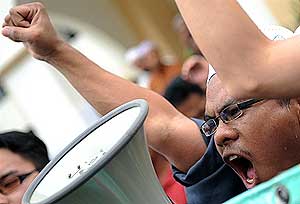 In any event, Akhramsyah used it in a limited sense, in a political context, and within the country. What happens of this word is used alternatively in the economic context and well out of the borders of Malaysia? Consider the following:
Firstly, economically the majority of income tax payers in the country (some say up to 80 percent) are non-Malay. Are we going to ignore the interest and beliefs of the (majority) tax-paying non-Malay? Would this not be tantamount to the tyranny of the political majority Malay over the political minority (but tax-paying majority) non-Malay?
Secondly, when Akhramsyah mentioned the Malay-Muslim majority who supported the ban on non-Muslim use of 'Allah', on what authority has he been in doing so? The point is, there can be many Malays who might object to his contention and presumptuousness. (How can we be sure this issue has not been used only by the 'Ketuanan Melayu' advocates to suit its private agenda, for example).
Third, with almost the rest of the Muslim world (read that as the Muslim majority) totalling about 1.5 billion people not objecting to this term, it appears that it is only the Malay-Muslim in Malaysia comprising say 15 million (i.e. the minority) who is making this contentious claim. Akhramsyah should be looking for ways and means to ‘respect the wishes’ of the vast majority of Muslims the whole world over, in the past and at present.
Might is right, might makes right
The sad part is the government of the day otherwise known as the 'Ketuanan Melayu' leadership are learning this principle of might is right and perhaps on the basis of imitation, the present government is politically bullying the citizenry.
The Ketuanan Melayu leadership using the ‘might is right’ principle of governing where strength or physical might (in this case the numerical and political majority of the Malay) can establish moral right, as it appears to be in this case.
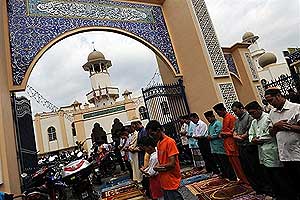 Later this might become ‘might makes right’ whereby the view of right and wrong is determined by this same 'Ketuanan Melayu' institution. The views and sentiments of the people are completely ignored.
What a way of governing a country when the authorities deny its own citizens from discussing the very ideas and principles that are central to their lives. What a way of governing when the people are not allowed even to think creatively and imaginatively.
Perhaps Raja Petra Kamarudin is right when he suggested in his blog that the government appears to actively suppress our thinking facilities. In the event we and our future generations will soon be reduced from thinking human beings to mechanical robots.
AB SULAIMAN is an observer of human traits and foibles, especially within the context of religion and culture. As a liberal, he marvels at the way orthodoxy fights to maintain its credibility in a devilishly fast-changing world. He hopes to provide some understanding to the issues at hand and wherever possible, suggest some solutions. He holds a Bachelor in Social Sciences (Leicester, UK) and a Diploma in Public Administration, Universiti Malaya.


Are you sure you want to delete this comment?
This action cannot be undone.