




Reasons for Nazri's longevity
COMMENT There is no accounting for the worth of Pakatan Rakyat’s ‘secret weapon’ in Umno-BN - Mohd Nazri Aziz, the minister who must easily qualify as the ‘great survivor’ of Malaysian politics.
COMMENT There is no accounting for the worth of Pakatan Rakyat’s ‘secret weapon’ in Umno-BN - Mohd Nazri Aziz, the minister who must easily qualify as the ‘great survivor’ of Malaysian politics.
Nazri has survived as minister into a third change of prime minister, an impressive longevity in a sphere where tenancies are ephemeral.
No doubt he has done well for his patrons, and not just them; his loose cannon ways redound to the opposition’s advantage too.
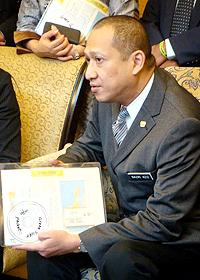 Nazri, who can be depended on to unleash fusillades against targets in the Umno-BN orbit that Pakatan may find better to leave alone, had Perkasa and Gertak in his crosshairs the other day.
He allowed that both Malay NGOs that are busy these days generating a siege mentality among Malays would not survive without Dr Mahathir Mohamed’s patronage.
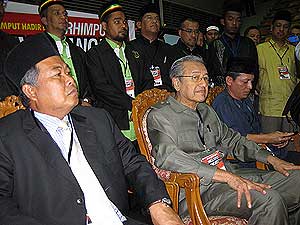
Nazri must have made that deduction partly on account of the sparseness of the crowd at the Gertak-organised ‘Bangkit Melayu’ rally in Kuala Terengganu last week: an underwhelming 1,000 people gathered in an indoor stadium to hear Mahathir’s ‘state of the Malays’ oration.
The numbers were nothing near the tens of thousands that then Umno secretary-general Sanusi Junid had threatened to assemble at the Merdeka Stadium in late 1987 when thunderheads boiled up on the national horizon because of a controversy over the posting of non-Mandarin speaking teachers to Chinese schools.
At that time, Sanusi’s threat of assembling a huge throng was credible because language and race were inflammatory issues.
It’s not that these issues are no longer emotive; it’s just that their voltage is not as high as to readily drive people to display their feelings in mass gatherings.
The big difference between then and now is that more Malaysians have entered the middle-class and that class is sufficiently populous these days to render them impervious to radical incitement.
A broad middle-class, social analysts say, is a reliable hedge against radical behaviour.
This was the reason why acts of arson and sacrilege against places of worship in the wake of the High Court decision on the ‘Allah’ issue earlier this year did not provoke displays of mass outrage.
Media reports of religious tensions rising in the country because of these incendiary acts reflected journalistic hype more than the actual realities on the Malaysian streets.
Khairy versus Mukhriz
This brings us to the probable motives behind Mahathir’s patronage of Perkasa and Gertak, NGOs that Nazri predicts would wane once the octogenarian former prime minister departs the national scene.
 Mahathir is adept at keeping a fire going as a smokescreen, the better to advance his agenda in another area that is more central to his concerns.
Umno Youth chief Khairy Jamaluddin’s claim the other day that he and Prime Minister Najib are reformists would give some idea of the jockeying in the upper tier of Umno with regard to positions in the cabinet.
Najib could use the services of an ostensible liberal on race and economic issues like Khairy in the cabinet, from which the Umno Youth chief was excluded when the new PM announced his line-up in April last year.
But Mukhriz Mahathir, who lost to Khairy in the fight for the Umno Youth presidency, was appointed a deputy minister.
This was widely seen as a sop to his father Mahathir just as Khairy’s exclusion was viewed as an attempt at further ingratiation of the former PM to whom Khairy is anathema.
Mahathir must reckon that by lending his patronage to Perkasa and Gertak he can keep the pressure on Najib enough for him to be wary of displeasing the former PM by including Khairy in the cabinet.
Mahathir may feel that if Najib, progeny of a former PM, can ascend to the top of the greasy pole, why not Mukhriz.
That’s where a person like Nazri comes in handy. He is useful for putting things in perspective that actual protagonists cannot intimate in public, but would like it done nevertheless.
It helps keep the main actors in the wider drama aware of the limits to their room for manoeuvre and their exploitation of red herrings to further parochial interests.
TERENCE NETTO has been a journalist for close on four decades. He likes the occupation because it puts him in contact with the eminent without being under the necessity to admire them.


