




Gov't in 'no hurry' to decide on UPSR, PMR exams
The government has not set any time-frame to decide whether to abolish or retain the Penilaian Menengah Rendah (PMR) and Ujian Pencapaian Sekolah Rendah (UPSR) examinations, Deputy Prime Minister Muhyiddin Yassin said.
The government has not set any time-frame to decide whether to abolish or retain the Penilaian Menengah Rendah (PMR) and Ujian Pencapaian Sekolah Rendah (UPSR) examinations, Deputy Prime Minister Muhyiddin Yassin said.
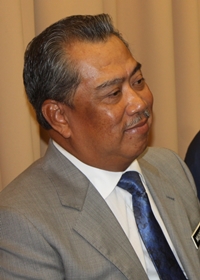 Muhyiddin, who is the education minister, said the government was in no hurry to decide on the matter.
He said he was still weighing the responses from all interested parties.
"When we are satisfied with it, we will announce the decision," he told reporters here after opening the 2010 Education Services Conference today.
Muhyiddin said on Sunday that the government was mulling over abolishing the two examinations as part of the effort to transform the country's education system which some said was too examination oriented.
He also called on the public as well as education experts to give their feedback on the proposal.
Muhyiddin said that so far the people had responded actively to the idea, putting forth arguments both in support and against the idea.
"Some agree that both examinations should be abolished while others want one of them retained. We are still waiting for others to give their views on the matter," he said.
All views would be collated and discussed at the ministry's level involving interested parties and stakeholders, he said.
He said that for a start the ministry had taken the initiative to scrutinise recommendations by several survey bodies on the country's examination system.
Independent Consensus against proposal
Meanwhile a group of Independent MPs, who called themselves Independent Consensus, voiced disagreement to the proposal to abolish the two examinations.
Heading a press conference held by the Consensus at the parliament lobby here, Bagan Serai MP Mohsin Fadzli Samsuri said the UPSR was for measuring the academic performance of Year Six students and the PMR, after nine years of schooling.
"More than that, the two public examinations also measure the effectiveness of teaching and learning among districts and states, as well as among schools with different socio-economic backgrounds.
"The rationale of the UPSR and PMR making the national education system too exam-oriented cannot be denied, but abolishing them is not the best solution. This is because only a balance between academic achievement and co-curricular involvement will create an education system that is holistic," he said.
Mohsin Fadzli said the teacher training methodology and school syllabus should thus be reviewed to create a holistic system of education.
He also noted that the country's education system appeared to depend on the whims of the minister.
"The system changes according to who holds the education portfolio. Therefore, the Consensus suggests that the government formulate a long-term national education system that is consistent and has continuity," he said.
The press conference was also attended by Bayan Baru MP Datuk Seri Zahrain Mohamed Hashim, Wee Choo Keong (Wangsa Maju), Zulkifli Noordin (Kulim Bandar Bharu) and Tan Tee Beng (Nibong Tebal).
The Independent Consensus was set by five members of parliament who were previously from PKR.
Meanwhile, Tony Pua (DAP-Petaling Jaya Utara) at a separate press conference said that without changing the present teaching system to encourage creativity, critical thinking and innovation, removing examinations would make no difference to the quality of education.
"However, we would like to express our thanks to the deputy prime minister for also stating that the ministry would not act in haste and wanted the public to give feedback to help improve the public examination system," he said.
- Bernama


