




DPM: Vernacular schools not sidelined
Deputy Prime Minister Muhyiddin Yassin (BN-Pagoh) stressed that the government is not sidelining vernacular schools.
Deputy Prime Minister Muhyiddin Yassin (BN-Pagoh) stressed that the government is not sidelining vernacular schools.
He said this while winding-up the 10MP debate, in reply to opposition parliamentarian Teoh Nie Ching (DAP-Serdang) who had alleged that federal education reserve land was denied to vernacular schools by the federal government.
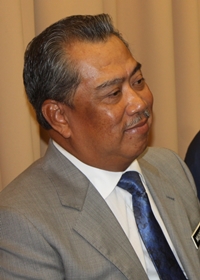 The reason vernacular schools were not allocated land from the education reserve, said Muhyiddin (
left
), who is also the education minister, was due to priorities.
The reason vernacular schools were not allocated land from the education reserve, said Muhyiddin (
left
), who is also the education minister, was due to priorities.
"We are not sidelining vernacular schools but we must give priority to the national education system. We respect the vernacular schools, we don't restrict or stop them from operating. In fact it is illegal for the minister to close down vernacular schools."
"Those sites are reserved for national type schools, not only for now but also for the long term. If we give them to the vernacular schools, when the time comes to expand national type schools, we will have to relocate to more expensive sites," he answered.
Teoh had earlier asked Muhyiddin about the ministry's policy on not providing land from the education reserve to vernacular schools which want to relocate to areas with more students.
"All schools that want to relocate must find its own site and they cannot use land from the education reserve. Why can't they use education reserve land? Is this 1Malaysia? Why is it that the national type school can use the land while the Tamil and Chinese schools can't?," she asked.
Teoh further alleged that the schools have been sidelined.
The denial of land, said Muhyiddin, does not mean that the ministry does not support vernacular schools. Instead, he said, they merely asked for understanding and cooperation from the Chinese and Tamil communities that the ministry has to look to the national type schools first.
Denying that the government is unfair in its handling of the matter, the deputy prime minister pointed to the RM1.8 billion the ministry is spending annually to pay for the wages of Tamil and Chinese school teachers.
"We pay them wages, we don't care if they support the DAP or BN...This shows that we support these schools... this is a big allocation, we provide the teachers, we pay their wages, can't they find their own site?," asked Muhyiddin.
He added that it is not as if the government had not helped vernacular schools before with regard to land.
"I have gone myself to give RM3 million in Hulu Selangor for land for a Chinese school."
Education allocations
During the same winding-up speech by Muhyiddin, he was asked by Penang Chief Minister Lim Guan Eng (DAP-Bagan) on the possibility of allocating funds for educational development according to the percentage of students in the schools.
 "Can you consider that development allocation be given according to the percentage of students in the schools. If the percentage of students is 22 percent, give us 20 percent of the allocations. Now we only receive 3.6 percent," quizzed Lim (
right
).
"Can you consider that development allocation be given according to the percentage of students in the schools. If the percentage of students is 22 percent, give us 20 percent of the allocations. Now we only receive 3.6 percent," quizzed Lim (
right
).
Muhyiddin however brushed aside Lim's suggestion, saying that any allocation of funds must be holistic.
"We look at infrastructure, not at the number of students. This must be a holistic approach as we have 5.6 million students to look after."
Contending that in different areas, development may cost more regardless of the number of students, Muhyiddin gave the example of a school in Sarawak which he had ordered to be rebuilt.
"The school which I saw was flooded 18 times, despite there being only 12 months in the year. I ordered it rebuilt. If it is over here, the cost would be RM10 million, but over there the cost is RM56 million. If we distribute allocations using this formula, it will not be fair," said Muhyiddin.
He maintained that this difference in the cost of infrastructure and other costs will make it difficult to give allocations purely based on the percentage of students.


Are you sure you want to delete this comment?
This action cannot be undone.