




Should lawmakers enjoy legal immunity?
Besides the issue of whether PKR strategist Tian Chua should remain as Batu MP due to the RM2,000 fine imposed by the High Court, the criminal case raised a bigger question - should an elected representative be disqualified after being sentenced to a fine of a certain amount or a jail term irrespective of the offence?
SPECIAL REPORT Besides the issue of whether PKR strategist Tian Chua should remain as Batu MP due to the RM2,000 fine imposed by the High Court, the criminal case raised a bigger question - should an elected representative be disqualified after being sentenced to a fine of a certain amount or a jail term irrespective of the offence?
What more when the lawmaker is sentenced due to an offence that is linked with voicing out the people's concerns or fighting for more democratic space?
Chua's case falls squarely into this category.
Revisiting Tian Chua's case
 Chua (
right
), who was then yet to be elected as a parliamentarian, participated in a peaceful assembly on Dec 12, 2007 organised by election watchdog coalition Bersih to protest the constitutional amendment to extend the tenure of the Election Commission (EC) chairperson, which the coalition claimed would enable the allegedly biased chairperson Abdul Rashid Abdul Rahman to conduct the next general election.
Chua (
right
), who was then yet to be elected as a parliamentarian, participated in a peaceful assembly on Dec 12, 2007 organised by election watchdog coalition Bersih to protest the constitutional amendment to extend the tenure of the Election Commission (EC) chairperson, which the coalition claimed would enable the allegedly biased chairperson Abdul Rashid Abdul Rahman to conduct the next general election.
He was trying to enter the Parliament compound in a car to submit a memorandum to the lawmakers when he was forcefully pulled out from the vehicle by policemen and a scuffle broke out between the two parties.
Police then arrested Chua and charged him under Section 332 of the Penal Code (voluntarily causing hurt) for allegedly biting the arm of a policeman during the scuffle.
He was initially sentenced to six months in jail and a fine of RM3,000, but this was later reduced by the Kuala Lumpur High Court to RM2,000 or two months' jail in default.
RM2,000 fine is outdated
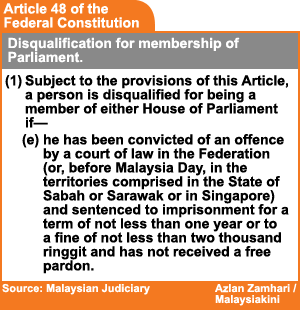
Article 48(1) of the Federal Constitution stipulates that a member of parliament is disqualified if sentenced by any court to a fine of "not less than RM2,000".
 Although 53 years of inflation has increased the prices of goods and services a few times higher, the RM2,000 ceiling fine has not changed since independence.
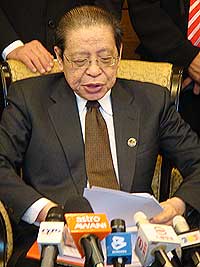
DAP supremo Lim Kit Siang ( left ) had suggested increasing the ceiling fine to RM20,000 considering the inflation factor.
This view was shared by former Bar Council president Yeo Yang Poh ,who was of the view that the RM2,000 is way too low and outdated.
"Nowadays even a traffic offence fine can exceed RM2,000," said Yeo when contacted by Malaysiakini recently.
Fear of losing seat
Former Human Rights Society (Hakam) deputy president Yang Pei Keng added that Article 48(1) is too harsh to the extent that it would hinder representatives from speaking up for the rakyat due to fear of losing his or her seat.
Soon after Chua's sentence was announced, DAP chairperson Karpal Singh openly reminded Pakatan Rakyat MPs to avoid participating in illegal assemblies as the offence carries a minimum fine of RM2,000.
Commenting on Karpal's statement, Yang pointed out that the definition of illegal assembly lies completely with the government and the enforcement agencies fail to carry out their duty fairly towards opposition and ruling politicians. This is further compounded by the lopsided judiciary system.
"All these factors cause Article 48(1) to be very detrimental to the opposition," said the veteran lawyer in a phone interview recently.
 Yeo (
right
) described the disqualification of an MP for participating in an illegal assembly as "ridiculous", and the Sedition Act 1948 that is frequently used to stifle opposition as a "16th century law" that should not exist in a modern nation.
Yeo (
right
) described the disqualification of an MP for participating in an illegal assembly as "ridiculous", and the Sedition Act 1948 that is frequently used to stifle opposition as a "16th century law" that should not exist in a modern nation.
Since February this year, there are at least 18 Pakatan representatives under police investigation for various offences including illegal assembly and sedition.
Although BN lawmakers also attended public rallies regarded by police as illegal such as the anti-Israel protest on Jun 4 spearheaded by Umno Youth Chief Khairy Jamaluddin, no action was taken against them.
Disqualification based on offence
On the issue of protecting lawmakers' rights in discharging their duty, Yeo suggested that the disqualification should depend on the nature of the offence.
"The offence should be related to certain qualities of the MP that we cannot tolerate such as honesty," said Yeo, citing criminal breach of trust as an example.
"Setting a ceiling fine is a wrong approach... the law needs to be changed, not on the ceiling fine but the nature of offence. Peaceful assembly should not be included."
 However Chua's case reflects another trend where the lawmakers are charged for other offences such as voluntarily causing hurt although the nature of the offence is illegal assembly, for which it is harder to obtain a conviction.
If we refer to the experience of another former British colony - Hong Kong, though the public has broader rights regarding peaceful assembly, protestors are usually charged with attacking the police when there is a scuffle with the authorities. Critics view this as an approach to smear the protestors using a legal loophole.
To maximise the protection of elected representatives, Yeo further proposed that the new law replacing Article 48(1) should list out serious offences that will disqualify lawmakers such as murder, kidnapping and fraud and exclude all other offences.
"If the Parliament later thinks they need to include other offences, then they will amend the law again to include the offences."
Taiwan and Philippines provide the solution?
Asked if Malaysia should emulate Taiwan and the Philippine where lawmakers enjoy immunity during their tenure, Yeo and Yang had different stands.
 Yang (
left
) gave a thumbs-up for the immunity because it could allow elected representatives to discharge their duty more effectively.
Yang (
left
) gave a thumbs-up for the immunity because it could allow elected representatives to discharge their duty more effectively.
"This practice by Taiwan is more democratic. It takes into account that lawmakers are elected by the people and they should not be oppressed during their tenure," Yang said.
However, Yeo was of the contrary view as it would still be open for abuse."It is not the solution."
He stressed that every law can be a tool for good or to be abused, hence it is not enough to have a good legal system without a strong justice system.
According to him, a strong justice system include good law, a democratic Parliament, an independent judiciary and unbiased enforcement agencies.
To him, the solution should come in a package that involves all institutions instead of amending a particular law.
"A justice system can be strong if only all these factors are strong. Unfortunately Malaysia is still weak in many departments. There is still a long way to go," he concluded.


Are you sure you want to delete this comment?
This action cannot be undone.