




Sword of Damocles over opposition MPs
SPECIAL REPORT PKR Batu MP Tian Chua is still in his seat, but whether his case will cast a chill on his colleagues, resulting in them becoming more conservative when fighting for democratic space and people's rights, is a question everybody is asking.
SPECIAL REPORT PKR Batu MP Tian Chua is still in his seat, but whether his case will cast a chill on his colleagues, resulting in them becoming more conservative when fighting for democratic space and people's rights, is a question everybody is asking.
Chua was recently fined RM2,000 for intentionally causing injury to a police constable on duty, but he is appealing the case. His lawyer, Ranjit Singh, says the appeal is sufficient to act as a stay against Chua's possible disqualification until the matter is disposed of by the court.
Currently, there are at least 18 Pakatan elected representatives under police investigation for various alleged offences, including illegal assembly and sedition.
Should they be found guilty and sentenced to not less than a year's jail, or a fine of RM2,000, they will lose their seat, according to Article 48(1) of the Federal Constitution.
Keeping the opposition in line
Many opposition elected representatives described the article, which had not been amended since independence, as a Sword of Damocles over them.
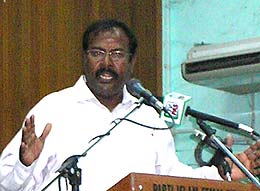
 For PKR vice-president R Sivarasa (
left
), who is still being investigated for illegal assembly and sedition, the article is nothing more than a political weapon the BN uses against the opposition lawmakers.
For PKR vice-president R Sivarasa (
left
), who is still being investigated for illegal assembly and sedition, the article is nothing more than a political weapon the BN uses against the opposition lawmakers.
"In other countries, MPs will not lose their seat due to offences of a political nature. Disqualifying MPs because they speak up for people is not tolerated in a democratic country," said the Subang MP when contacted by Malaysiakini .
Asked about DAP chairperson Karpal Singh's reminder to Pakatan Rakyat MPs to avoid participating in illegal assemblies as the offence carries a minimum fine of RM2,000, Sivarasa said: "The intended effect of the article is to make MPs practise self-censorship, forcing us to bite our tongue when we want to say something, and stand away from the rakyat."
Calculating risks
He conceded that he while he was mindful of the article when taking action that might be construed as breaking the law, his attitude was: "I try not to bother about it".
DAP Rasah MP Anthony Loke shares the same view that opposition lawmakers sometimes need to take calculated risks when taking any action.
"Of course we need to know our limits and whether what we are doing is really important... we have to know what the objective of the action is and be aware of the situation.
"But if it will help the rakyat, then we should do it," said Loke in a phone interview with Malaysiakini .
Political career, perks on the line
The stakes are high for lawmakers if they fall foul of the article, as not only they will lose their salaries and perks, their pensions will be forfeited as well.
Former lawmakers will also lose their pension if they exceed the maximum sentence, even though they have finished their tenure.
Furthermore, they will be deprived of political rights for five years after serving their sentence - they cannot contest in elections or assume posts in political parties.
Many politicians see the five-year ban as the death knell for their political careers because they would miss two general elections and party polls as well.
This has happened to opposition MPs who have been rising fast in national politics.
 The famous cases include Fan Yew Teng, Lim Guan Eng and Wee Choo Keong. All three lost their seats due to Article 48(1).
However both Sivarasa and Loke ( right ) are confident that Pakatan representatives will not be affected by Chua's case.
"Our track record speaks for itself. If we pull back, 80 or 90 percent of our actions would not have been done," Sivarasa said.
For Loke, it was "part and parcel of Malaysian opposition politics".
Nevertheless, Sivarasa agrees that abolishing Article 48 and other repressive laws, such as the Police Act and the Sedition Act, will establish more freedom for lawmakers.
Less risk for BN after three years
Another issue that has drawn the attention of some quarters is whether the cases of the 18 Pakatan representatives will drag on till after April 28 next year.
According to election laws, a by-election would only be called if a seat is declared vacant three years after the swearing in of a lawmaker. For the current Parliament, the cut-off date is April 28 , 2011.
Some political observers speculate that Chua was let off the hook due to BN's fear of facing a by-election in Batu, which PKR won in last the general election with a 9,455 majority.
There is little doubt the BN qwill benefit if opposition lawmakers are charged and sentenced after the three-year period as BN will be able to reduce the opposition in Parliament without much worry.
"The BN can then recapture the two-thirds majority and build up momentum to face the next general election," commented a political observer who requested anonymity.
 After Chua, the next case will be that of PKR Padang Serai parliamentarian N Gobalakrishnan (
left
).
After Chua, the next case will be that of PKR Padang Serai parliamentarian N Gobalakrishnan (
left
).
He was found guilty of obstructing the police in an incident eight years ago and sentenced to a fine of RM3,000 or a six-month jail term.
His appeal is still pending.
Besides the opposition, legal experts also agreed that Article 48(1) needed amending.
"From the perspective of the rakyat, Article 48(1) is too harsh, and puts the opposition in a difficult position.
"I don't know whether (these cases) are coincidental or deliberately (done)... it appears to be a trend (that Article 48 is being abused to oppress the opposition)," commented Yeo Yang Poh, former Bar Council president.
Previous cases of opposition lawmakers disqualified under Article 48(1):
Fan Yew Teng (1977)
 Fan (
right
) was a rising star in DAP when he was arrested in 1970 and later charged with sedition for publishing the speech of the then Penang DAP chairman, Dr Ooi Kee Saik, in the party's newsletter.
Fan (
right
) was a rising star in DAP when he was arrested in 1970 and later charged with sedition for publishing the speech of the then Penang DAP chairman, Dr Ooi Kee Saik, in the party's newsletter.
Initially he was fined RM2,000 or six months' jail but the court was ordered to rehear the case after he won his appeal to the Privy Council in United Kingdom.
When the case was heard again in 1975, Fan had been elected as Menglembu MP and Petaling state assemblyperson in the 1974 general election.
The Kuala Lumpur High Court again found him guilty and the Election Commission (EC) was quick to announce a by-election despite the fact that Fan had appealed to a higher court.
Two days before the polling day, the court ruled that the by-election was null and void, forcing the EC to cancel it.
Fan kept his seat until the Privy Council in 1977 upheld the High Court decision. However no by-election was called because the three-year period from the last general election had passed.
He later left the country for further studies and quit DAP in 1978.
Lim Guan Eng (1998)
The current DAP secretary-general cum Penang chief minister was arrested in 1994 when he was Kota Melaka MP, following his criticism of the government's handling of an allegation of statutory rape of a Malay minor by the then Malacca Chief Minister Abdul Rahim Thamby Chik.
Lim was charged under the Sedition Act and Printing Presses and Publications Act 1984 for causing "disaffection with the administration of justice in Malaysia" and '"maliciously printing" a pamphlet containing alleged false information.
He lost his seat after being sentenced to 18 months' imprisonment despite a series of appeals. Due to the five-year ban, the DAP Youth chief missed two general elections until he was re-elected in the 2008 general election.
Wee Choo Keong (1995)
 The current Wangsa Maju MP, who recently quit PKR and to become an Independent, was elected as Bukit Bintang MP in the 1995 general election under the DAP ticket.
His opponent, Lee Chong Meng from MCA, challenged his position after he was fined RM7,000 by the court for breaching a court injunction.
The injunction banned Wee ( left ) from making allegations against MBF after he made a police report claiming irregularities in the finance company.
The judge made a controversial decision to nullify his election victory and declared Lee as the legitimate MP, without calling for a by-election.
However, Wee won his appeal to set aside the injunction in 2007, 12 years after he was disqualified.


Are you sure you want to delete this comment?
This action cannot be undone.