




Double-speak in justifying subsidy cuts
The government yesterday launched a surprise "5-in-1" price hike programme, raising the prices of RON95 and RON97 petrol, diesel, white sugar and liquified petroleum gas (LPG), including cooking gas cyclinders, by at least 2.8 percent and as much as 15.2 percent. In fact, for white sugar, the 25 sen a kilo hike on top of the 20 sen hike in January raises its price by more than 31% this year alone.
The government yesterday launched a surprise "5-in-1" price hike programme, raising the prices of RON95 and RON97 petrol, diesel, white sugar and liquified petroleum gas (LPG), including cooking gas cyclinders, by at least 2.8 percent and as much as 15.2 percent.
In fact, for white sugar, the 25 sen a kilo hike on top of the 20 sen hike in January raises its price by more than 31% this year alone.
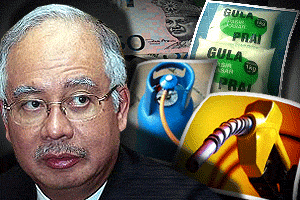 It is hence shocking to hear Prime Minister Najib Abdul Razak, supported by the Performance & Management Delivery Unit (Pemandu), claim in their subsidy rationalisation fact sheet that the price increases will have "minimal impact" on households in Malaysia.
In the fact sheet, it is "demonstrated" that the new teh tarik price, taking into the impact of subsidy reduction of fuel and upward price adjustment, would be around RM1.0155 sen, or an increase of less than 2 sen.
The impact on other popular items such as roti canai was stated as being 0.24 sen per piece, 0.6 sen for rice, 6.3 sen for meat per kg and 1.05 sen for mee goreng.
Pemandu, under the chairmanship of the Minister in Prime Minister's Department Senator Koh Tsu Koon, must be living in a parallel universe for having the audacity to publish such numbers that are at best applicable only in a fictitious and theoretical universe, and at worse, showing a complete lack of understanding of real world market dynamics on the prices of goods and services.
I challenge Koh to find me a mamak stall in Malaysia that will increase the price of teh tarik by a mere 1.55 sen, or the price of roti canai by a minute 0.24 sen, to prove the "minimal impact" of the latest round of 5-in-1 price increases.
Inflated prices stayed when fuel price dropped
Even anecdotal evidence of the previous price hikes have clearly demonstrated that prices will increase by a percentage much larger than the theoretical impact of the price hikes because of the real-world imperfect market.
What's more, when the prices of fuel actually decreased, the inflated prices never returned to their previous levels.
The government should stop spewing these ridiculous and out-of-this-world hypothetical data but instead demonstrate how it will not only seek to trim the subsidies that affect the rakyat directly, but also the wasteful expenditure and subsidies to crony companies, as well as clamping down on corruption, which will have a much larger impact on government finances.
 The prime minister must prove to the rakyat that the "people first" slogan is not about increasing taxes and prices, while reducing subsidies to the people.
We would like to express our complete disappointment with the unequal actions taken by the Barisan Nasional government for prioritising the subsidies to the rakyat as the first expenditure to be cut as a result of fiscal deficits caused by the government's irresponsible and wasteful expenditures over the past decade.
We agree that some of the subsidies to the rakyat need to be rationalised to ensure that the poor and needy receive a greater proportion of the benefits than the wealthy.
However, the above should not be used as an excuse to victimise the people first, without first taking concrete and visible actions to cut subsidies to large politically-connected companies or bloated expenditures for price-inflated projects.
The prime minister claims that even after the latest subsidy cuts, the government will still spend RM7.82 billion for fuel and food subsidies.
However, he fails to highlight the fact that Petronas will continue to provide subsidies to Tenaga Nasional (TNB), the independent power producers (IPPs) and the industrial sector, which was RM18.9 billion for its financial year ending March 2010.
No cheap electricity from subsidies given to IPPs
Out of this amount, more than 40% ,or nearly RM8 billion, goes to the IPPs. Unfortunately, most of the subsidies to the IPPs do not translate into lower prices of electricity for the users due to the unequal and unfair agreements that TNB was forced to sign with the IPPs.
TNB has not only to purchase electricity from IPPs at prices much higher than what it can produce on its own, but it has also to pay for the total capacity of these IPPs, regardless of whether there is a demand or otherwise.
Hence, there is an excess capacity as high as 50 percent today, which is completely wasted and which has resulted in heavy subsidies for the IPPs, high prices of electricity for the users and massive profits for the IPPs.
The question to the government is, given the financial constraints that it is facing, why isn't it targeting the fat cats that are lynching off the taxpayers' hard-earned monies first, before attacking the livelihood of the ordinary Malaysians?
The government has also failed in other means to save money for the rakyat by continuing the practice of direct negotiations for large-scale privatisation contracts, which often result in substantially higher prices and higher risks of project failure or further increases in cost.
For example, the government awarded the contract to build Malaysia's largest exhibition and convention centre, at the cost of RM628 million, to Naza TTDI Sdn Bhd without any tender, open or closed.
The government has also awarded a 20-year, interest-free, unsecured and back-loaded RM320 million loan to Syarikat Bekalan Air Selangor (Syabas), a private company, which will cost taxpayers more than RM250 million in interest.
The government's lack of political will to tackle corporate subsidies and opaque procurement processes to politically-connected companies demonstrate without a doubt that it is failing to live up to the prime minister's slogan of "people first", but has instead made the people the first to suffer from the government's transgressions, incompetence and a serious lack of accountability.
Tony Pua is DAP national publicity secretary and MP for Petaling Jaya Utara


Are you sure you want to delete this comment?
This action cannot be undone.