




BN still rock solid in S'wak: analysts
While the result of the recent Sibu by-election may have cast some doubt over the BN influence in Sarawak, a recent independent poll seems to indicate the Sarawakian electorate is still solidly behind BN.
While the result of the recent Sibu by-election may have cast some doubt over the BN influence in Sarawak, a recent independent poll seems to indicate the Sarawakian electorate is still solidly behind BN.
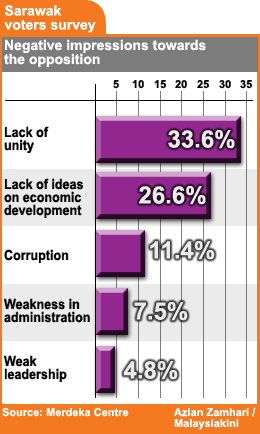
The latest Merdeka Center for Opinion Research poll on Malaysian political values show that 64.1 percent of Sarawakian respondents still supported BN.
Commenting on the poll results, Universiti Malaysia Sarawak (Unimas) head of political science studies, Dr Faisal S Hazis, said BN had consistently won at least 55 percent of the popular vote in Sarawak, since 1974.
 BN won 71.2 percent of the popular vote in the 2001 elections. However, this dropped to 62.9 per cent in 2006. Still, this body of voter support is regarded as substantial.
According to the Merdeka Center’s poll, most Sarawakians still support BN. In fact, there is an increase of 1.1 percent of the popular vote received by the ruling party in the 2006 elections.
Faisal said the 2006 election data showed that there were only 12 marginal seats out of 71 in Sarawak.
"If there was a five per cent vote swing towards the opposition, it would only give them five more seats. A 10 percent vote swing would give the opposition 12 more seats and a total of 21 seats in the state assembly,” he said.
However, for the opposition to capture 36 seats and take over the government, it would require a vote swing of 20 percent, which Faisal categorised as “ridiculously impossible” by the next election.
Challenging terrain
Sarawak’s size and terrain means that it would be challenging for the opposition, for even an average-sized constituency such as Krian is about the size of Singapore, whereas the largest constituency, Belaga, is the size of Pahang.
 Some opposition campaigners said bringing supporters to polling centres on polling day would easily cost between RM40,000 and RM50,000 in a average-sized constituency.
"Moreover, we don't have the resources as compared to BN to cover such huge constituencies. Many of these places are not easy to access and is time-consuming to travel. That is why, BN always has the advantage as it has the financial resources to hire helicopters for candidates to carry out their campaigns," said an opposition campaigner.
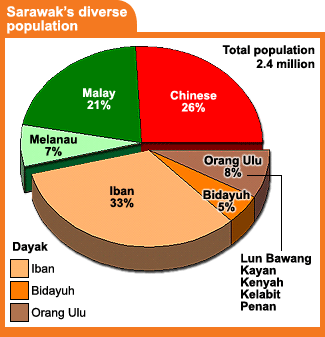
Moreover, BN's position in the rural and bumiputera seats is said to be just too strong for the opposition to make major inroads, a fact acknowledged by Pakatan Rakyat.
"Of course, we must be realistic. To unseat BN is not easy as almost half of the 71 seats are in the rural areas. This is almost impossible for us to penetrate. Even if we go in, to campaign is a huge task by itself. It is a totally different ball game from Peninsula Malaysia," said DAP Youth chief
Anthony Loke.
 Parti Rakyat Sarawak (PRS) president and state land development minister James Jemut Masing has even openly declared that the opposition would not be able to make inroads into these rural areas.
“BN will remain strong in the rural areas, and the swing of votes in the urban constituencies would not affect BN in Sarawak," he said, while admitting that it might be tough for BN in many urban constituencies.
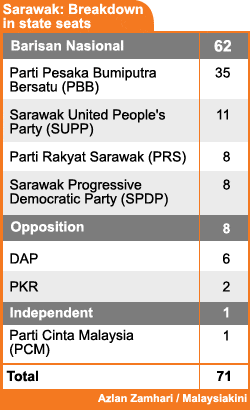
With Parti Pesaka Bumiputra Bersatu (PBB) solidly controlling 35 state seats, PRS nine and Sarawak Progresive Democratic Party (SPDP) eight seats, it is almost impossible for the opposition to wrest control of the 71-seat state assembly from BN, even if BN components such as the Sarawak United People's Party (SUPP) were to lose all 19 seats it has been allocated.
SUPP is BN’s weakest link
In the last state election, SUPP lost eight of 19 state seats it contested. Most of the seats they lost were in the predominatly Chinese urban and mixed seats but retained most of their predominantly Bidayuh and Iban seats in the rural areas.
However, the weakening political grip in several urban areas, mostly allocated to SUPP, is a main concern for BN as urban seats are considered the best avenues for Pakatan to increase their catch.
 "At least in urban seats, there will be a good fight. We are optimistic that those in urban areas are more ready to vote for us," said Loke.
There are only between 12 and 15 seats that can be considered as urban constituencies.
Predominantly Chinese urban seats are less than eight. The rest are very much mixed constituencies where bumiputeras form at least one-third of the total vote.
"There are actually very few predominantly Chinese seats where 90 percent of the voters are Chinese. The rest mostly are mixed seats.
"The way I see it, SUPP can still retain two urban seats, namely Piasau and Bawang Assan," said Sarawak-born political analyst Prof James Chin.
The predominantly Chinese seats are Batu Lintang, Padungan, Pending, Bt Kawa (Kuching), Piasau (Miri), Kidurong (Bintulu) and Bukit Assek (Sibu) while some mixed constituencies with a fairly good number of Chinese voters are Pelawan, Bawang Assan, Kota Sentosa, Pujut, Meradong and Repok.
"BN may be able to take back the Meradong seat if it puts in a strong candidate but overall, SUPP still faces an uphill task to win over most of the Chinese voters," said Chin.
Sarawak DAP chairman Richard Wong Ho Leng said DAP would not brush aside the survey results by the Merdeka Center as it was mindful that there was much work to do, in terms of rural constituencies.
"There is progress to a certain degree in the urban seats as they seem to be quite responsive for change. What we hope is that the urban voters would be able to influence their counterparts in rural areas," he said.
With the migration from rural to urban and semi-urban areas expected to hit 70 percent in the next 10 to 20 years, the opposition hopes the political scenario in Sarawak would change.
As it stands, BN appears to have the upper hand for now and will continue to be so, if it enhances its delivery system and fulfills its promises to the voters.
- Bernama


Are you sure you want to delete this comment?
This action cannot be undone.