




Court: No jurisdiction over Moorthy's conversion
The Court of Appeal has upheld a controversial Kuala Lumpur High Court decision that the civil court has no jurisdiction to rule on the religious status of a person who had embraced Islam.
The Court of Appeal ruled today that the civil court has no jurisdiction to determine the religious status of the late Everest climber Sergeant M. Moorthy, whose conversion to Islam has been a matter of dispute.
A three-man panel comprising Justices Zainun Ali, Abdul Wahab Patail and Clement Allan Skinner made the ruling in dismissing the appeal brought by Moorthy's widow S Kaliammal.
The bench held that the Syariah Court was the competent authority to determine any matter relating to the conversion to, or renouncement of, Islam.
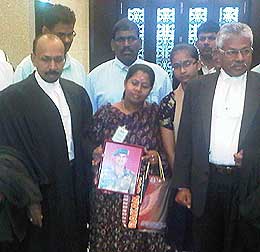
Hence, the appellate court dismissed Kaliammal's ( middle ) appeal to reclaim Moorthy's body from the Islamic religious authorities.
The decision today reaffirmed what has been decided in previous religious disputes - that the Syariah Court is the competent authority, based on Article 121 (1A) of the Federal Constitution, to determine whether a person had embraced Islam or not.
Kaliammal wanted the matter reverted back to the High Court, after it rejected leave for the application to be heard.
She had, among other things, wanted a declaration that her husband was a Hindu and that she was his lawful wife. However, the High Court in 2005 only granted a declaration that Kaliammal was Moorthy's lawful wife.
She had named the Federal Territory Islamic Council, Kuala Lumpur Hospital director and the government as respondents in her application.
Moorthy died at the age of 36 in 2005, and was given a Muslim burial instead of a Hindu one as he was said to have embraced Islam prior to his death.
Syariah court sole jurisdiction
Justice Zainun Ali read out the sole written judgment. She said where a question arises as to whether a person is a Muslim or not, it is the sole jurisdiction of the Syariah Court to determine.
"The religious authority of a particular religion is better placed to consider and decide whether a person belongs and continues to adhere to that religion," she said in her 14-page judgment.
"The Syariah High Court has the power to hear and decide to make a declaration as to the status of a person as a Muslim. It is the court of competent jurisdiction for that purpose.
"These questions become emotive because of the assumption that she (Kaliammal) had no access to that court to be heard on the issue," she said.
 "In this case, the appellant is not prevented from applying to the Syariah Court to try to set aside the ex-parte order made by it, giving the said court occasion to address the relevant issue concerns and deliver a fair and just decision in accordance with the religion of Islam and Islamic law," said Justice Zainun (
left
).
"In this case, the appellant is not prevented from applying to the Syariah Court to try to set aside the ex-parte order made by it, giving the said court occasion to address the relevant issue concerns and deliver a fair and just decision in accordance with the religion of Islam and Islamic law," said Justice Zainun (
left
).
She said in a dual judicial system anywhere, there would always be occasions of differences between the two systems.
"The civil court seeks to resolve such dissonance where possible by applying an interpretation so that there is no conflict, or to ensure that the grievances be first brought before the court of competent jurisdiction to consider a rule upon it.
"It is not the proper course to reject the court of competent jurisdiction and instead go to the civil court. Then, if the dissonance proves irreconcilable, it is the intent of the Federal Constitution that it is for the legislature to provide the remedy," said the judge in dismissing the appeal. No order was made as to costs.
No body snatching
Senior lawyer Sulaiman Abdullah said his client, the religious council, has been vindicated as it had been plagued with allegations of body snatching.
 "We strictly follow the law and do not snatch bodies. The decision today simply upholds the earlier decision of the High Court, whereby a person's status of being Muslim or not is determined by the Syariah Court," said Sulaiman (
right
).
"We strictly follow the law and do not snatch bodies. The decision today simply upholds the earlier decision of the High Court, whereby a person's status of being Muslim or not is determined by the Syariah Court," said Sulaiman (
right
).
On Dec 28, 2005, then High Court judge Md Raus Sharif ruled the matter had already been decided by the Syariah Court, which had ruled that Moorthy had converted to Islam.
"The civil court has no jurisdiction and cannot act to review the Syariah Court's decision," judge Md Raus said, adding that Article 121 (1A) of the Federal Constitution clearly stated that all matters pertaining to Islam should be handled by the Syariah Court.
Last month, lawyer M Manoharan, for Kaliammal, submitted that the Federal Territory Islamic Religious Authority had acted in bad faith when it obtained an ex-parte order to declare Moorthy a Muslim.
The other lawyers representing Kaliammal are A Sivanesan and M Kulasegaran.
Appeal to Federal Court
Manoharan, representing the family, said they will appeal to the Federal Court over today's decision.
"Non-Muslim spouses do not have an avenue to be heard in this case. Our case was not heard on merits but was struck out by the Syariah High Court's decision recognising him to be a Muslim. We cannot go to the Syariah Court as we are non-Muslims."
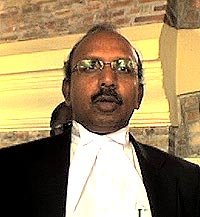 Manoharan (
left
), who is also Kota Alam Shah assemblyperson, said the court had showed bias against non-Muslims as it did not provide an avenue for them to be heard.
Manoharan (
left
), who is also Kota Alam Shah assemblyperson, said the court had showed bias against non-Muslims as it did not provide an avenue for them to be heard.
"We cannot be heard by the civil court and also by the Syariah Court," he said, adding this was a sad day for justice.
Meanwhile, Kulasegaran, who is also Ipoh Barat MP, called for Article 121 (1A) of the Federal Constitution, which gives powers to Syariah Court to determine matters on Islam, to be amended to give justice to non-Muslims.
He said when the amendments to the constitution were done in 1988, most of opposition MPs were held in Kamunting, under the Internal Security Act.
Kulasegaran said today's decision would have an impact as to other religious dispute cases involving conversion to Islam.
"It is a sensitive issue, but it is something that has to be handled carefully. I will bring this matter up in Parliament," he said.
T Chandiran, who spoke on behalf of Kalimmal, said she was saddened by the decision as she had supported Moorthy when he was disabled for eight months, since the Defence Ministry nor the army rendered him no assistance.
He asked whether is this was justice. Kaliammal was present in court with her daughter, M Theneswary.


Are you sure you want to delete this comment?
This action cannot be undone.