




Hudud row: Coalition politics is the art of the possible
COMMENT Coalition politics, which is the politics of emphasising essential similarities and downplaying differences, received a bracing defence yesterday just when two of Pakatan Rakyat’s components looked to be sporting a case of amnesia on what holds the coalition together.
It took Dr Dzulkefly Ahmad, PAS MP for Kuala Selangor, to remind some leaders of his party and DAP that what unites them in the coalition’s Common Policy Framework is greater than what divides them on hudud law...
COMMENT Coalition politics, which is the politics of emphasising essential similarities and downplaying differences, received a bracing defence yesterday just when two of Pakatan Rakyat’s components looked to be sporting a case of amnesia on what holds the coalition together.
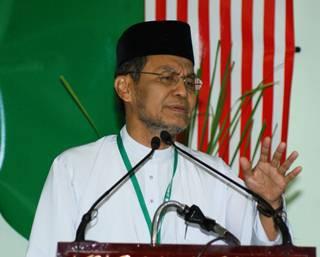 It took Dr Dzulkefly Ahmad (
left
), PAS MP for Kuala Selangor, to
remind some leaders
of his party and DAP that what unites them in the coalition’s Common Policy Framework is greater than what divides them on hudud law.
It took Dr Dzulkefly Ahmad (
left
), PAS MP for Kuala Selangor, to
remind some leaders
of his party and DAP that what unites them in the coalition’s Common Policy Framework is greater than what divides them on hudud law.
Dzulkefly had interjected in a futile debate that was welling up between DAP stalwarts and some PAS leaders over the latter’s intention to press for the implementation of hudud should Pakatan take power at the next election.
Chief among the commonsensical reasons he gave for decrying the futility of the DAP-PAS exchanges was that the issue was not in the Common Policy Framework of Pakatan. Therefore it is not on the table as a policy for implementation once Pakatan takes power. Further debate, Dzulkefly opined, would only set Pakatan in “self-destructive mode” and prolong BN misrule.
He went on to describe the philosophy of coalition politics which under the circumstances was a salutary reminder to the disputatious that fighting for essential similarities in component parties’ struggles required a certain maturity.
"Pakatan must understand what is necessary in coalition politics, which is about parties undertaking common objectives and policies," Dzulkefly said.
“In Pakatan, we have more than enough common ground to form a broad-based policy," he reminded disputants from both sides of the hudud debate.
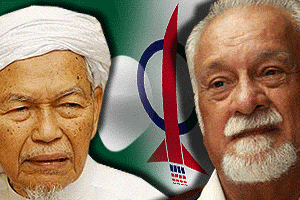 The discordant exchanges over hudud between some PAS leaders and at first DAP’s Karpal Singh, before he was
joined by others
from his cohort, arose over comments on the rising incidence of baby dumping in the country.
The discordant exchanges over hudud between some PAS leaders and at first DAP’s Karpal Singh, before he was
joined by others
from his cohort, arose over comments on the rising incidence of baby dumping in the country.
Karpal, in an unguarded comment no doubt, proposed the death sentence for baby dumpers, a call he must have immediately regretted not only because of the flak it drew from women’s rights champions but also for what it elicited from some PAS leaders.
PAS spiritual leader Nik Aziz Nik Mat suggested hudud law as a prescription for the country’s mounting social ills, of which baby dumping is a symptom.
Standard response
Nik Aziz was giving vent to a standard response of an Islamic party to the problem of rising social ills. In the process, he displayed the flaw of the ideological approach to the ever changing nature of society’s problems: the substitution of abstractions for reality.
When leaders in DAP other than Karpal joined in the demurral over hudud as the solution to rising social ills, some PAS leaders voiced the view that this was due to a misunderstanding of hudud by the DAP that is only an earnest explanation - by PAS - away from dispelling.
“The fallacy of misplaced concreteness” was the philosopher Alfred North Whitehead’s take on the weakness of the ideological mindset when confronting social problems.
This is the mindset that withdraws problems from the turbulent stream of change and treats them as splendid abstractions from the whirl and contingency of life.
When one has considered that for the implementation of hudud law you have to amend the Federal Constitution and also hold a referendum in Sabah and Sarawak on the issue because the territories would have to have a separate say on the matter which means secession is a possibility, one would begin to fathom the problems in the way of hudud’s implementation in Malaysia.
Only a starry eyed ideologically-driven optimist would underestimate the problems we would have with implementing hudud.
Needless to say, coalition politics is the art of not only the possible but of abjuring the impossible.
TERENCE NETTO has been a journalist for close on four decades. He likes the occupation because it puts him in contact with the eminent without being under the necessity to admire them.


Are you sure you want to delete this comment?
This action cannot be undone.