




Gov't may make ringgit tradeable offshore
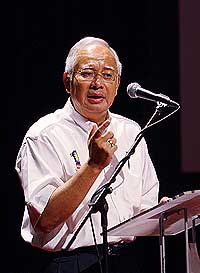
The government is open to the idea of making the ringgit, that recently touched a 13-year high, tradeable offshore again, Prime Minister Najib Razak said today.
The government is open to the idea of making the ringgit, which recently touched a 13-year high, tradeable offshore again, Prime Minister Najib Razak said today.
"We are quite adaptive, and if we think that it's going to help the economy, certainly we will review the situation," he said in an interview with CNBC Asia's Martin Soong aired today.
 The ringgit, which traded at a 13-year high of RM3.11 versus the greenback on Sept 6, was reflecting the fundamentals of the country's economy and would not bring a negative impact on the nation's exports, he said.
"The government is monitoring the situation all the time, very closely," he said in the interview.
He also said that the government was comfortable with the current level.
Najib, who is also the finance minister, said that most investors felt that the issue of whether the currency was tradeable overseas was not the key determinant in their investment decisions.
"Most importantly, there is no restriction in terms of repatriation of dividends and profits, for example, and bringing in currency through the banking system. So, it is not really a major factor," he said.
Six percent growth this year
Najib also said that Malaysia is poised to grow by at least
six percent this yea,r fueled mainly by domestic and consumption, while external factors remain somewhat dampening.
"We believe we can achieve quite a robust growth this year. We should end up with at least six per cent," said Najib.
He said despite a staggering 9.5 per cent growth in the first half of the year, it was overall moderate due to an expectation of the momentum tapering off in the second.
The prime minister said the GDP growth for the first and second quarter of 2010, was 10.1 percent and 8.9 percent respectively.
In the first half of the year, the country’s growth was driven by sustained expansion in domestic demand and robust growth in external demand.
Najib said under the New Economic Model (NEM), the government has identified where the new sources of growth are going to come from, including how to resuscitate the domestic private economy.
"We want the private sector to play a more dominant role. In fact, we have stated very clearly that to achieve our lofty targets, we have to raise RM150 billion annually in terms of total investment.
"That's a huge undertaking. Hence, the government has to address some of the concerns with respect to skills, for example.
"We must ensure we move up the value chain in terms of the skills level, so we have to prime up the human capital development," he added.
Najib said the country also needs to look at new growth sources, and it can come not only from consumption and demand, but also innovation.
"If you want to get to six percent, seven percent (GDP growth), then innovation will be the key enabler to achieve that," he explained
Gov’t to examine tax base, eventually
The government will also be eventually looking at the country’s tax base to help reduce the nation's budget deficit.
"Malaysia's tax base is rather narrow with one percent growth in GDP, our tax revenue only increases by about 0.8 per cent, or 0.85 percent," said Najib.
"So there is that limited elasticity in terms of tax returns. Some of the structural problems have to be addressed."
But this would be about maybe several years down the road, he added.
The current efforts taken by the government to slash the budget deficit include cutting back on its development and operating expenditure to cut its budget deficit to around 5.6 percent this year.
It is also planning to introduce the controversial good and services (GST) tax in the coming years.
The government plans to bring down the deficit further to three percent by end of the 10th Malaysia Plan.
- Bernama


Are you sure you want to delete this comment?
This action cannot be undone.