




Sabah rejects 'eyesore' project in Kota Kinabalu
The Sabah Environment Protection Department (EPD) has rejected an initial plan for a 16-storey building in Kota Kinabalu on land owned by the Sabah Housing and Town Development Authority.
The Sabah Environment Protection Department (EPD) has rejected an initial plan for a 16-storey building in Kota Kinabalu on land owned by the Sabah Housing and Town Development Authority.
But the battle is by no means over against the proposed development which includes a hotel and a mall.
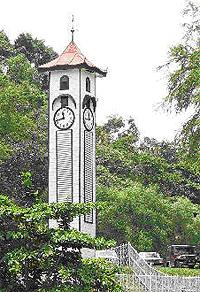 The site along Jalan Balai Polis is next to the century-old Atkinson Clock Tower at the foot of Signal Hill, Bukit Bendera (
left
), a green lung with colonial houses and the Istana.
The site along Jalan Balai Polis is next to the century-old Atkinson Clock Tower at the foot of Signal Hill, Bukit Bendera (
left
), a green lung with colonial houses and the Istana.
No building in the city is currently taller than 12 stories. The proximity of the Kota Kinabalu International Airport is one reason.
The proposed building would dwarf the clock tower and also be an eyesore in the vicinity of Signal Hill.
"The (project) was rejected on technical as well as other grounds. We will see what happens after this," said state tourism, culture and environment minister Masidi Manjun.
He was commenting on public fears that the developer will conduct a fresh Environment Impact Assessment study and renew attempts to bulldoze the project through the state government. The EPD is under Masidi's ministry.
He confirmed that he and a colleague - Dr Yee Moh Chai - had raised their concerns about the proposed project at the state cabinet meeting last week.
 "We requested that the state cabinet takes another look at the proposed project," said Masidi (
right
).
"We requested that the state cabinet takes another look at the proposed project," said Masidi (
right
).
"Under the proposed project, the clock tower will still be there but it's no use having the landmark if the neighbouring structure is a 16-storey commercial building."
Under the proposal, the building will be within nine metres of the clock tower, thereby blocking it from view from the city.
The question of relocating the clock tower does not arise, stressed Masidi, the site having been gazetted as historical and having heritage value. However, the proposed building will compromise its significance.
Profit, according to Masidi, should not be the driving force behind development in the city which is also the state capital.
Development must be intended to add value to Kota Kinabalu while maintaining the very reasons why people come to the city, he added.
"The moment that we change the skyline (and) the feeling of history and romance that the city is noted for, then we are destroying the very reasons why it draws visitors."
Online petition underway
Criticism of the proposed project has been raging on Facebook since last week.
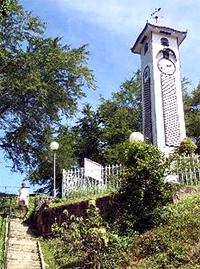 Independent heritage researcher and architect Richard Nelson Sokial is against the last heritage site in the city being sacrificed for development.
"The proposed development would ruin the natural surroundings and the intrinsic heritage value of the Atkinson Clock Tower," he said.
A group of concerned individuals has launched an online petition to plead with the state government not to allow the proposed development even under a new EIA, so that the greenery can be preserved in perpetuity.
City dwellers want the proposed building site to be made a public park, as an extension of the town field, to add to a proposed historical precinct.
The historical precinct would begin at Dewan Masyarakat - the site of many post-war historical events - down through Jalan Dewan, the regenerated Australia Place of old buildings to the colonial style Traffic Police Station, the Rainforest Walk up Signal Hill, and the Atkinson Clock Tower to the town field.
The wooden clock tower was named after Francis George Atkinson, the first district officer of Jesselton (now Kota Kinabalu) and has a series of steps linking the town centre to the observatory overlooking the city on Signal Hill.
The clock tower was built in his memory by his mother, Mary Edith Atkinson, following his death from suspected malaria. It was not only a timekeeper but was lighted at the top at night, with the beacon serving as a navigation aid to ships.
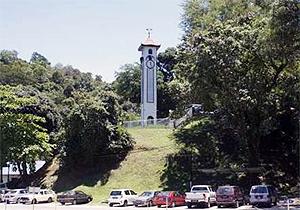 The Atkinson Clock Tower is one of only two pre-war structures in KK that survived World War II. The other is the structure now housing the Sabah Tourism office in Jalan Gaya.
Both structures add value to the city, along with the waterfront along Gaya Bay and the islands of the Tunku Abdul Rahman Park. A forested hillside frames one edge of the city from Tanjung Lipat right along Signal Hill, past the town field and along Jalan Istana.


