




Women affirmative action shouldn't penalise men
COMMENT That KTM is mulling a law to penalise males who "deliberately enter" women-only coaches is hilarious at first glance. Let me say that I am humoured - but not at the expense of KTM Bhd president Dr Aminuddin Adnan.
COMMENT That KTM is mulling a law to penalise males who "deliberately enter" women-only coaches is hilarious at first glance. Let me say that I am humoured - but not at the expense of KTM Bhd president Dr Aminuddin Adnan.
Let's complicate the discussion.
Some men are unhappy with the KTM proposal. If men are the majority of commuters on KTM, and if they are sufficient in numbers to take an informed decision that impacts against the corporate interest, it might spell trouble.
But I don't think Malaysian citizenry as a whole is sophisticated enough to take, for example, a public-interest litigation against KTM at present, or even to work for a boycott. The second point is just not feasible, since we have such a bad public transport system.
 I think this proposal of penalising men can offend the philosophy of affirmative action in the Women's Convention, in principle and in substance.
There are weaknesses at present in mainstreaming human rights principles on the basis of the substantive standards of gender equality under the Women's Convention (debunking the formal standard of equality and the protectionist approach to women's rights). This is something even law schools here may not necessarily impart in a first degree course.
And I have yet to see this principle being manifested in litigation and judicial decisions in the civil courts.
Let's set out the operational options to mainstreaming the substantive standard of gender equality/justice in the KTM example.
Excellent example
The KTM decision to allocate women-only coaches is an excellent example of an affirmative action for women. Affirmative action is a temporary, special measure to be instituted until the conditions of discrimination in that particular sphere are abated and eliminated. The actions taken will have to be targeted and strategic.
We don't want women to stay home and "be safe". Women need to go out and use public transport for all kinds of reasons, just like men do. If for example, the decision for women-only coaches was to provide an environment where women can be safe from sexual harassment and intimidation, the special measure will stay until our society respects women's rights to safety and bodily integrity in KTM trains. This is the common good that women and men, as members of our society, want to achieve.
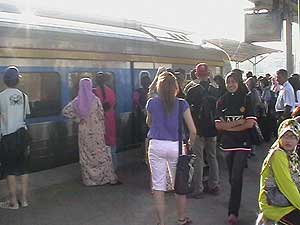 We hope this will happen in all public transportation. But this is not the worry of KTM. This is the province of the government, which should have a gender mainstreaming policy in governance that includes guidelines for non-state actors. I would think that the government can learn some valuable lessons from the KTM example.
Coming back to the twin strategies, the targeted action is to provide for women-only coaches. This should not prevent other coaches from being utilised by women and men. There are women who are quite capable of fighting off harassment and standing up for themselves in a hostile environment.
And there are women who may, for example, like the attention that other women might view as harassment. Women have varying experiences, but KTM has limited resources as a corporation. It would be helpful, for KTM's targeted action policy, to use the designated coaches.
Social change strategy
A strategic action is more of a long-term measure. But it can be instituted now. What it is in practice must vary by context. What it aims to achieve, together with a targeted action in place, is social change that involves the targeted group, which in this case for KTM, are the commuters.
A strategic action is a social change strategy. It's objective is a shift in power relations that cause women KTM commuters to suffer harassment/intimidation in mixed coaches.
Targeted action or practical action focuses on women's immediate needs or the immediate conditions of women and men. A strategic action addresses gender relations and is focused on resolving gender-based inequalities.
An example of a strategic action that should be instituted in tandem with the designation of women-only coaches by KTM can be education on respect for women commuters so that they are free from uninvited attention, sexual harassment, intimidation and violence on KTM trains. This should be addressed to women and men.
And, KTM should not be expected to take on the government's task of public education. A public awareness programme for commuters (the public) is a public service pogramme and is part of its corporate social responsibility (CSR).
I have read Yeoh Chee Weng's letter dated Oct 4, which prompted this write. In my opinion, the problem the elderly face as KTM commuters is not caused by the women-only coaches. This affirmative action is not discrimination in human rights understanding.
Age and disability
What is the analysis to help KTM in its CSR? The same principle of substantive standard of equality which was born from the Women's Convention is applicable across the board. This means that KTM, in its operations, should consider how the elderly as a category of people may be discriminated against on the basis of age and gender. Thus it is both elderly women and men who face discrimination.
KTM would have to think through its targeted action and strategic action in compliance with the substantive standard of equality. As a corporation, it has limited resources as compared with the government. The strategic action of public education on gender would have to include discrimination based on age in the context of all that KTM operates or has control over, such as the KTM premises.
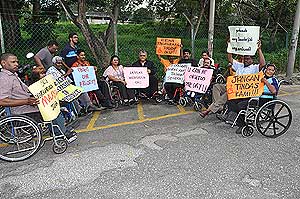 The targeted action will on a variety of factors. One simple suggestion is to designate seats in all coaches for the elderly. It will be logical and prudent to also consider categories of commuters who may face some kind of discrimination, such as the disabled. Change is necessarily incremental and KTM may desire to locate incremental changes as part of its CSR policies.
Whether KTM should penalise (not criminalise) men who deliberately enter women-only coaches is certainly a legitimate consideration in its policies. KTM needs to have oversight over its operational measures. However, such a proposal should not stand alone.
Thus the women-only coaches should remain with seats marked for the elderly and the categories of people that KTM, in the longer term, would identify as deserving of reserved seats.
This reservation of seats should be available in the other coaches as well. The women-only coaches may end at some point in the future - but that depends on the context of that Malaysian society of the future. KTM should also consider increasing services to accommodate the increased numbers of commuters and not cut back on specially designated coaches or seats.
The transgender
This write could end here, if not for my interest in the complexities of gendered lives. The question is posed, where should the transgender or cross-dresser go? Would this class/category of commuters face discrimination that is sexual harassment, intimidation and violence in KTM trains? The human rights/substantive equality standard principles should remain the same. KTM's operational guidelines may differ.
If people falling in these two latter categories do not face discrimination as KTM commuters, then there would be no problem. They may, however, face discrimination on the basis of age or disability. In which case the designated seats based on age and disability are open to them.
These people should also be given the choice of boarding the women-only coaches. This is a difficult policy decision for KTM, but it can draw up guidelines on these issues in consultation with human rights groups or special interest groups.
SALBIAH AHMAD is a lawyer by training and works on human rights, specialising on Islam and gender


Are you sure you want to delete this comment?
This action cannot be undone.