




Bumi equity: Perkasa agrees with MCA proposal
Pertubuhan Pribumi Perkasa Malaysia (Perkasa) president Ibrahim Ali said national unity could not be achieved as long as the Malays and other bumiputeras were not united.
"The bumiputeras make up 65 per cent of the population. If this majority group of people quarrel among themselves, how can there be national unity?" he said at a forum titled 'Malay unity in safeguarding the community's future' organised by Universiti Teknologi Mara in Shah Alam today.
Pertubuhan Pribumi Perkasa Malaysia (Perkasa) president Ibrahim Ali said national unity could not be achieved as long as the Malays and other bumiputeras were not united.
"The bumiputeras make up 65 per cent of the population. If this majority group of people quarrel among themselves, how can there be national unity?" he said at a forum titled 'Malay unity in safeguarding the community's future' organised by Universiti Teknologi Mara in Shah Alam today.
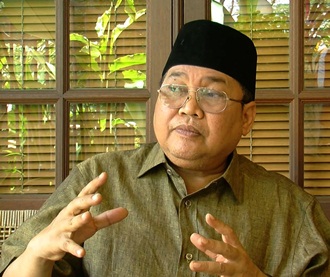 Ibrahim
(right)
said Malay unity was not only vital for the community's survival but was also a religous obligation, that was, strengthening ties among Muslims.
Ibrahim
(right)
said Malay unity was not only vital for the community's survival but was also a religous obligation, that was, strengthening ties among Muslims.
He said disunity among the Malays could be resolved if PAS and Umno became friends again "but unfortunately, PAS spiritual leader Nik Aziz Nik Mat prefers to befriend DAP and PKR".
On bumiputera achievement, he said he was still dissatisfied as far as the economic sector was concerned and that economic distribution must be fair for all races.
He also agreed that the bumiputera equity participation target of 30 per cent be reviewed based on merit as suggested by MCA president Dr Chua Soi Lek at the close of the party's annual general assembly yesterday.
Ibrahim also said that it was not wrong for Perkasa as a non-governmental body to defend Malay rights because likewise, MCA was also fighting for the interest of the Chinese community.
Editor: Malays divided into five groups
The other two speakers at the forum were National Defence University of Malaysia senior lecturer Ridhuan Tee Abdullah and Utusan Malaysia deputy editor-in-chief Zaini Hassan.
Ridhuan said the Malays must be united in order to be viewed seriously by the other communities in the country.
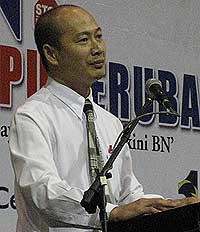 He said among the factors that had caused friction between Umno and PAS was over the implementation of an Islamic state concept and hudud law.
"But PAS must realise that to implement hudud, it requires the support of the Chinese (lawmakers) as the Muslims do not have two-thirds majority in parliament," he reminded.
Ridhuan (left) said in reality, some of the privileges accorded the Malays could not be enjoyed by most of them, for instance, the seven per cent bumiputera discount for houses above RM500,000. "How many Malays can afford such houses?" he asked.
Zaini, meanwhile, said the Malays were not divided into only two groups - Umno and PAS - like in the past but in fact, into five now as there were also PKR, the fence sitters and the Malay liberals.
He said the Malay liberals who were increasing in number, were not helping the Malay unity cause as they could not care less for the special rights and privileges of the Malays.
- Bernama


Are you sure you want to delete this comment?
This action cannot be undone.