




Logjam puts S'wak gov't on the rack
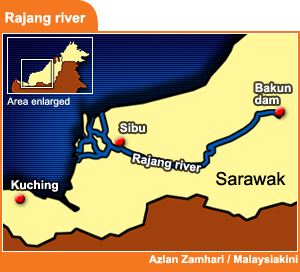
The logjam on the Baleh and Rajang rivers in Sarawak, reputed to be 250km long, stretching from the upper reaches to Kanowit down to Sibu on the South China Sea coast, could not have come at a worse time for the government of Chief Minister Abdul Taib Mahmud.
The logjam on the Baleh and Rajang rivers in Sarawak, reputed to be 250km long, stretching from the upper reaches to Kanowit down to Sibu on the South China Sea coast, could not have come at a worse time for the government of Chief Minister Abdul Taib Mahmud.
 The continuing logjam, making river transport
nearly impossible
and depriving people living in longhouses off the banks of vital fish stocks, has heightened Dayak discontent with the ruling BN coalition, already embroiled in disputes with the community over native customary rights (NCR) land.
The continuing logjam, making river transport
nearly impossible
and depriving people living in longhouses off the banks of vital fish stocks, has heightened Dayak discontent with the ruling BN coalition, already embroiled in disputes with the community over native customary rights (NCR) land.
Ministers in Abdul Taib's government initially tried damage control by blaming heavy rains and rising water levels for the calamity which struck late last week, but the enormity of the disaster overwhelmed the impulse to euphemise.
Even James Masing, state minister of land development and second to Alfred Jabu in the role of Dayak representative in the BN-ruled government, could not hold back his apprehensions.
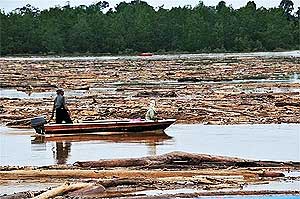 "This is an ecological disaster," pronounced Masing, the Parti Rakyat Sarawak (PRS) leader in the BN-led coalition headed by Abdul Taib.
"My people in Baleh have suffered so much from this incident," lamented Masing, who is the PRS state assemblyperson for Baleh.
Masing's comments were in marked contrast to those made by other members of the government, including Soon Koon Poh from Sarawak United Peoples’ Party (SUPP), who is the second minister of finance.
He said the phenomenon of the debris-logged rivers were a natural disaster caused by heavy rain and rising waters.
Uncontrolled logging
But others disagreed, saying that indiscriminate and uncontrolled logging in the upper reaches of Rajang where the Balui and Baleh rivers intersect with Malaysia's longest river and massive land clearing in the lower regions for plantation agriculture - largely oil palm - have contributed silt, debris and logs to the now clogged flotsam.
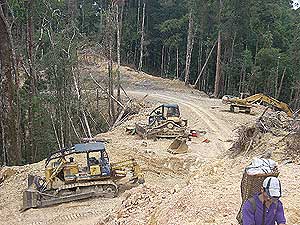 "In the past, logging was controlled and plantations were virtually non-existent or practiced on a small scale," said Ali Basah, a lawyer who comes from the area.
"In recent years, the scale of the logging and the huge areas that were cleared for oil palm has resulted in silt, logs and debris being swept into the Baleh and Rajang rivers," he added.
"The scale was phenomenal, that is why long stretches of the rivers are clogged now," he explained.
‘Now they have polluted our rivers’
Calvin Jemarang, from the Kakus region which is north of Kapit on the Rajang, said the rains this season were not any heavier than what had been the case in the past.
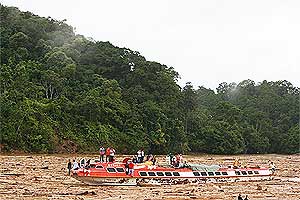 "When you log the surroundings forests on the scale that has been allowed in recent years and couple that with oil plantations of gigantic size, you can expect things like this to happen," he opined.
The debris and timber-logged rivers meant people living in longhouses off the banks were deprived of vital fish stocks that provide them with food and income.
Fish like empurau, mengelan and patin, species that fetched livelihood-sustaining prices and were vital sources of protein to the families living off the banks of the Baleh, Balau and Rajang rivers, are now impossible to net for fishermen who foraged them when the rivers were clear.
"First they took our NCR land and now they have clogged and polluted our rivers. And Oxford University recently honoured Taib for being environment friendly. What a travesty!" sighed Ali Basah.


Are you sure you want to delete this comment?
This action cannot be undone.