




2011 budget fails to prop up NEM, ETP
While Premier Najib Abdul Razak made much ado about his new wave New Economic Model (NEP) and Economic Transformation Programme (ETP), neither head nor hair of these policies showed up in his 2011 budget.
While Premier Najib Abdul Razak made much ado about his new wave New Economic Model (NEP) and Economic Transformation Programme (ETP), neither head nor hair of these policies showed up in his 2011 budget.
Speaking at a forum organised by the DAP in Petaling Jaya last night, experts and opposition politicians said the budget announced last Friday failed to live up to the public relations hype over the government's very expensive "transformation" programmes to turn Malaysia into a high income society.
University Malaya's (UM) business lecturer Cheong Kee Cheok, for one, finds no linkage between the first budget in Najib's "transformation" era and his new pet policies.
"There are no clues as to how to link the budget with the ETP. There are some infrastructure investments, but the question is, where are these invested in? There is little to link them to the NEM," he said.
Cheong also argued that the key areas of human resource development and technology development, crucial to driving a high income economy, were never meaningfully touched on by the budget.
Behind Singapore in maths and science
"This is serious, because we continue to lag behind Singapore in mathematics and science education in the US Education Department's Trends in International Mathematics and Science Study. Our neighbour is number 1, We have slipped from number 20 to below average on a list of 60 countries."
 His colleague, economics professor Rajah Rasiah, echoed Cheong's sentiments, telling the 70-strong crowd that attended the forum that the budget did not offer convincing details on how the money spent would generate Malaysia's "transformation" into a high income economy.
Rasiah (right) questioned the RMK10 announcement that private investment in Malaysia would jump from a growth rate of 2.1% per annum over the period 2005-2010 to 12.8% per annum over the period 2011-2015.
He contended that greater justification, and explanations, were needed on how such a jump could be achieved.
Rasiah also spoke out against the outflow of capital from government-owned companies overseas.
"Why invest GLC money overseas? The spillovers from such investments will be in places like Indonesia, which will create linkages and jobs that are sorely needed here. It is not a problem if it is private capital, but government capital should be used to make money and stimulate the domestic economy," said the UM lecturer.
"There is no mechanism to ensure that the money being disbursed goes to the target groups. There is also no evidence of pre-approval evaluation of projects, monitoring of execution/implementation and no appraisal mechanisms that are accountable to ensure performance," Rasiah contended.
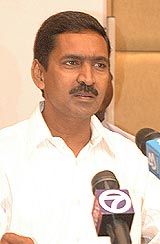 Suaram chairperson K Arumugam (
left
), who also spoke at the forum, pointed to the lack of focus on addressing the increasingly debt-ridden Malaysian workforce. He attributed this to wages that have stayed stagnant despite the sharp increase in GDP over the last few decades.
Suaram chairperson K Arumugam (
left
), who also spoke at the forum, pointed to the lack of focus on addressing the increasingly debt-ridden Malaysian workforce. He attributed this to wages that have stayed stagnant despite the sharp increase in GDP over the last few decades.
The growing economy, Arumugam said, failed to provide the workers with proper and reasonable wages, thereby forcing them to go into debt just to continue to afford a decent livelihood. He argued that a minimum wage was necessary to address this problem.
While agreeing with him, another panellist Klang MP Charles Santiago said that the minimum wage in question must be a properly adjusted wage and not a figure simply plucked out of the sky, like the RM500 to RM700 ceiling for security guards.
"I spoke with a few of my friends who are security guards. They are already receiving that level of wages for now, and RM700 is still below the poverty line. A minimum wage must be adjusted to assure a decent standard of living for workers, and should be much higher than RM700," he stressed.
Address structural problems of economy first
Santiago argued that in spite of big projects and initiatives to entice locals who have left the country to return, the structural problems in the economy must first be addressed before those measures can showcase results.
These include minimum wages as well as ensuring a meritocratic and performance-based economy, and transparency in the implementation.
Bukit Bendera MP Liew Chin Tong said the budget was focussed on the wrong priorities, and he singled out expenditures such as RM66 million for the National Civics Bureau and RM15 billion for the Prime Minister's Department, while an august institution like Parliament was only allocated RM78 million.
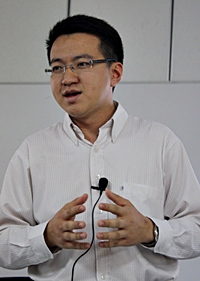 Liew (
right
) also pointed to the over-funding and over-staffing of the police intelligence units, which are mostly used to monitor and suppress the citizens, which he said showed that the priority of the Barisan Nasional government was not fighting crime but to hold on to power.
Liew (
right
) also pointed to the over-funding and over-staffing of the police intelligence units, which are mostly used to monitor and suppress the citizens, which he said showed that the priority of the Barisan Nasional government was not fighting crime but to hold on to power.
The final member of the six-member panel, MTUC chairperson Syed Shahrir Syed Ahmad, likened the budget to an overdose of "make-up" that the BN government, which was beginning to lose its looks, had put on to try to impress the public to support it.
"Once the lipstick and powder wear out, there will be nothing there," Syed Shahrir concluded.


Are you sure you want to delete this comment?
This action cannot be undone.