




DAP: M'sia a Greek tragedy in the making?
DAP warns that BN government policy of massive borrowing and wasteful spending may see Malaysia tragically heading towards the same situation as faced by Greece in its recent economic crisis.
DAP warns that BN government policy of massive borrowing and wasteful spending may see Malaysia tragically heading towards the same situation as faced by Greece in its recent economic crisis.
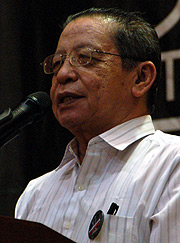 Party supremo Lim Kit Siang (
right
) warned that deep austerity, a falling of living standards and the destruction of wealth are likely consequences.
Party supremo Lim Kit Siang (
right
) warned that deep austerity, a falling of living standards and the destruction of wealth are likely consequences.
"The (Budget 2011) spending is directed towards projects and activities that will not contribute to either enhancing the productive or the competitive capacity of the economy.
"The key beneficiaries are likely to be a small coterie with links to Barisan," reasoned the Ipoh Timor MP in a media statement, adding that short term political objectives are being placed ahead of the long term needs of the nation.
"A weak and divided BN government is being driven to adopt failed and disastrous policies of the past. Reforms are being obstructed by vested interests whose narrow agenda is without vision. The nation's path to the future and its destiny cannot and must not be set by yesterday's men."
Apparently, Kit Siang was referring to Tun Dr Mahathir Mohamad's 22-year tenure from 1981 to 2003 which saw many mega projects given to Umno-friendly corporate chiefs in return for their support during election time.
He also warned that Malaysia must move away from that path to the precipice and must instead embrace reforms that will lead the country to a higher plane.
Lack of transparency
The DAP leader pointed out the shortcomings in Premier Najib Abdul Razak's national budget 2011 speech.
"There is no indication given to the large hidden off-budget transactions and nor is there even a hint of the increase in contingent liabilities that the government will assume via the granting of loan guarantees. The lessons from the PKFZ fiasco have yet to be learnt," he lamented.
"What the prime minister failed to disclose in his speech was that net domestic borrowings by the federal government would rise to RM51.1 billion in 2011, from RM36.5 billion in the current year.
"A 40 percent jump in net borrowing and the lack of disclosure of this fact in the Budget Speech is not an oversight or non-disclosure of a fact of insignificance.
"The concealment is a clear example of lack of transparency and accountability. The nation is being misled and lulled into a false sense of wellbeing, " he reasoned.
He assumed that the 2011 budget was an eulogy for the death of the New Economic Model and a re-launch of the Mahathir Economic Model.
It provided clear confirmation that this government is incapable of living up to the rhetoric of reform that it had vigorously promoted over the past year. he lamented.
The budget yet again demonstrates that this administration is incorrigibly incapable of drawing lessons from the past and persists with policies that have entrapped Malaysia in the middle income trap he said.
"The budget for 2011 has all of the attributes of a blunt tool for distributing public funds to Umnoputras, BN cronies, and vested groups that constitute the vote bank of the BN.
"The distribution of public resources is to be achieved by way of granting mega projects to Umnoputras and cronies, new and additional perks to the 1.2 million public servants and party hacks that feed at the public trough.
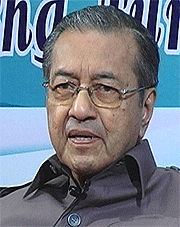 "The budget is more than just a throwback to the discredited Mahathir (
right
) era of mega projects, bailouts, piratisation of public assets and rampant corruption.
"The budget is more than just a throwback to the discredited Mahathir (
right
) era of mega projects, bailouts, piratisation of public assets and rampant corruption.
"The budget will not only return the nation to that tragic era of bad governance but put it on a path to economic disaster in the medium term.
"After having used the technique of dishing out grants and "projects" in recent by-elections in a desperate attempt to win, he is now resorting to the use of the same methods to win the GE 13.
"The announcement of multiple mega projects with little economic rationale, and the handing out of perks to particular constituencies and interest groups is nothing but a magnified game plan to win the next election at all costs. Party interest is placed ahead of the national interest," said the DAP supremo.
Silent on key reforms
He pointed out that the budget presented on Oct 15th is singularly silent on the issue of key reforms needed to restore competitiveness, provide the basis for the private sector to assume the lead role in spearheading economic growth and transformation, and place Malaysia on a path that would permit it to escape the middle income trap by the end of the next decade.
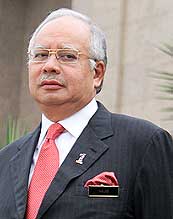 The DAP leader accused Najib (
left
) of choosing to sweep under the carpet the entire issue of needed fiscal and structural reforms which were highlighted by the International Monetary Fund during the 2010 annual Article IV consultations.
The DAP leader accused Najib (
left
) of choosing to sweep under the carpet the entire issue of needed fiscal and structural reforms which were highlighted by the International Monetary Fund during the 2010 annual Article IV consultations.
The IMF report touched on the various steps announced by the Government - the 1Malaysia program, the Government Transformation Program, the Economic Transformation Program built on the New Economic Model, (NEM) and the Tenth Malaysia Plan, (10MP).
It is most significant that the IMF was blunt in stating its assessment. It stated: "Development policies have been dressed in rhetoric before but the sense of urgency seems higher now than in the past."
This is a rather remarkable and blunt statement and points to a question about the credibility of the BN government but Najib has chosen to ignore the IMF's assessments.
Declining FDI flows
He added it is significant that the prime minister did not deal with the issue of declining FDI flows and how he proposes to reverse these trends.
"The ostrich-like approach adopted by the Government in reacting to these issues in the formulation of the Budget for 2011 is further magnified by the fact that no attempt has been made to acknowledge the critical issues the economy faces, inter alia : continued weaknesses in FDI flows, significant capital flight, loss of human capital and policy paralysis brought about by the demands of reactionary vested interest groups opposed to reforms.
"The prime minister has gone totally silent on the issue of subsidies and the broadening of the tax base and gaining control over unsustainable budget deficits.
"The government has yet again ignored the opportunity to seriously address the need for measures that would result in economies that would result from improved procurement as well as cuts in discretionary spending and transfers."
Kit Siang added the budget for the year ahead calls for an expenditure of RM212 billion and is 2.8 percent higher than in 2010.
"There is however little doubt that the final outturn will exceed by a sizable margin the budgeted amount when customary Supplementary Allocations are taken into account.
"The projected reduction in the deficit to 5.4 percent from 5.6 percent is not likely to be met.
"It is also important to note that expenditure increases of the order of 2.8 percent are unrealistic when account is taken of likely inflation in the range of 2 to 2.5 percent."
The statement added that expenditure in real terms will increase by only 1 percent stretches credibility to the limit.
"It is to be noted that the expenditure proposals generously allocate funds to Federal Government controlled projects." said Kit Siang.
"The prime minister's speech was eloquently silent on the amounts that are to be transferred to the various state administrations as federal revenue sharing in the face of major structural changes appears to be wholly ignored.
"The revenue projections call for an increase of 2.3 percent in current price terms.
"Firstly, it is most odd that revenue growth will be slower than GDP growth as GDP at current prices is likely to be of the order of 7 to 8 percent.
"It implies that tax revenues will not keep pace and point to large leakages in tax collections."
For Kit Siang, that expenditure growth will outpace revenue growth is most telling.
It signifies that prudent budgeting principles are being set aside in the interests of short term expediency.
"The much touted goal of bringing the deficit under control is thus unlikely to be achieved as Mahathir's model of large deficits continues to drive economic policy," he concluded.


