




PKR veep aspirants in the hot seat
Who should become PKR deputy president? Should a party built on the platform of democratic reforms be fronted by a leader who is not democratically elected? Is PKR the weakest link in Pakatan Rakyat, and what will it do to address party-hopping?
These were among questions posed by Malaysiakini to the 17 vice-presidential hopefuls via email last week.
Who should become PKR deputy president? Should a party built on the platform of democratic reforms be fronted by a leader who is not democratically elected? Is PKR the weakest link in Pakatan Rakyat, and what will it do to address party-hopping?
 These were among questions posed by
Malaysiakini
to the 17 vice-presidential hopefuls via email last week.
These were among questions posed by
Malaysiakini
to the 17 vice-presidential hopefuls via email last week.
Four have responded to date - incumbent vice-president R Sivarasa, central committee member Mohd Yahya Sahri, Lembah Pantai division chief Nurul Izzah Anwar and elections director Fuziah Salleh.
Up to now, 68 divisions have voted in the polls. Among those contesting as veeps, direc tor of strategy Tian Chua leads the pack with 3,621 votes, followed closely by Nurul Izzah with 3,543.
Fuziah trails them with 2,895, while Yahya and Sivarasa have respectively won 1,778 and 1,553 votes.
Excerpts of their responses follow, edited for language and brevity. Answers have been dropped where these are similar in content.
Malaysiakini: Who would you prefer as deputy president: Zaid Ibrahim, Azmin Ali or Mustaffa Kamil Ayub. Please state your reason(s).
Sivarasa: Whilst I respect both Azmin and Mustaffa as leaders and comrades, I would prefer Azmin given his 12-year stint as a vice-president and his demonstrated capacities of leadership, in particular in organisation building.
I would have preferred Zaid not to have rushed too quickly for leadership, having only just come into the party last June. I think he should spend more time building trust and relationships within the party and demonstrating that he can be a team player who can add value.
Zaid was accorded (full participation in the highest leadership level) but unfortunately has not been able to demonstrate a similar capacity to work collectively for the benefit of the party.
Fuziah: I do not think that any of the three is the perfect candidate. None of them fulfills my expectations of criteria as outlined by the Quran which is Quwwah wal Amanah (strong, trustworthy and credible).
 (The best candidate would be) someone who is a good person, such as Mustaffa, with a 'worldview' outlook like Zaid, and loyal, disciplined and tested through thick and thin like Azmin.
Yahya: If you are asking who I will vote for, you are asking the wrong question because votes are confidential. Sorry.
Nurul Izzah (left) : I will let the collective judgment decide.
How should unity be strengthened after the party elections?
Fuziah: (Those who win) must co-opt those who lose. Do not be judgmental about dissenting voices, but consolidate weakness within the party and set up special team-building efforts.
Yahya: We can’t unite unless we understand our goals in this cause, or if (we’re unable to set) our goals right.
Nurul Izzah: Simple. We close ranks and work together to focus on a bigger goal than the party - the upcoming general election.
Why do PKR members recognise Anwar Ibrahim as de facto leader? Do you think the post is undemocratic, given that he has not been elected?
Sivarasa: The formation of Parti Keadilan Nasional in 1999 was result of his incarceration. Anwar has been the bedrock of the party’s transformation to what it is today. He is the glue that keeps Pakatan Rakyat together.
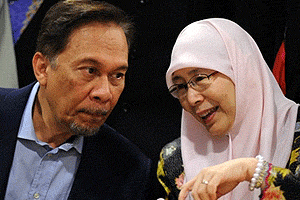 A huge majority of the party divisions nominated Dr Wan Azizah Wan Ismail as president and thereby continued to endorse Anwar as (
de facto
leader) for the party, albeit unelected. In any case, do you for a moment think that he would not win if he had contested the presidency?
A huge majority of the party divisions nominated Dr Wan Azizah Wan Ismail as president and thereby continued to endorse Anwar as (
de facto
leader) for the party, albeit unelected. In any case, do you for a moment think that he would not win if he had contested the presidency?
Fuziah: It is not a position that is enshrined in the constitution, yes, but by definition, a leader is someone who is able to inspire, motivate and guide others towards achieving a certain goal.The members still choose to follow him due to his charismatic leadership.
Democracy is about rights and choices, and the members do have a choice to follow or not to follow. In this case they choose to do so!
Nurul Izzah: The members recognise (Anwar) as the symbol of Malaysia’s fight against injustice and the anti-democratic conditions in which we live. His role must be put in the right context and historical background: it was recognised as appropriate and relevant by members.
Yahya: (The fact that members do) is what we call ‘a political miracle’. Can you find this in any other party? Anwar Ibrahim is not a man (but) an institution…those who adhere or hold to this struggle (of political reform) recognise Anwar as their leader.
(The post) was unanimously decided by selected party leaders, so you can’t say it is undemocratic (but) a tactical decision.
Do you think PKR will suffer greatly if Anwar is found guilty of the sodomy charge?
Sivarasa : More than any party, (PKR) has shown that it has the experience, commitment and strength to deal with all kinds of adversity including the foregone outcome of Anwar’s trial.
Remember we went from our low point of one seat in Parliament in 2004 when Anwar was in jail to 31 seats in Parliament and 42 state seats all over the country.
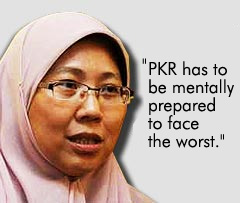 Fuziah:
PKR has to be mentally prepared to face the worst. Hence the choice of the deputy and vice-president must be given much thought.
Fuziah:
PKR has to be mentally prepared to face the worst. Hence the choice of the deputy and vice-president must be given much thought.
Members must choose someone who is right for the party, not someone who others tell them to choose, or who they like on the personal front, without looking into specific criteria.
What are your proposals to control/prevent leaders or members from party-hopping?
Sivarasa: In a repressive political situation as exists in Malaysia, this is wishful thinking, but in a new democratic Malaysia, I would advocate that if an elected representative chooses to change party, he or she must be required to vacate his seat and a by-election must ensue.
The elected representative can choose to run again if he or she wishes. The voters can then decide whether they agree or not with the decision to change party.
This means that Article 48 of the federal constitution must be amended to repeal the five-year ban on an elected representative running again for any seat.
Fuziah: (We can control it with) better candidate selection criteria, training and an accreditation programme for future candidates and training on political ideology and value-based politics, all of which (we) have started.
Nurul Izzah: We cannot control or prevent members from party-hopping. In the end, the voters will pass judgement on elected party-hoppers and the democractic process will take its course.
PKR is viewed as the weakest link in Pakatan Rakyat. To what extent do you think this perception is accurate?
Sivar
 asa:
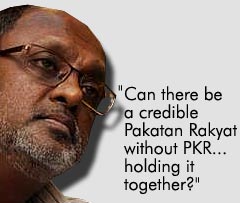
(It) is unjustified and unfair…in the light of what we have achieved in a relatively short time.Look at it another way - can there be a credible Pakatan Rakyat without PKR and Anwar in the middle holding it together? I don’t think so.
asa:
(It) is unjustified and unfair…in the light of what we have achieved in a relatively short time.Look at it another way - can there be a credible Pakatan Rakyat without PKR and Anwar in the middle holding it together? I don’t think so.
BN would continue to play them off against each other and argue that only BN as a so-called multiracial coalition could govern Malaysia.
Fuziah: There may be some truth in this perception. It may have been formed due to a record number of members and leaders who have hopped (to other parties), the lack of discipline that allows members to attack the party openly, and weak understanding and practice of political ideology.
Nurul Izzah: Yes, we have challenges, as in any other party. Umno had Umno Baru and then Semangat 46, while MCA had Gerakan.
Why are PKR members considered to be the least dependable of Pakatan parties in terms of discipline and machinery?
Sivarasa: I do not agree. If you are looking simply at the numbers of our elected members who have jumped ship, I accept that most of the recent ‘frogs’ are from us. But DAP and PAS have had their fair share as well in the past.
PAS lost senior leaders including a president (Asri Muda) and deputy president (Nakhaie Ahmad). DAP lost up to a third of its MPs after the 1969 general election and key leaders since then, from time to time.
(This) does not mean that they are weak or undisciplined (but is) an unfortunate consequence of the oppressive political reality of Malaysia. It affects all of us.
Fuziah: Party leaders must reward the disciplined and punish those who err instead of doing the opposite. Failing to practise this will cause the effects that we're seeing now.
Yahya: As a party, it is very reliable and most dependable in terms of the establishment of Pakatan, but I admit there are members whose discipline is questionable. PKR is still young and we are still struggling to produce quality members and leaders.
Will Pakatan Rakyat be able to take over Putrajaya in the 13th general election? What strategies would you suggest to win over the people?
Sivarasa: I am confident that Pakatan can form the next government. Our Common Policy Framework and our visible leadership in good governance and people-oriented policies in the four Pakatan-governed states are already resonating with the people.
We need to keep up the hard work of communicating our messages at all levels especially in a climate of hostile mainstream media.
Fuziah: The performance of Pakatan-led states will be pivotal to taking over Putrajaya, apart from common policies and strategies. (We should) share common best practice of good governance in Pakatan states to voters in other states and (focus on communication on) semi-urban and rural areas where Internet penetration is low.
 Nurul Izzah:
History is on the side of the righteous and change is around the corner.
Nurul Izzah:
History is on the side of the righteous and change is around the corner.
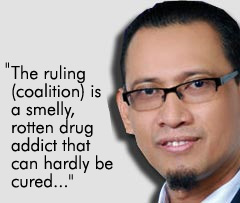
Yahya: Actually we don’t need a complicated strategy to win over the people right now. The ruling (coalition) is a smelly, rotten drug addict that can hardly be cured and can no longer be trusted. It is counting the days to its (demise).


Are you sure you want to delete this comment?
This action cannot be undone.