




Asri's Anwar critique under the lens
COMMENT A few months ago had it not been for Anwar Ibrahim, Islamic preacher Mohd Asri Zainul Abidin would have been baulked by faceless bureaucrats in the Penang state religious department.
The former Perlis mufti was invited by a mosque on the island to speak to the congregation after evening prayers. The state religious department shot a letter asking the mosque officials to explain why they had invited Mohd Asri...
COMMENT A few months ago had it not been for Anwar Ibrahim, Islamic preacher Mohd Asri Zainul Abidin would have been baulked by faceless bureaucrats in the Penang state religious department.
The former Perlis mufti was invited by a mosque on the island to speak to the congregation after evening prayers. The state religious department shot a letter asking the mosque officials to explain why they had invited Mohd Asri.
Prompted by Anwar, the Penang state executive councillor for religion, Abdul Malik Abul Kassim, intervened to see that Mohd Asri’s invitation was not withdrawn which would have been the case had mosque officials keeled over to departmental pressure.
No doubt the thinking at the department was that since Mohd Asri had already run into problems over his preaching in Selangor, Penang should err on the side of caution by drawing the shutters.
The episode sheds ironic light on Mohd Asri’s startling claim , posted on his blog earlier this week and highlighted by Utusan Malaysia, that Anwar is an impediment to the emergence of an effective opposition.
Mohd Asri does not substantiate the criticisms he levels at Anwar; he liberally sprays them in ad hominem argument that does little to embellish his intellectual credentials. He compounds his spurious reasoning with a disclaimer of any gains his takedown of Anwar would bring him.
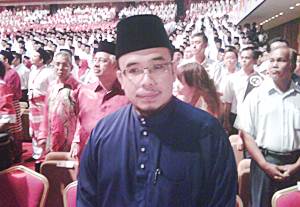 He is being disingenuous: Mohd Asri was seen at the recent Umno general assembly (
right
) and the timing of his criticism just days before the Batu Sapi and Galas by-elections is not inadvertent.
He is being disingenuous: Mohd Asri was seen at the recent Umno general assembly (
right
) and the timing of his criticism just days before the Batu Sapi and Galas by-elections is not inadvertent.
For a public intellectual attempting to carve a neutral corner from which to critique issues and players on the national stage, Mohd Asri just now appears none too anxious to sustain the stance of disinterested critic.
Courted by Umno
It’s no secret he is being ardently courted by Umno to enlist in their cause. His liberal instincts propel him towards the opposition parties but his courtship by Umno must be flattering to his ego.
The resulting ambivalence ought to have afforded him insight into the inner life of a leader he now criticises for allowing a burning desire to become prime minister to constrain his commitment to building a principled opposition.
Mohd Asri advises Anwar to retire; more importantly, that he be allowed to retire. He presumably means that the sodomy case against Anwar should be dropped in exchange, perhaps, for Anwar’s retirement from politics. If that is what he means, the disingenuousness of it all would be staggering.
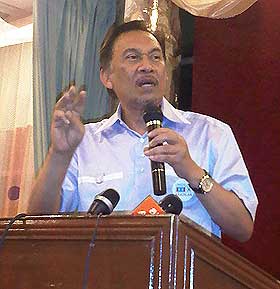 The travails of Anwar Ibrahim that began in the late 1990s gave birth to a movement for political change in Malaysia that is now unstoppable.
Asking him to step aside now would be like asking Morgan Tsvangirai to step aside after his long and valiant leadership of a struggle to free Zimbabwe from the despotic clutches of Robert Mugabe.
Furthermore, Anwar’s whole career is ineluctably bound up with what has become a world-historical issue: whether Islam is compatible with democracy. The world over Anwar Ibrahim is known as the political leader whose Islamic confession holds no contradiction to democratic theories of governance.
Because a resolution of this world-historical question is vital for the pacification and prosperity of polities from Damascus to Denpasar, taking Anwar out of the Malaysian political equation would be amputation.
We’ve just had Hillary Clinton in town where the US secretary of state urged Malaysia to be an Islamic thought leader . Pray, who is the Malaysian leader Mohd Asri thinks can best accomplish this?
Principal adhesive
Obviously the man who is the principal adhesive in a coalition in which you have an avowedly secular party (DAP) and a theocratic one (PAS), working together in an improbable alliance with Anwar’s party, PKR, holding the balance.
Now all this is not to say that Anwar is without faults of a disquieting kind. Mohd Asri speaks about “imbalances”, meaning Anwar’s penchant for thin and specious diagnoses than for viable prescriptions. But the more troubling imbalance would the one between the man’s image and his self.
The most devastating things that have been said about Anwar were not said by his political enemies but by people who worked closely with him for years. How to explain this?
Only the naive would try, for matters like these have to do with the mysteries of human nature, of an individual’s possession of a centre of self where the lights and shadows fall with a difference.
A cop-out analysis? Maybe, but this much is sure: had it not been for his refusal to go along in September 1998, something that cost him six years in jail and a near-death experience under ISA detention, the entrenched plutocracy that today is Umno’s bane would be that much harder to extirpate.
TERENCE NETTO has been a journalist for close on four decades. He likes the occupation because it puts him in contact with the eminent without being under the necessity to admire them.


Are you sure you want to delete this comment?
This action cannot be undone.