




Bloodbath at Rumah Bali and Rumah Busang
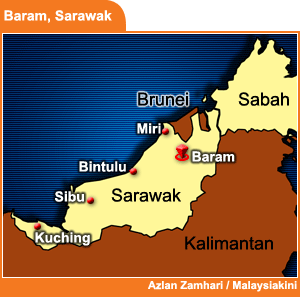
COMMENT Of all the conflicts over land in Sarawak, the bloodbath that broke out in Rumah Bali and Rumah Busang in Ulu Niah, midway between Miri and Bintulu, was the most violent.
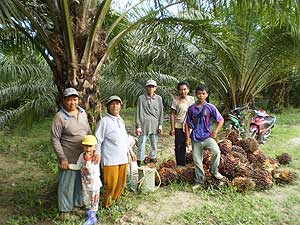
It all started the same way all other land disputes in Sarawak. Palm oil plantation projects in fertile areas of Sarawak are commonly implemented without consultation with the indigenous landowners.
COMMENT Of all the conflicts over land in Sarawak, the bloodbath that broke out in Rumah Bali and Rumah Busang in Ulu Niah, midway between Miri and Bintulu, was the most violent.
It all started the same way all other land disputes in Sarawak. Palm oil plantation projects in fertile areas of Sarawak are commonly implemented without consultation with the indigenous landowners.
There are very few channels for negotiations between the native landowners and the plantation firms. It would take only a small spark for a local conflict over land to blaze into the open.
This is what happened in Rumah Bali and Rumah Busang, two relatively small Iban longhouses.
The problems there were complicated by the introduction of strong-arm elements, brought in by the Chinese company. This company hired gangsters as part of their workforce, to implement company discipline among their workers.
 They were not sensitive to the ethnic and traditional sentiments of the native landowners. This was the perfect formula for an explosive disaster.
The strongarm elements of the plantation company had more than once resorted to the threats of violence against villagers, in an attempt to get the Iban natives off their land. There were quite a few instances of physical intimidation, threats with samurai swords, and beatings.
The native customs, offering miring or sacrifices, had also faced constant insults by the invaders. The thugs hired by the plantation company had desecrated the rice and other food laid out by the Iban villagers as offerings to the spirits they prayed to.
When pent up anger erupts
One morning on Sept 1, 1999, the simmering anger exploded out of hand. During a meeting between the village peoples and the plantation workers, violence broke out. When the dust had settled, four Chinese workers, thugs hired by the plantation company, lay dead, while four others ran helter-skelter into the jungle.
Soon enough, the police were all over the plantation and the adjacent longhouses. They arrested 19 of the villagers from the two longhouses. Fortunately, the violence did not escalate with the arrest of the 19 Iban, and everybody heaved a huge sigh of relief.
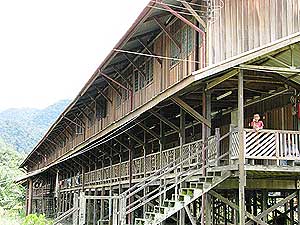
 Shortly after the violent clash between the Kampung Busang and Kampung Bali villagers and the plantation workers, the village elders organised a Gawai Kelingkang at their longhouse, a celebration and offering in support of the arrested villagers.
I was invited to attend the Gawai, together with many village chiefs and elders from surrounding longhouses. I turned up at the doorstep of the Rumah Busang longhouse on the appointed date, to give my moral support to the villagers as well.
According to the local people, this Gawai Kelingkang had been a nearly lost tradition, and the one organised by the villagers of Rumah Busang and Rumah Bali was the first in living memory. It was a particularly bloody ritual sacrifice, but I shall spare you the gory details.
Since most of the adult men in the two villagers had been arrested, the Gawai Kelingkang ceremony was officiated by women, in particular by Elam Busang, the daughter of Tuai Rumah Busang, the village chief of Rumah Busang.
Though Elam was a young lady, she had the personality and bearing of a born leader, and conducted herself with great dignity. The Gawai Kelingkang became a resounding success despite the small number of adult menfolk among those present.
A
 s the Gawai rituals and speeches progressed, I noticed a strange phenomenon in Rumah Bali and Rumah Busang. All the adults and older children spoke Mandarin perfectly.
Apparently, the schools they had attended were Chinese schools, and Mandarin had become a lingua franca even among the Iban villagers themselves.
Dark cloud over longhouses
During the Gawai, I could sense great tension in the air. The arrests of the 19 villagers, aged between 17 and 76, were a major crisis. The longhouses required their manpower on the farms every day.
 The charge of murder or manslaughter also hung heavily over their heads. They lived through many months of uncertain existence, amidst disruption to their normal way of life.
Eventually, only the oldest detainee, Jalen Anton, was charged, having signed a confession, although he could not read or write English or Malay, and suffered from cataract.
Jalen spent seven years in jail. Eight months after he was arrested, Jalen's wife died in the longhouse, but his appeal to attend her funeral was turned down by the authorities.
No other villagers from the two kampungs were charged.
Looking back at the incident in Kampung Bali and Kampung Busang, I am glad that the incident did not trigger widespread violence. The death of the gangsters was regretted, and I wish the incident had not been as violent as it was.
 The loss of human life is always to be regretted. I hope the other gangsters learned their lesson well.
But the clashes between the native people in Sarawak and the companies that are invading large tracts of farming land, have continued unabated down through the years.
The fault lies as much with the lack of protection for the native customary rights over the land ownership, as with the absence of a comprehensive and equitable land development programme to provide land and sustainable income to the needy.
As long as these two structural problems exist, the saga of the struggle for land in Sarawak will continue.
SIM KWANG YANG was member of parliament for Bandar Kuching, Sarawak from 1982 to 1995. He can be reached at sky8hornbill@gmail.com. All comments are welcomed.


Are you sure you want to delete this comment?
This action cannot be undone.