




ETP goals too distant for East M'sia
Sabah and Sarawak will not be able to reach the USD15,000 (app. RM47,333) per capita income target under the Economic Transformation Plan (ETP), so long as nothing is done to manage the imbalance in regional development in Malaysia.
Sabah and Sarawak will not be able to reach the USD15,000 (RM47,333) per capita income target under the Economic Transformation Plan (ETP), so long as nothing is done to manage the imbalance in regional development in Malaysia.
Pang Teck Wai, the chief executive officer of POIC Sabah Sdn Bhd, said both states face "major physical infrastructure problems" that contribute to a much higher cost of doing business compared to the Peninsula.
POIC was set up by the Sabah state government to spearhead palm oil downstream processing, and create jobs and business opportunities.
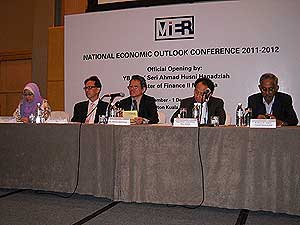
"The cost of doing business in Sabah is about 35 to 40 percent higher than in the Peninsula, while in Sarawak it is about 15 percent higher," he said when speaking as a panellist at the National Economic Outlook Conference 2011-2012 yesterday.
 Pang pointed out that there is currently "not much" attention on the issue of imbalance in regional development between East and West Malaysia under the ETP, leaving a major obstacle in attracting investment into the country's two largest states.
Discussing the topic of ‘Malaysia's Economic Transformation Going Forward', he noted that 65 percent of imports in Sabah come from the Peninsula, adding that the disparity in prices between the two regions is only getting wider.
"The FDI going in (Sabah) is a lot lesser than more developed states. We pay 35 percent more (to do business) so how can we expect investors to come in, or at least get all the states to mobilise private sector investment to reach the USD15,000 per capita income target?
"Currently the per capita income in Sabah is around USD4,000... Sabah and Sarawak will not be able to reach the USD15,000 target," he said, referring to the ETP's objective of achieving the five-figure per capita income by 2020.
ETP, economic plans too ‘Klang Valley-centric'
Another panellist in the discussion, Wilson Baya Dandot, said development policies set at national level seem too "Klang Valley-centric", particularly in terms of infrastructure.
 The chief executive officer of the Regional Corridor Development Authority (Recoda) Sarawak said the 10th Malaysia Plan (10MP), for example, only set aside a "minimal" amount for infrastructure development in East Malaysia, despite the critical need for better infrastructure in both Sabah and Sarawak.
Wilson stressed that diversification of investments, which is needed to boost per capita income in both states, will only come if money is pumped in to develop infrastructure.
He also urged policy makers, particularly in the context of the ETP, to consider revamping the tertiary education courses and modules for skills and vocational training.
Recounting his visits to several Industrial Training Institute (ILP) campuses in Sarawak, Wilson said the courses and modules offered were too "generic" and were not up to date.
He told the audience of his visit to the automotive training faculty at one of the campuses, where he came across a stripped down Proton that the lecturer said was used to train students how to put a car together.
 "I said that I know government departments have Mercedes (cars), some people have Jaguars; the rich people also have BMWs. So I asked them, ‘can I send the Mercedes from the government to your ILPs to fix?'
"Their answer was, ‘sorry sir, no. We're not ready to fix or repair Mercedes or BMWs', (because) it's all electronic gadgets... are we teaching the right things?," he asked in terms of producing a workforce that is ready to face present day and future challenges.
The panel discussion was the last item of the two-day conference organised by the Malaysian Institute of Economic Research at the Hilton Hotel Kuala Lumpur.
The two other panellists in the discussion were Prof Ahmad Zubaidi Baharumshah of the Faculty of Economics and Management, Universiti Putra Malaysia; and Prof Rugayah Mohamed, a deputy vice-chancellor at Universiti Tun Hussein Onn in charge of research and innovation.


Are you sure you want to delete this comment?
This action cannot be undone.