




'NEM-2 forgettable, hopeless and meaningless'
Three years down the road, muses Petaling Jaya Utara parliamentarian Tony Pua, no one will remember what the New Economic Model (NEM) is all about.
Three years down the road, muses Petaling Jaya Utara parliamentarian Tony Pua, no one will remember what the New Economic Model (NEM) is all about.
"It is a tremendous disappointment, a document riddled with contradictions, which is hopeless and meaningless," was how Pua described Prime Minister Najib Abdul Razak's much-touted policy in an interview with Malaysiakini.
This, he said, was because the NEM was no different from the New Economic Policy (NEP) and the policies implemented by the BN-led federal government before this.
"It is going to become like the National Vision Policy or the National Development Policy, where no one actually knows what these are. Nothing changed, (they are) a direct continuation of the NEP that should have ended," said the DAP leader.
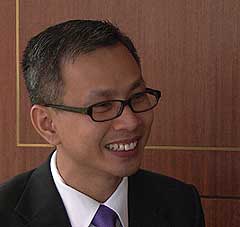 Asked if the newly-announced policy would have an impact on the future of the Malaysian economy, Pua (
left
) said that despite the excitement raised, the NEM and the other collective polices announced by Najib and his government wouldn't put a dent on anything.
Asked if the newly-announced policy would have an impact on the future of the Malaysian economy, Pua (
left
) said that despite the excitement raised, the NEM and the other collective polices announced by Najib and his government wouldn't put a dent on anything.
"They don't, really. I mean, after reading all the documents produced by the government, the GTP in December last year, NEM part 1 in March, 10MP in June, the budget in October and now the NEM part 2 ."
"If you read all these documents, not one of them seems to play a major guiding role on government policy," lamented the Oxford University graduate.
An ill-fitting jigsaw
What the documents paint, he believes, is that the government is conducting "business as usual". For this, he largely blamed ministerial ignorance and public service inertia.
"No one reads them. Ministers don't know what's in them. The clearest example is from Deputy Prime Minister Muhyiddin Yassin ( below, right ), who does not know the meaning of 1Malaysia that was stated in the GTP."
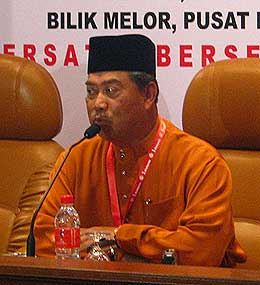 "Oh! It was inside, ah?" mimicked Pua, recounting what he described as the type of reaction he often sees from ministers, who he believes never read these documents.
"To the civil servants, who know that their bosses don't read them, it is better to stay on with the existing old policies," said Pua, adding that these were like parts of an imperfect jigsaw, with the prequel and the sequel trying to jive with each other.
"I think they didn't even want to do a part 2. I think they already wanted to give up on the NEM but unfortunately, you cannot have part 1 without the concluding part... you will become the butt of jokes. So they had to come up with part 2."
"But at the same time, part 2 has to be different from part 1, because of opposition from the different Malay rights groups, such as Perkasa," he sniped.
This, Pua argued, led to the discrepancies in the two supposedly paired documents.
GLCs crowding out private sector
"(NEM) Part 1 says affirmative action should not be target-based or quota-based. But... (NEM) Part 2 says bumiputera rights are back ."
"They have a lot of polices that are nice sounding in there; for
 example, that GLCs should play a secondary role to the private sector. But all the biggest projects are given to the GLCs, such as Sungai Buloh, Sungai Besi and Jalan Cochrane," he argued.
Questioning the special reservations, Pua wondered why the government was sending out the signal that GLCs would play a secondary role to the private sector, and yet awarding all the juiciest projects and juicy parcels of land to the government-linked companies.
He believes the recent purchase of 10 hectares of prime land in Singapore for US$1.7 billion (RM5.33 billion) by the Hong Leong Group-linked Guocoland, proved that GLCs were crowding out private sector investment in Malaysia.
"Or rather, there's nothing on that juicy scale for the private sector to be interested in. They have to go out of the country, they have to take money out of the country," he reasoned.
Other than the over-prominence of the GLCs and the sudden return of the bumiputera quota, Pua said, Najib's attempts to reform the civil service were just an echo of what former Prime Minister Abdullah Ahmad Badawi had done in his time.


Are you sure you want to delete this comment?
This action cannot be undone.