




Women's groups seem afraid to raise their voices
As much as it pains women's groups to note the media's sexist portrayal of women, the fact remains that while the press is to be blamed for its gender-insensitive attitude in reporting news, equal if not more blame must be shared by the women's groups in this country for being passive and letting government agencies which humiliate women, off the hook.
COMMENT As much as it pains women's groups to note the media's sexist portrayal of women, the fact remains that while the press is to be blamed for its gender-insensitive attitude in reporting news, equal if not more blame must be shared by the women's groups in this country for being passive and letting government agencies which humiliate women, off the hook.
 One such agency that got away unscathed is the labour department. In 2009, its director-general Ismail Abdul Rahim in 2009 ridiculed the need for a Sexual Harassment Act, saying having such a legislation "could lead to a dull and rigid environment in the workplace".
Obviously Ismail doesn't cares two hoots about respecting women, as proven by his words.
A shame that he is ignorant that Malaysia is a signatory to the Convention on the Elimination of All Forms of Discrimination Against Women (Cedaw).
It seems that Ismail has zero knowledge that in 1995 a commitment was made to safeguard women's dignity at the Beijing Platform for Action at the United Nations Fourth World Conference on Women.
One of the vows was to remove legal obstacles and gender discriminatory practice.
While Ismail is foolish, what is even more frustrating was that there was not a single murmur from women's groups objecting to such an uncouth and sexist remark, except for a statement by Women's Centre for Change on its website lamenting Ismail's remark.
A women's organisation true to its cause would have marched up to Ismail's office and demanded that he retract his statement and make no such sexist utterances in future.
But that never happened. And it is precisely because women's groups have failed to take chauvinists like Ismail to task that has caused the likes of him to insult women and ridicule women's rights time and again.
Ismail's turbid mind thinks sexual harassment adds spice to work life. It is such a shame that the women's groups remained silent over such an insult and that too from a government servant.
Obviously Prime Minister Najib Abdul Razak's propaganda slogan 'People First Performance Now' is just that - a gimmick to win public votes.
This tagline is least respected by the civil servants as seen from Ismail's ineffectiveness in serving as the labour department director-general.
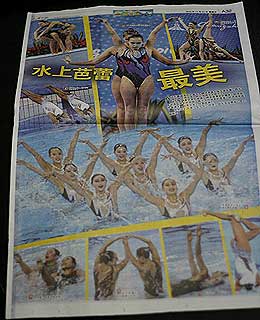 Recently, women's organisation All Women's Action Society (AWAM) in a letter to
Malaysiakini
lamented the sexist portrayal of Malaysia's female swimmers by a Chinese newspaper, the Mandarin-daily
Kwong Wat Yit Poh
.
Recently, women's organisation All Women's Action Society (AWAM) in a letter to
Malaysiakini
lamented the sexist portrayal of Malaysia's female swimmers by a Chinese newspaper, the Mandarin-daily
Kwong Wat Yit Poh
.
This newspaper's Oct 21 issue had in its coverage of a synchronised swimming competition during the recently concluded 16th Asian Games a caption that read "makes you unable to restrain yourself" in reference to the picture of the swimmers in action.
A loaded caption, the intention being all too obvious.
Mainstream media the culprit
But the fight here is not and should not be with just one newspaper. Be it the print or broadcast media, both are culprits in the way they 'use' women to sell their newspapers or channels.
In the case of the television stations, they unashamedly grab advertisements that send out only one message to viewers, which is that women are nothing but sex objects.
One example of this is the Super Power coffee advertisement where the husband runs seeking help from a genie asking for 'power' to perform. The next round he brings his wife along for the same reason.
Then there is the Orang Kampung Kacip Fatimah advertisement where the husband is impatient to get home from office and join his wife in bed who minutes before his return had consumed a drink containing Kacip Fatimah.
There are various other coffee advertisements which sadly have prostituted the herb Kacip Fatimah for only one purpose - to enhance a women's sexual prowess.
An advertisement by Ombak Besar promoting bigger breasts for women further confirms that a woman's worth is measured solely on her sex appeal, giving rise to the ‘all looks no brains' stigma.
The issue here is why are such advertisements bearing obviously lewd messages being aired?
One reason is that the sexist mentality is so deep rooted in the minds of those in the media business that they are lost to the cause of women's rights including respect for women.
 A look at the perfume advertisements both on television and in magazines shows how big a ‘role' women play in selling these products.
Why, even our Malaysia Airlines and the low-cost carrier Air Asia cannot do without their respective air stewardessess being in the picture each time a new fare in flight or a new desination is announced. Whatever happened to the male stewards?
Sex sells, as an editor once told me and it appears there is very little the mainstream media is going to do to change that notion. It is until and unless the women's groups in this country object to such portrayal of women by way of public protest, advertisements manipulating women are here to stay.
Action speaks louder than words
Change will not happen by merely writing letters to the editors. The women's groups must not forget their reason d'etre ; instead of penning down their frustrations, the women's groups must do what their existence calls for - organise protests to display their annoyance over sexist statements.
In the case of Labour Department director-general Ismail, women's groups should have marched up to his office to caution him to treat women with respect. Women are not objects of ridicule, as Ismail has made it out to be.
To squarely blame the media for the lopsided reporting is not going to help improve matters. Women's groups must continue educating the editors and reporters on issues concerning gender senstivity and the correct use of terms, for instance, it's a rape 'survivor' and not a rape 'victim'.
Also, there must be no ‘bureaucracy' between the media and the women's groups when it comes to giving and asking for comments to an issue.
After all, both the media and the women's groups are agents of change and it would serve the people well if a smart partnership is forged between the media and the women's organisations to help the latter further the cause of women in this country.
Not a priority
There is no denying that the mainstream media is plagued by the 'seasonal' reporting disease, highlighting women's issues only when a tragedy has occured.
Yes, it is true too that it is not a priority for the media to highlight women's concerns on a regular basis as issues like rape, sexual harassment, marital rape, polygamy and portrayal of women as sex objects are seen as 'heavy' topics by media organisations.
 When former minister Jamaluddin Jarjis was accused of sexual harassment by a bar waitress what did the women's groups do? Nothing. In less than 24 hours the waitress withdrew her statutory declaration saying she was "used" to Jamaluddin's "rough way" and jokes.
Why was there no hue and cry over this issue as far as the women's groups were concerned? Was what Jamaluddin did a venial act?
To pick and choose issues over which to protest belittles the existence of a women's group; there is absolutely no room for them to play pharisee.
As for the 'powers that be', they cannot hold the women's groups at ransom for engaging in protests to display their unhappiness over the gender discrimination taking place in this country.
To blacklist a women's group or an activist because of their show of displeasure against a government policy or remark is a childish act, unbecoming of a nation that practices democracy.
Marching down the streets to send the message across that women are as deserving of respect as men is not a crime. Taking to the streets or marching up to the relevant government department to display their annoyance with uncouth and chauvinistic mindsets is the right of a women's groups and it must be exercised as much as possible; this is the only way women's rights in a patriachal country like Malaysia will be taken seriously.
Sexist and chauvinistic minds abound
There is much for the women's groups to do to change the chauvinistic mindsets so prevalent. And one way of doing this is by keeping vigil over the statements made by politicians and dialogue uttered by actors in local dramas.
A recent Malay movie 'Cuti-cuti Cinta' directed by actor-turned-director Ahmad Idham had a line that went "ni apa, nasi lemak 50 sen" uttered by the hero (played by Farid Kamil) while pointing to the heroine's (Nora Danish) breast.
 How was it that such a dialogue went uncensored but the slight sight of Sharifah Amani's (
left
) belly button in the Anugerah Skrin 2010 nominated drama 'Dalil Cinta' aied by TV3 on Nov 28 was blurred?
How was it that such a dialogue went uncensored but the slight sight of Sharifah Amani's (
left
) belly button in the Anugerah Skrin 2010 nominated drama 'Dalil Cinta' aied by TV3 on Nov 28 was blurred?
Serious business would call for the women's groups to walk up to Ahmad Idham's office in a show of protest over such sexist dialogue.
But that never happened. And this is not the first time a Malay movie has ridiculed women. There have been movies or dramas that have made fun of traumatising issues like rape.
If no action is taken by the women's groups, such dialogue will become a common feature in movies and dramas and issues so damaging like rape will no longer receive due ‘respect'.
It is noted that the women's groups have their hands full dealing with the issues like amendments to the Penal Code on rape laws, tackling conversion issues and looking at ways to empower women but all this will only be good if first and foremost, the male chauvinist pigs (MCPs) in Malaysia be they the politicians, ministers, editors of mainstream media and owners of television stations are educated and their sexist mentality tackled.
It is hoped that the coming new year will bring with it renewed zest for the women's groups in championing women's rights and taking to task all those MCP's, especially the rodomontade VIP MCPs - do not give them the carte blanche to treat women as they please.
JESWAN KAUR is a journalist who spent many years writing for the mainstream media before deciding to 'break free' and put pen to paper to focus on and fight for issues that are conveniently marginalised by the powers-that-be.


Are you sure you want to delete this comment?
This action cannot be undone.