




Ban on non-Muslim Syarie lawyers is 'non-binding'
The National Fatwa Council’s decision to bar non-Muslim lawyers from practising in the Syariah Courts has no legal effect as Islam is a matter for the states, contends constitutional law expert Abdul Aziz Bari.
The National Fatwa Council’s decision to bar non-Muslim lawyers from practising in the Syariah Courts has no legal effect as Islam is a matter for the states, contends constitutional law expert Abdul Aziz Bari.
"As such, it is not binding on the states and they may adopt different ways of dealing with the matter," Abdul Aziz told Malaysiakini .
In any case, said the International Islamic University Malaysia (IIUM) lecturer, the ruling is retrogressive and not in line with the move towards enhancing the position of the Syariah Courts.
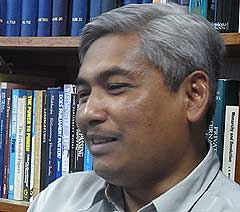 "It smacks of exclusivity and does not underline the universal and humanistic character of Islam. A more inclusive approach should have been taken by the council," argued Abdul Aziz (
right
).
"It smacks of exclusivity and does not underline the universal and humanistic character of Islam. A more inclusive approach should have been taken by the council," argued Abdul Aziz (
right
).
The law professor said he believes the council's argument about non-Muslims lawyers having insufficient knowledge of Islam is debatable, as this can be dealt with through the undertaking of courses and even postgraduate diplomas, something which he said universities like IIUM have been doing for years.
"One must also accept that if the worry is about ignorance of Islam and Islamic law, the same actually applies to Muslims as well. Obviously, not all Muslims are learned in Islam."
Spectre of contempt
The lecturer also expressed disbelief that the council would cite the spectre of contempt in its reasoning.
To him, the possibility that contempt would be committed by non-Muslim lawyers was a small matter, whereas the council had overlooked the bigger and more noble objectives of Islam.
"Lawyers did not do that (commit contempt) on purpose, and it actually is not a serious problem. Thus, it is highly inappropriate for the council to use it as a ground to bar non-Muslims from appearing in the Syariah Courts."
The Fatwa Committee of the National Council recently ruled against accepting the appointment of non-Muslims as Syarie lawyers.
 The decision received the
support
of Minister in the Prime Minister's Department Jamil Khir Baharom who said that it was appropriate and should be accepted.
The decision received the
support
of Minister in the Prime Minister's Department Jamil Khir Baharom who said that it was appropriate and should be accepted.
"To be a Syarie lawyer, a person has to have in-depth knowledge and understanding of Islam to be able to handle Syariah cases properly," said Jamil Khir ( right ).
He added that it would create problems if non-Muslims were allowed to become Syarie lawyers because action could not be taken against them if they were found to be in contempt of court, as Syariah law is only enforceable on Muslims.


Are you sure you want to delete this comment?
This action cannot be undone.