




Message from the Middle East
COMMENT After three decades, the government of Hosni Mubarak of Egypt has come to an ignominious end.
Despite the many warning signs in the shape of high unemployment, rampant police brutality, the indignity of rigged elections, a restless youthful population (two-thirds of Egyptians are under 30) and spiralling food prices, the government did not seek to stay ahead of the game by reforming its political system. In fact Mubarak did not make plans to hand over power except perhaps to his son and key allies.
COMMENT After three decades, the government of Hosni Mubarak of Egypt has come to an ignominious end.
Despite the many warning signs in the shape of high unemployment, rampant police brutality, the indignity of rigged elections, a restless youthful population (two-thirds of Egyptians are under 30) and spiralling food prices, the government did not seek to stay ahead of the game by reforming its political system. In fact Mubarak did not make plans to hand over power except perhaps to his son and key allies.
As a result, a spark in the form of police brutality against Khaled Saad in Alexandria and the successful uprising in Tunisia, started a revolution that swept away Mubarak.
Interestingl
 y, support and strategy for the street protests were galvanized through the social networking tool Facebook, which allowed me to stay in touch with developments on the ground.
The well-planned street protests stretched the security apparatus of the Egyptian police and removed fear from the hearts of ordinary Egyptians. Eighteen days later, Mubarak finally resigned bringing an end to years of corruption, repression and autocratic rule.
The US, which has long propped up the Mubarak government and which has created a debacle for itself in Iraq, is now facing the same dilemma that the UK and France did some 50 years ago.
Like those two older European powers, the US will now have to adjust to a multi-polar world where it can no longer dictate but must instead win hearts and minds. With Tunisia and now Egypt having gotten rid of their respective strongmen, the entire Middle East can finally emerge from under the shadow of the West.
What lessons can we draw from the Tunisian and Egyptian examples? How can Malaysia keep one step ahead of the kind of regime change that happened in the Middle East in the last two months?
We must firs
 t begin by identifying the problem and it is a word that begins with the letter ‘g’. Government, which is supposed to solve problems, is the biggest problem. Although the premier Najib Abdul Razak has announced a slew of reforms and is himself quite committed to those reforms, like his predecessors, it is the implementation of those reforms that will decide his fate.
Former premier Dr Mahathir Mohamad recently admitted that the poor implementation of the New Economic Policy was to blame for the socio-economic situation of the Malays today. If he could do it again, he said, he would put devote more attention to making sure ethnic relations were better managed.
His handpicked successor Abdullah Ahmad Badawi introduced a slew of reforms that shone the light on corruption and the need to invest in people instead of only on building new cities. Najib promises a future where Malaysians earn high incomes and development will be equitable. But can the government deliver on all these promises and good intentions?
Direct communication
There are three chief lessons we can learn from Egypt and the voices calling for reforms in the Middle East. Firstly, despite what Rais Yatim thinks, we are all of us globalised individuals.
In the 1930s, when mass entertainment came to Malaya in the form of moving pictures, it was reported in the Straits Echo that our European masters felt the movies were degrading. Seeing Asian men leering at white starlets on the silver screen was too much for them.
 In the 1950s, when Southeast Asia began to break free of the chains of colonial rule, organisations like RTM began to define our own ‘national culture’. Malaysians will remember fondly the patriotic songs that the late Mohammad Rahmat made us all sing in schools.
But television, which became a tool of mass popular culture in the 1970s, meant that Malaysians who could afford it, had access to different types of cultures whilst Tok Mat was cutting the hair of Malaysian pop stars. Those of us in our thirties grew up watching ‘Little House on the Praire’, ‘Dallas’ and ‘Remington Steel’. But what is truly fascinating is that so did all our peers all over the world.
By the 1990s, shoulde
 r pads were out but the Internet allowed us to connect directly with people all over the world and the connections were easy to make because we all shared very similar opinions and tastes. Popular culture was truly global. This means that the aspirations of most young people are the same the world over. The so-called fight against ‘yellow culture’
(budaya kuning)
was lost decades ago.
r pads were out but the Internet allowed us to connect directly with people all over the world and the connections were easy to make because we all shared very similar opinions and tastes. Popular culture was truly global. This means that the aspirations of most young people are the same the world over. The so-called fight against ‘yellow culture’
(budaya kuning)
was lost decades ago.
With Internet penetration on the rise and very rapidly, the government must begin to heed this first crucial lesson from the Middle East: most of your citizens can no longer accept the fact that there are one set of standards of equality, justice and what constitutes good governance for them because they are in a ‘developing country’. They want developed world standards of service, infrastructure and social justice; and they want it now!
The second point is a lesson in economics. In both Tunisia and Egypt, young men and women are relatively well educated but have little social and economic mobility. This was also a major concern during the colonial period. What are we to do with all the people we educate?
That was why our parents’ generation had to pass exams at the end of every school year; if they failed, they had to re-sit the whole year. If they failed twice, they were out. Eventually, even this strategy was a mere stop-gap measure and the only way was to allow self-government.
 Today, in Malaysia, tertiary education is seen as a natural right. Can the economy grow in a fashion that graduates will be gainfully employed? What about the not-so-clever ones? If we are to beef up our manufacturing sector, which is one of our biggest source of employment, can we attract the talent we require to do innovative work that will lead to higher levels of production?
How long more can the civil service be the repository for the unemployable? The more such people are recruited the more inefficient the government becomes. It is a vicious cycle, the result is that government policies cannot get implemented and/or are resisted.
In most developed countries, the best brains are in government, the universities and the civil service. If the government does not resolve the employment issue seriously and with single-minded political will, Malaysia will face the problems that plague the Arab countries today.
Party politics ineffective
The third and final lesson has to do with hubris. Politicians and the ‘inner circle’ tend to become ossified without any real political challenge over a long time. They begin to think they can get away with everything. Some do not even bother to cover their tracks.
In Malaysia, both sides of the political divide tend to think that party politics is everything and they operate in the framework of party politics.
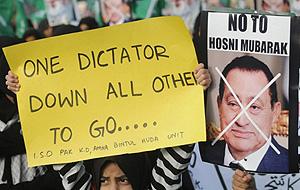 What happened in Egypt and Tunisia has shown that party politics is not everything if the situation is so bad that citizens begin to take things into their own hands. And with the technology to enable them to channel their frustrations into organised protests, governments can fall.
The Mubarak government was many times more repressive than the Malaysian one, but all governments have the potential to be brutal and oppressive. But in a globalised world, it is hard for them to send in the tanks to kill and crush their own citizens with impunity. More importantly, an Internet-driven revolution has little need for opposition parties.
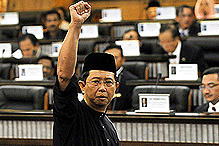 In Malaysia, the government is still putting a lot of attention on monitoring and controlling the activities of its political rivals. But the power grab in Perak; Selangor’s protests over the appointment of its state secretary; and a slew of by-election campaigns have shown how ineffective party politics are in recognising and solving both day-to-day as well as systemic problems.
These three lessons should not make the government nervous about citizens but should instead inspire it to work harder to stay in the game. For the opposition, the writing is also on the wall. Come up with the goods or face irrelevance.
Postscript: The author would like to acknowledge and thank his two friends in Egypt Ms Rasha Arous in Cairo and Professor Wessam Elmeligi in Alexandria for their brave and courageous efforts in recent days. Through Facebook, we kept in touch with the news as it was happening on the ground. May Egypt now find the will to make the best of the change it has achieved.
NEIL KHOR completed his PhD at Cambridge University and now writes occasionally on matters that he thinks requires better historical treatment. He is quietly optimistic about Malaysia's future.


Are you sure you want to delete this comment?
This action cannot be undone.